

Hey, Prasad here 👋 I’m the voice behind the weekly newsletter “Big Tech Careers.”
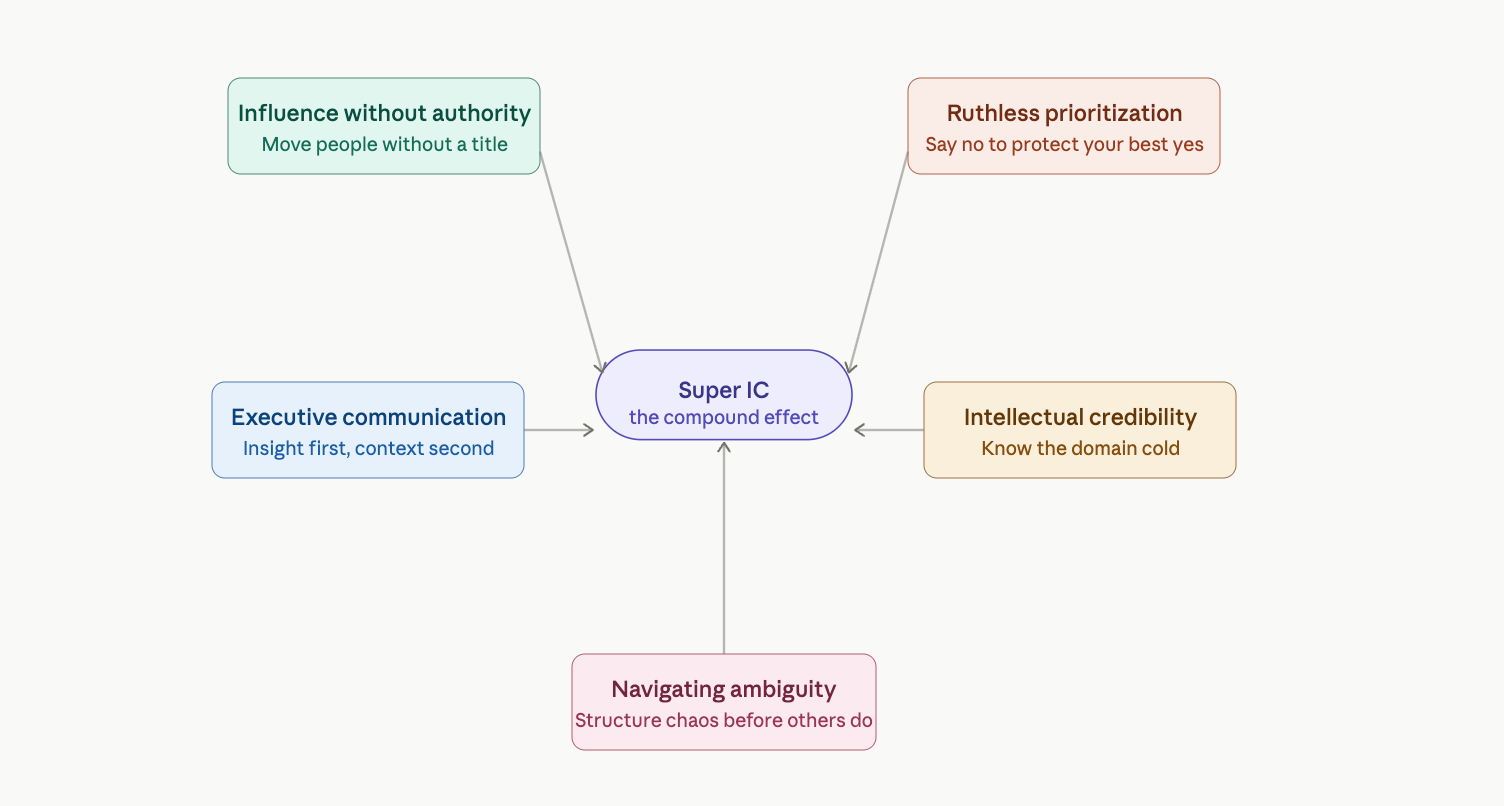
In this week’s article, I share 5 soft skills that will help you become a super Individual Contributor (IC).
If you enjoy this article, click the ❤️ icon — it helps me know what content resonates with you.
Your technical skills get you in the room. Your soft skills determine what happens once you are there.
I have watched incredibly sharp professionals get passed over for promotions. I have seen people struggle to get their ideas adopted even when their ideas were clearly right. I have seen others spin their wheels on the wrong work, delivering good output that nobody asked for.
In almost every case, the gap was not technical ability. It was something else. It’s the soft skills that consistently separate good ICs from super ICs.
These are not the fluffy skills. These are real, learnable skills and directly tied to your impact and your career trajectory.
Let’s get into them.
1. Influence without authority
This is the defining skill of a great IC.
You cannot mandate anything. You do not have direct reports. You cannot order anyone to do what you think is right. Your only lever is your ability to make people want to move in your direction.
Most ICs try to win arguments through logic alone. And logic helps. But influence is built over time through a combination of track record, clarity of thinking, and knowing when to push hard versus when to plant a seed and let it grow.
The ICs who are genuinely influential tend to do a few things well. They frame problems in a way that makes others feel seen. They invest in understanding what motivates different stakeholders before they start advocating. They pick their battles carefully, which means when they do push, people listen.
If you are finding that your ideas get adopted less often than they should, this is the skill to look at first.
The question to ask yourself: When I last tried to move something forward and it stalled, was it a logic problem or an influence problem?
2. Ruthless prioritization
This one is invisible until it goes wrong.
Nobody tells you what to drop. At senior IC level, your calendar will always have more in it than you can execute well. The ability to choose what not to do is just as important as the ability to do things well.
I see a lot of ICs fall into a trap here. They are hardworking, they respond to every request, they say yes to everything because they want to be helpful. And then they spread themselves so thin that nothing they do is truly excellent.
Super ICs have a clear answer to the question “what is the most important thing I can do?” They protect that work fiercely. They are not rude about saying no, but they are clear.
Doing five things adequately will always be less impressive than doing two things memorably. Promotions and recognition go to people whose names are attached to outcomes, not to people who were involved in a lot of things.
The question to ask yourself: If I could only complete two things this quarter, which two would create the most impact? Am I actually spending my time on those?
3. Executive communication
Most ICs communicate the way they think, which is from context to conclusion.
They start with the background, explain the problem, walk through the options considered, and eventually land on the recommendation. This works well in a design document. It does not work well in a 15-minute meeting with a VP.
Executives think the opposite way. They want the conclusion first, and they will ask for context only if they need it.
Super ICs learn to flip their communication style. One sentence on what they are recommending. One sentence on why it matters. Then they stop and open the floor. Context is available on request.
This is not about being less thorough. It is about respecting that senior stakeholders are context-switching constantly and need to quickly understand where to focus their attention.
The practical shift is simple. Before any meeting or written update, ask yourself: if I had 60 seconds and nothing else, what is the one thing this person needs to hear?
Start there.
The question to ask yourself: Am I leading with the insight or leading with the journey?
4. Intellectual credibility
Intellectual credibility means people trust your judgment specifically because you consistently know more than they expected, ask the questions nobody else thought to ask, and connect dots across domains.
In a world where AI tools are accelerating the pace of change, this matters more than ever. Everyone can now produce a decent answer quickly. What distinguishes super ICs is that they are genuinely ahead of the room, not just broadly informed.
Intellectual credibility compounds. Once people know you are the signal in the noise, they bring their hardest problems to you. That access creates more opportunities to have impact, which builds more credibility.
How do you build it? Deep work. Staying close to the frontier of your domain. Being honest about what you do not know. And following through when you say you will come back with an answer.
The question to ask yourself: When someone in my organization has a hard problem in my area, am I the person they think of?
5. Navigating ambiguity
This is the one that most clearly separates good ICs from super ICs.
Most professionals are comfortable executing against clear requirements. They wait for clarity before they move. At senior levels, clarity often does not come. The situation is genuinely complex, the requirements are incomplete, and the stakeholders have conflicting views.
Super ICs do not wait. They impose structure on the ambiguity themselves.
This means writing the draft definition of the problem when nobody else has. It means calling out the assumptions being made and asking whether they are correct. It means moving the conversation forward even when the answer is not yet known.
This skill matters because ambiguity is expensive. Every week a problem sits undefined is a week of delayed progress. The IC who steps in and makes the ambiguity legible is creating real organizational value.
You do not need to have the answer. You need to be the person who makes the question clearer.
The question to ask yourself: When I encounter an ambiguous situation, is my instinct to clarify it or to wait for someone else to clarify it?
How these five skills compound
Here is the thing about these skills. They do not just add up. They multiply.
When you have intellectual credibility, your influence without authority becomes much more effective. When you communicate like an executive, your prioritization choices get more buy-in. When you navigate ambiguity well, you create the conditions for everyone else to be more effective.
Super ICs are not superhuman. They are just consistently good at these five things, and the compounding effect over time is significant.
The good news is that every one of these skills is learnable. They are not personality traits. They are behaviors, and behaviors can be practiced.
Pick the one where the gap is biggest for you right now. Work on that first.
Strong list. The 2026 wrinkle I'd add from the data: soft skills decide who gets heard, but they no longer decide who gets repriced. EY's Future of Pay 2026 puts India Inc's average hike near 9.1%, while AI and platform-depth ICs pull 30-40% in the same band, so the super-ICs I see in career conversations aren't the best communicators, they are the ones who own one hard problem end to end and then use these skills to make that ownership legible. Communication amplifies depth, it does not substitute for it. When the room is full of equally articulate people, which of these five actually separates them?
Zia. AI career strategist for Indian professionals. itszia.ai