

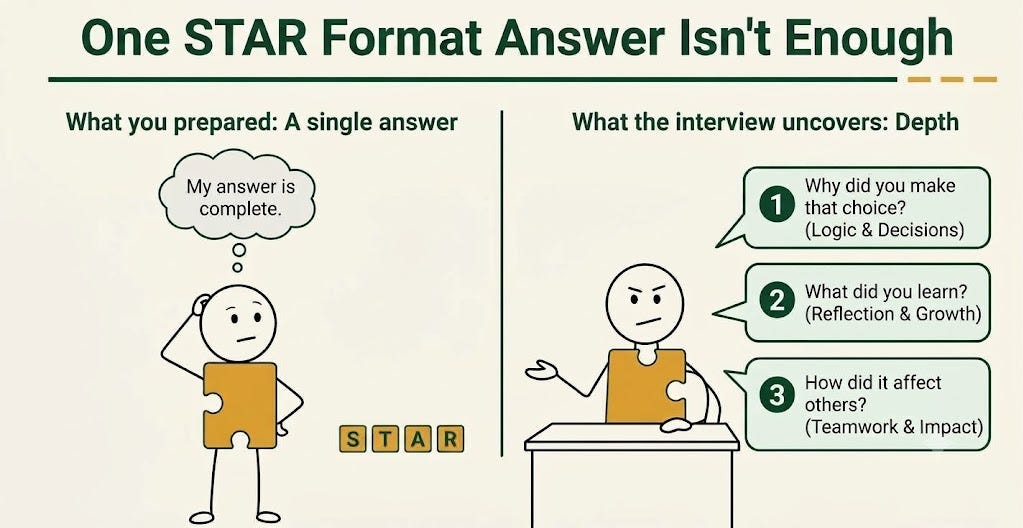
You’ve prepared for weeks. You’ve shortlisted the common behavioral questions, written your answers using the STAR method, and rehearsed your stories until they sound polished.
The interviewer asks: “Tell me about a time you had a disagreement with a teammate”
You deliver your answer with confidence. You explain the situation, the actions you took to resolve the disagreement, and the positive outcome. It goes exactly the way you practiced it.
Then the interviewer asks
“How do you think your teammate would describe that disagreement?”
You’ve only ever told it from your side. You offer a vague line about how they probably saw it differently.
“What evidence did you have that your approach was right?”
You reach for “I felt strongly about it” and realize how thin that sounds. A benchmark, a customer complaint, or a past incident helps
“What did you get wrong?”
You pause. Your story had no mistakes in it. That’s the problem.
“What did the disagreement cost the team? Days lost, work redone?”
You said it ended with “we aligned.” They want to understand the impact.
“At what point would you have taken it to your manager?”
You never had to, so you’ve never decided where that line sits.
“And how was the working relationship afterward?”
Somewhere around the third question, the story you rehearsed ran out. You prepared what happened, and the interviewer has been asking how you think.
If this sounds familiar, you are not alone. It is one of the most common problems with behavioral interviews. Preparing your answer is not the same as being prepared to talk about your experience.
This is exactly why I created Big Tech Interviews: Build Your Story Bank in 4 Weeks. The cohort helps you turn your real work experiences into structured, compelling stories and prepare to discuss the decisions, trade-offs, and lessons behind them. Through guided practice, mock interviews, and feedback, you’ll learn to go beyond rehearsed STAR answers and handle follow-up questions with greater confidence.
The cohort starts October 16.
Build Your Story Bank With Me in 4 Weeks
Big Tech Interviews: Build Your Story Bank in 4 Weeks
📅 October 16 to November 8, 2026
👉 Explore the October Cohort [Starts tomorrow 16th Oct]
Have questions? Email prasad@bigtechcareers.com
Why STAR Alone Isn’t Enough
STAR is the right technique to prepare for behavioral interviews. It helps you structure your answer in a way that would help the interviewer to follow your story:
Situation: What was happening?
Task: What were you responsible for?
Action: What did you do?
Result: What happened as a result?
STAR allows you to tell about your experience correctly, but just responding to it properly does not always show that you can demonstrate an example. It is evident when the interview asks additional clarifying questions; thus, thinking about the possible additional questions that an interviewer might ask is also significant.
Follow-up questions go after the thinking behind your story:
Why did you choose that action?
What alternatives did you consider?
What was your specific contribution?
What did you learn from the experience?
Imagine a candidate telling a compelling story about leading a cross-functional team through an enterprise migration. The STAR version of the story is probably right there, told with a good pace and clarity. However, once the interviewer gets to probing, he or she may ask about conflict resolution within the team, underlying reasons for certain decisions, or lessons learned that the candidate would apply next time. The answers to these questions are not in the two-minute story told in the STAR format.
The way to prepare oneself for such challenges is by developing answers that are authentic, specific, and grounded in reality. To do that, it’s important to have a good grasp of one’s story, examine it from various angles as one expects an interviewer to do when asking clarifying questions, rather than simply rote-learning it.
Six Types of Follow-Up Questions to Prepare For
Every interviewer has their own style, and there are no hard-and-fast rules that every Big Tech interviewer follow. But many common probing questions fall into a few recognizable categories. By preparing answers to these six broad types of questions, you’ll have prepared yourself for the vast majority of follow-up questions you’re likely to face.
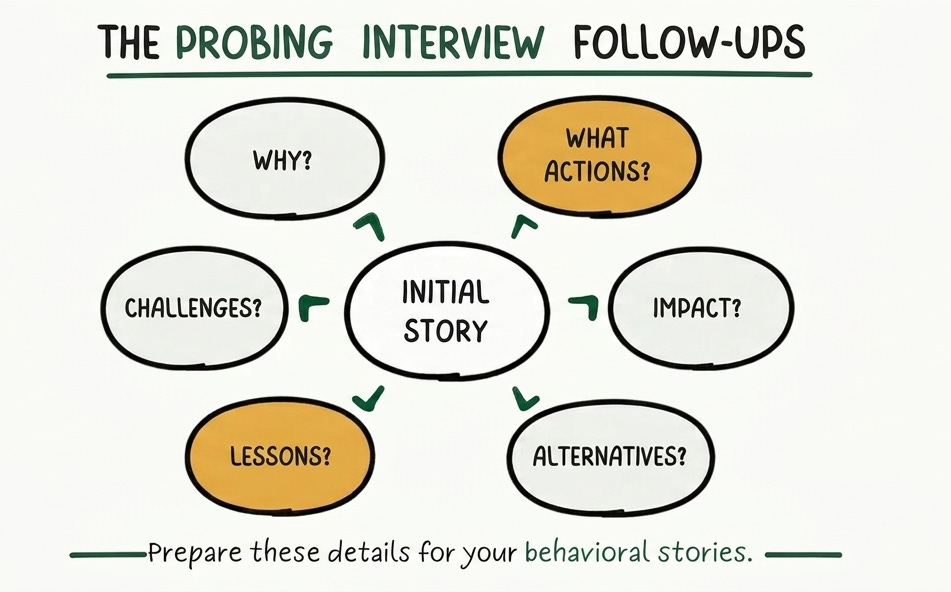
You won’t face all six types for every story. But any story you plan to rely on should hold up against most of them.
Stress-Test Your Story
Here’s a simple way to see where your preparation stands.
Choose one story from your own experience, one you’d feel comfortable using in an interview tomorrow. Then go through the statements below and check only the ones you can confidently support with a real example from that story.
Is your story follow-up ready?
☐ I can explain why I chose my approach.
☐ I can clearly separate my contribution from the team’s work.
☐ I can describe a real challenge, mistake, or trade-off.
☐ I can explain the outcome and how I know it mattered.
☐ I can discuss what I learned and what I would change.
☐ I can answer follow-ups without relying on a memorized script.
If you checked all six, that story is in good shape. If you hesitated on any of them, you’ve found exactly where the story needs more work. Revisit the decisions, actions, and outcomes behind it before you rely on it in an interview.
This is a self-reflection exercise, not a validated measure of interview readiness. Its value is in showing you where to focus next.
A Quick Challenge
Go back to the opening question: “Tell me about a time you disagreed with a teammate.”
You share your STAR answer. Then the interviewer asks:
“Why did you believe your approach was better?”
“What would your teammate say about how you handled the situation?”
“Knowing what you know now, would you make the same decision?”
Could you answer all three naturally without getting defensive, using what actually happened?
If not, the story probably needs to be developed further. Rehearsing it again won’t close that gap.
Having Ten Stories Isn’t the Same as Being Ready
You have tested one story against three challenging follow-up questions. But what if you had ten behavioral stories? Is that all it takes to prepare for an interview?
Not unless you know the story in such detail that you can talk about it backwards and forwards. Otherwise, your confidence will be unjustified, and you will stumble when asked to discuss decisions, contributions, or learnings not anticipated in your story.
A good story bank is not only a set of STAR answers but a set of experiences that you understand in sufficient detail to be able to discuss their different aspects. In each of your stories, you should be able to describe:
Why you made the decisions you did and what alternatives you considered.
What you personally contributed and how it affected the outcome.
What challenges you faced, what you learned, and what you might do differently.
Which other behavioral questions the experience can authentically address.
The goal isn’t to memorize multiple answers for every possible question. It’s to understand your experiences well enough to respond clearly, consistently, and honestly, even when the conversation takes an unexpected turn.
STAR gives your stories structure. Understanding the decisions, trade-offs, and lessons behind them helps you handle follow-up questions with confidence.
Don’t Stop at Your First Answer
Your next behavioral interview may start with the same set of familiar questions. What happens next, based on your first response, may depend on just how much you know about the experience itself.
Preparation for follow-up questions can not be done by simply preparing your STAR response to the question. You need to understand what led to your decisions, explain how and why you took a specific part of each story, while analyzing the trade-offs and lessons learned.
If you have been preparing by gathering commonly asked questions, practicing STAR responses, or simply wondering which experiences are worthy of discussion, then this is a great opportunity to improve your preparations.
That’s what Big Tech Interviews: Build Your Story Bank in 4 Weeks is designed to help you do.
The cohort starts October 16.
Build Your Story Bank With Me in 4 Weeks
Big Tech Interviews: Build Your Story Bank in 4 Weeks
📅 October 16 to November 8, 2026
👉 Explore the October Cohort [Starts tomorrow 16th Oct]
Have questions? Email prasad@bigtechcareers.com
Over four weeks, you’ll build your story bank using STAR as the foundation. Then you’ll strengthen each story by exploring the details behind it and preparing for the follow-up questions interviewers are likely to ask.
A central part of the cohort is the mock interviews. You’ll practice answering probing follow-up questions in a realistic setting and receive feedback on how you respond. It’s one of the most effective ways to find the weak spots in your stories before an interviewer does.
The goal is to move beyond a set of memorized answers and build stories you can explain and discuss in depth.
See you next Thursday,
Prasad Rao
Hey, Prasad here. I’m the voice behind the weekly newsletter Big Tech Careers. I share practical strategies for Big Tech interviews, behavioral storytelling, technical careers, and professional growth every Thursday.