Hey, Prasad here 👋 I’m the voice behind the weekly newsletter “Big Tech Careers.”
In this week’s article, I share the behavioral change needed to move from senior to staff+ roles. It’s part 1 of 2-part article series.
If you like the article, click the ❤️ icon. That helps me know you enjoy reading my content.
What We’re Covering in This Two-Part Series
Getting stuck at senior is incredibly common. The good news? It’s not because you’re not technical enough. It’s because nobody told you the rules change.
In Part 1 (this article), we’ll break down the fundamental mindset shift required for staff+.
You’ll learn
why being more technical is actually the wrong optimization
what truly changes between senior and staff+ work
how to think about scaling your impact through others instead of just doing more yourself.
In Part 2 (next week’s article), we’ll get specific.
You’ll discover the three types of behaviors that actually multiply your impact
knowledge multiplication
confidence multiplication
outcome multiplication.
More importantly, you’ll learn exactly how to practice them without waiting for permission or the title.
By the end, you’ll have a framework you can use immediately, regardless of your company or current level.
Before we get started, here is a Black Friday sale offer for you!
Moving from senior to staff/principal levels can suck. There are pitfalls. It doesn’t have to be so hard.
I’m a Principal Solutions Architect and I’ve mentored dozens of folks stuck at senior, clawing at the glass ceiling of staff/principal roles. This is what I’ve learned.
Getting promoted to staff+ can be messy! The path ahead is not straight forward. You have to embrace a simple concept: Your job isn’t to be the smartest person in the room anymore.
The thing everyone gets wrong
Let me tell you about one of my mentee. Brilliant engineer. Could design distributed systems in her sleep. Had the architecture diagrams to prove it. Three years at senior. Zero movement toward staff.
Why? She kept doing what made her successful at senior. Deeper technical dives. More complex projects. Better code. She thought the answer was more — more expertise, more ownership, more technical excellence.
She was optimizing for the wrong thing.
Here’s what the standard career advice won’t tell you. They’ll teach you about “technical leadership” and “scope expansion” when the real answer is simpler and more uncomfortable:
You need to change how you behave, not what you know.
What if I told you:
We can stop pretending to have all the answers
We can master the art of multiplying impact instead of just delivering it
We can unlock a simple pattern that turns individual excellence into collective excellence
That’s what I’ll share in this article. This is what I wish someone had told me five years ago before I got promoted to Principal. The patterns that actually matter, stripped of the corporate BS. I’ve watched this pattern play out dozens of times now. The specific behaviors that separate people who get promoted from people who stay stuck.
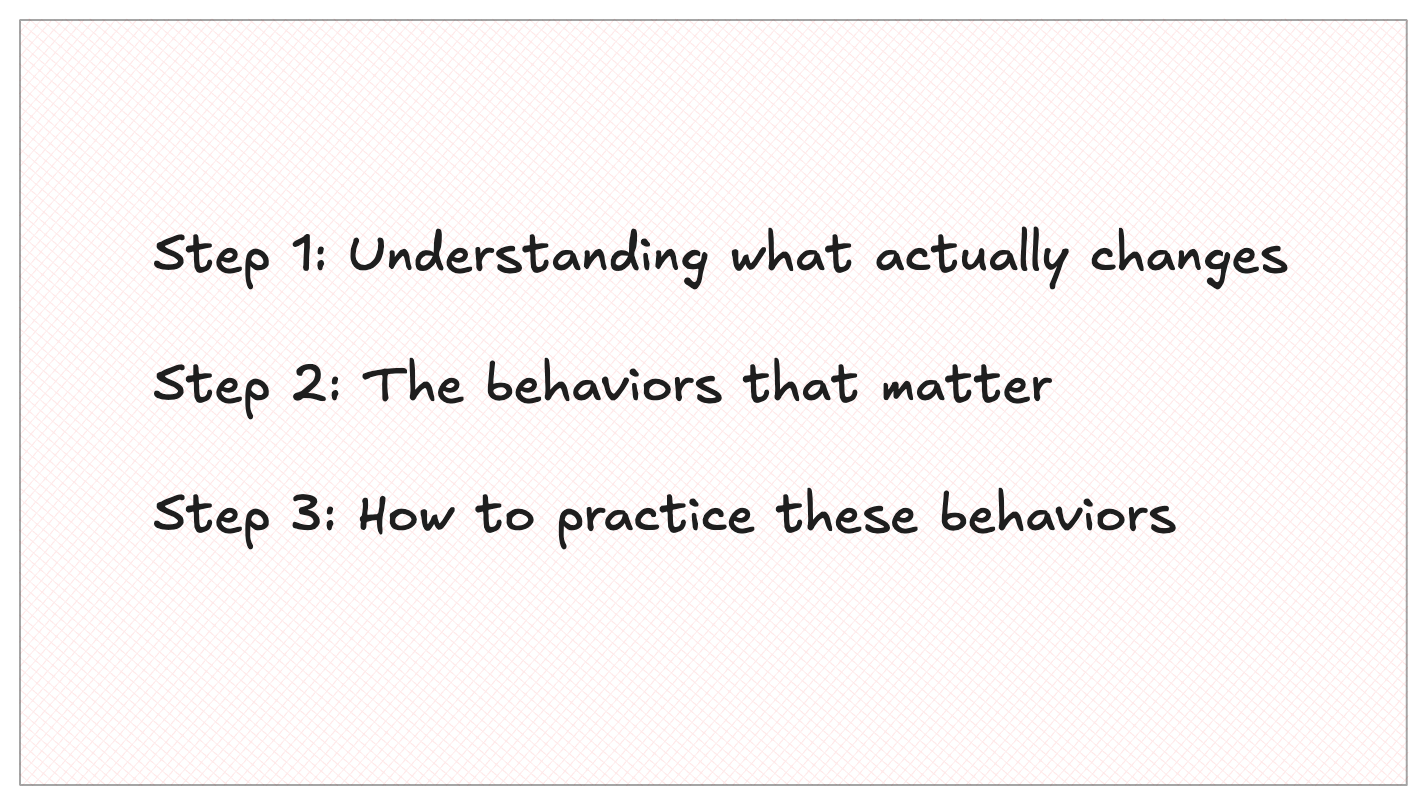
Step 1:Understanding what actually changes (and which parts of conventional wisdom are garbage)
Step 2:The behaviors that matter. Learn these and your career growth automatically accelerates.
Step 3:How to practice these behaviors without waiting for permission. Because spoiler: you don’t need the title to start acting differently.
I’ll show you a practical intro to staff+ thinking, where behavior change is the organizing principle, not an afterthought. In plain language, not tied to any specific company’s ladder, and useful to you today.
This approach works at every company. It will work at your company, whether you’re at a startup or Big Tech.
But first, to understand why this matters, you need some context about how growth actually works at these levels.
We will cover Step 1 in this article and Step 2 and 3 in next week’s article.
Step 1: Understanding What Actually Changes (Spoiler: It’s Not What You Think)
Our goals and our context
We are here to understand a simple truth: the game changes at staff+, and nobody tells you the new rules.
At senior, you’re rewarded for shipping. For being technically excellent. For solving hard problems. For being the person who can be dropped into any codebase/architecture and figure it out.
All of that is still true at staff+. But the catch is that it’s no longer enough. It’s table stakes. It’s like saying “I know how to use version control”. Yeah, we assumed that.
The basic building blocks of staff+ work are influence, multiplication, and ambiguity. The work streams that create and maintain staff+ engineers are completely different from what got you to senior.
A basic point about staff+ work (or principal, or distinguished, or whatever trendy title your company uses today) is that it is not just senior work at bigger scope. It must be a fundamentally different approach to how you operate.
Both are “IC roles”, both involve “writing code”, including “technical decisions” that might seem similar but the similarity should end there.
Your senior role is meant to be fast, serve your team directly. It is optimized for delivery and execution.
Your staff+ role is meant to be leveraged, and serve the organization broadly. It is optimized for multiplication, for enabling others, and for strategic impact.
Put it this way: as a senior engineer, you need to ship that feature as fast as possible. As a staff+ engineer you need to make sure three teams can ship similar features faster next quarter. The senior engineer won’t even think about the organizational pattern, much less make it scalable. Meanwhile if you’re the staff+ engineer spending all your time in the weeds, you’re missing the forest for the trees.
What does “good” look like?
The ideal staff+ professional should:
Multiply impact: ideally 5-10x through others, rather than a linear 1x through their own work
Navigate ambiguity: take undefined problems and create just enough structure for others to move
Influence broadly: without authority, across teams, even when it’s uncomfortable
There are tradeoffs between “technically deep enough to be credible” and “broad enough to have organizational impact”. A lot of hard work goes into reconciling those two needs.
At Big Tech, there is a popular saying: “Senior engineers ship products. Staff engineers ship engineers.” The idea is that you spend most of your time unblocking, mentoring, and designing systems that made others faster.
In a world where your time is expensive, access to you is limited, and your expertise is in demand, the bottleneck is your personal scalability. Solving that bottleneck allows us to break with the “just be more technical” approach that stops working at senior. That’s what I’m here to talk about.
The Career Funnel: From Individual Contributor to Organizational Multiplier
Imagine your career as a giant funnel, with impact flowing outward through it.
At the bottom: Your individual technical contributions. The code you write. The bugs you fix. The designs you create.
At the top: The organizational outcomes you enable. The projects that succeed because you unblocked them. The engineers who grew because you mentored them. The decisions that went better because you were in the room.
In between: Behaviors that multiply your impact.
How do we get from individual contributor to organizational multiplier? Behaviors.
See buzzwords like “leadership” and “influence”? Ignore the froth. Replace with “behaviors you can practice tomorrow” and move on.
Behaviors are the #1 tool of staff+ growth. At their most basic form, they’re ways of showing up that take your input (technical expertise, context, judgment) and amplify it across multiple people and projects.
What behaviors do you practice?
Like it or not, the foundation of staff+ work is making others successful. The core skill of demonstrating staff+ impact is showing the ripple effects of your work.
These behaviors can multiply easily because they’re not zero-sum. The more you help others, the more everyone benefits. The tools that invisibly translate your simple actions into complex organizational outcomes. They not only are literally set up with human behavior in mind, they figuratively cannot do the same for pure technical depth.
Why? Because technical depth only scales through you. Behavioral changes scale through everyone you touch.
When pure technical work makes sense (or doesn’t)
If you’re building foundational infrastructure, working on critical systems, or doing deep research, then pure technical work makes sense. But once you’re at staff+, beware anything that doesn’t have a clear multiplication factor. It’s likely necessary, but almost certainly not the thing that will get you promoted.
Your instinct might be to “take on the hardest technical problem”. That’s fine, but that’s how you succeed at senior. At staff+, you succeed by asking: “What’s the highest leverage thing I can do? Who else can grow by taking this on? How do I make this a learning opportunity?”
You may be tempted to dive deep into every codebase, review every design doc, be in every customer discussion — that’s fine, but you do that selectively.
Rule of thumb:
if you’re the one doing all the work, that’s senior behavior.
If you’re the one enabling others to do their best work, that’s staff+ behavior!
So here’s the simple reality:
Stop trying to be more technical. Start trying to be more multiplicative.
Each week, audit your impact:
What did I do that only I could do? (Should be small)
What did I do that made others more effective? (Should be large)
Who is better at their job because I was around? (Should be specific)
Then, set up a system of behaviors to multiply this, every week, in every interaction:
When someone comes to you with a problem: resist the urge to solve it. Ask questions that help them solve it themselves. (this is multiplication, not just expertise transfer)
When you see a gap in technical strategy: write it down. A good doc that influences five teams beats a perfect architecture that you implement alone. (this is your strategic leverage)
When you have a choice between doing the work yourself or coaching someone through it: choose coaching. Prioritize tasks that help you multiply through others!
Every week, new opportunities come in, and your behavioral setup cascades new impact across a host of people downstream of you.
What’s Next
That’s Step 1 - understanding what actually changes. You now know that the game is fundamentally different at staff+, and it’s not about being more technical.
In Part 2, we move to Steps 2 and 3: the specific behaviors that matter, and how to practice them right now without waiting for the title.
You’ll learn the three types of multiplication that separate people who get promoted from people who stay stuck:
knowledge multiplication,
confidence multiplication,
outcome multiplication.
Plus, I’ll share how how these behaviors compound over time to create exponential career growth.
The path forward is clearer than you think. And it starts with changing how you show up, not what you know.
See you next week!
Subscribe to receive next week article directly in your inbox!
Here is Black Friday offer for Big Tech Careers readers!


These two points summarised the whole article:
> if you’re the one doing all the work, that’s senior behavior.
> If you’re the one enabling others to do their best work, that’s staff+ behavior!
Waiting eagerly for the next Part, Mr Rao !