

Last year, an engineer I’ll call Anna told me she’d been passed over for a strong rating. Again.
She spent the whole quarter working on her team's deployment pipeline. Before that, about every fifth deployment was failing and required someone to take care of it. After she did her part, the number of failing deploys decreased to about 2%, and her team started deploying twice as often as before.
When I asked how her manager had described that work during the review discussion, she sighed.
“He said I did some solid infra work this quarter.”
Some solid infra work. That’s what a quarter of high-impact effort had been reduced to by the time it reached the room where decisions were made.
Meanwhile, a peer who launched a visible customer feature got the strong rating. Anna wasn’t angry with him. She was confused.
“I thought good work was supposed to speak for itself.”
I understood her frustration; She has been working on the project for months, and her hard work has paid off. It was significant, so why was it not enough?
But there’s a gap between doing valuable work and helping others understand its value. That gap can shape how your contributions are remembered, discussed, and rewarded.
Let’s look at what you can do to make your contributions easier to understand and recognize. We’ll explore practical ways to communicate your work, demonstrate its impact, and build habits that help others see the value you bring. Along the way, we’ll cover:
Why good work goes unnoticed: Understand why valuable contributions can get overlooked, even when the results are measurable.
Give people the context they need: Learn how to communicate your achievements without feeling like you’re bragging or taking credit away from others.
Describe the work at the right level: See how to move beyond describing tasks and explain the outcomes and impact of your work.
What this looks like in everyday situations: Explore practical examples of communicating your contributions in 1:1s, team updates, conversations with senior leaders, and performance reviews.
Keeping your updates grounded and credible: Learn how to use evidence, acknowledge others’ contributions, and communicate your impact without overstating it.
Build a simple habit around it: Discover small, consistent practices that help you keep track of your achievements and make performance conversations easier.
We’ll also return to Anna’s story to see how these changes helped her manager better understand and communicate her contributions, before ending with a simple exercise you can try before your next 1:1.
Why good work goes unnoticed
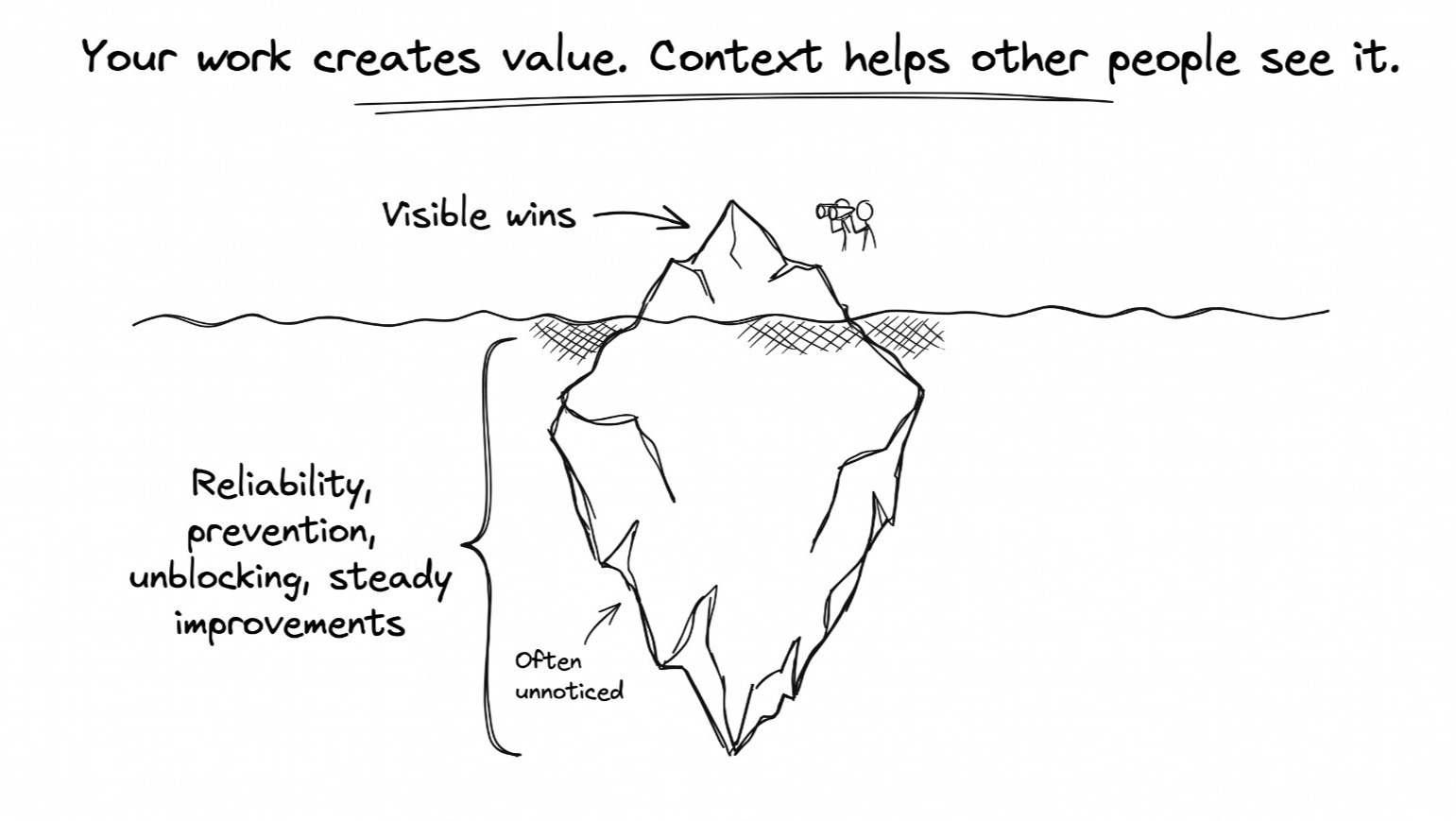
In my experience, when strong people get overlooked, it’s often because the people making decisions don’t have enough context to understand the value of their contributions.
A few things contribute to this.
Your manager only sees a fraction of what you do. He or she is juggling many projects and people, and there is always a priority. Your manager's managers see even less. By the time your promotion gets discussed in some review committee, there may not be more than a summary and a few notes left.
Some valuable work is difficult to see. Things like preventing outages, eliminating bottlenecks, unblocking other teams, and generally making the world a better place (but for a system that no one really cared about) are rarely celebrated. If they're done right, nothing really changes. There's no big release or flashy feature. The systems just run better. It doesn't cause an incident, so it's not talked about, and the other teams barely notice it happening.
The results can take time to show up. Anna’s pipeline fix didn’t produce one dramatic moment. It made hundreds of deployments more reliable. Unless someone connects those everyday improvements to the work behind them, the impact can go unnoticed.
People are busy. Your manager probably likes your work but might not be able to recall every nuance of what you have done. They will not have the time to go through each ticket, commit, or project note.
That is why it can be helpful to give context for your work. Your manager will need specific examples and evidence to explain your contributions in conversations that you are not part of.
Give people the context they need
Many thoughtful professionals feel uncomfortable talking about their achievements. They picture someone who dominates meetings, takes credit for team wins, or turns every small task into an announcement.
That isn’t what I’m suggesting.
The aim is to help people understand what your work involved, what changed as a result, and why that change matters.
Consider Anna’s deployment fix. She could have said:
❌ “I spent the quarter fixing the deployment pipeline and improving the retry logic.”
That’s a fair description of her work, but it leaves the listener to figure out the outcome.
She could instead say:
✅ “I fixed the deployment pipeline, bringing deployment failures down from about 20% to 2%. The team can now ship twice as often, with far less time spent babysitting releases.”
The second explanation gives her manager something concrete to remember and share. It shows the improvement, gives a sense of scale, and explains how the team benefited.
That’s the kind of information that helps your work stand out in a review discussion.
It also makes your manager’s job easier. They have to represent your work in rooms you’ll never be in. When they have clear examples and measurable results, they can explain your contribution with confidence.
Here’s a useful question to ask yourself: If my manager had to describe my last quarter in two sentences, what would they say? Would those sentences reflect the most important things I accomplished?
If the answer is unclear, you have an opportunity to help them fill in the gaps.
Describe the work at the right level
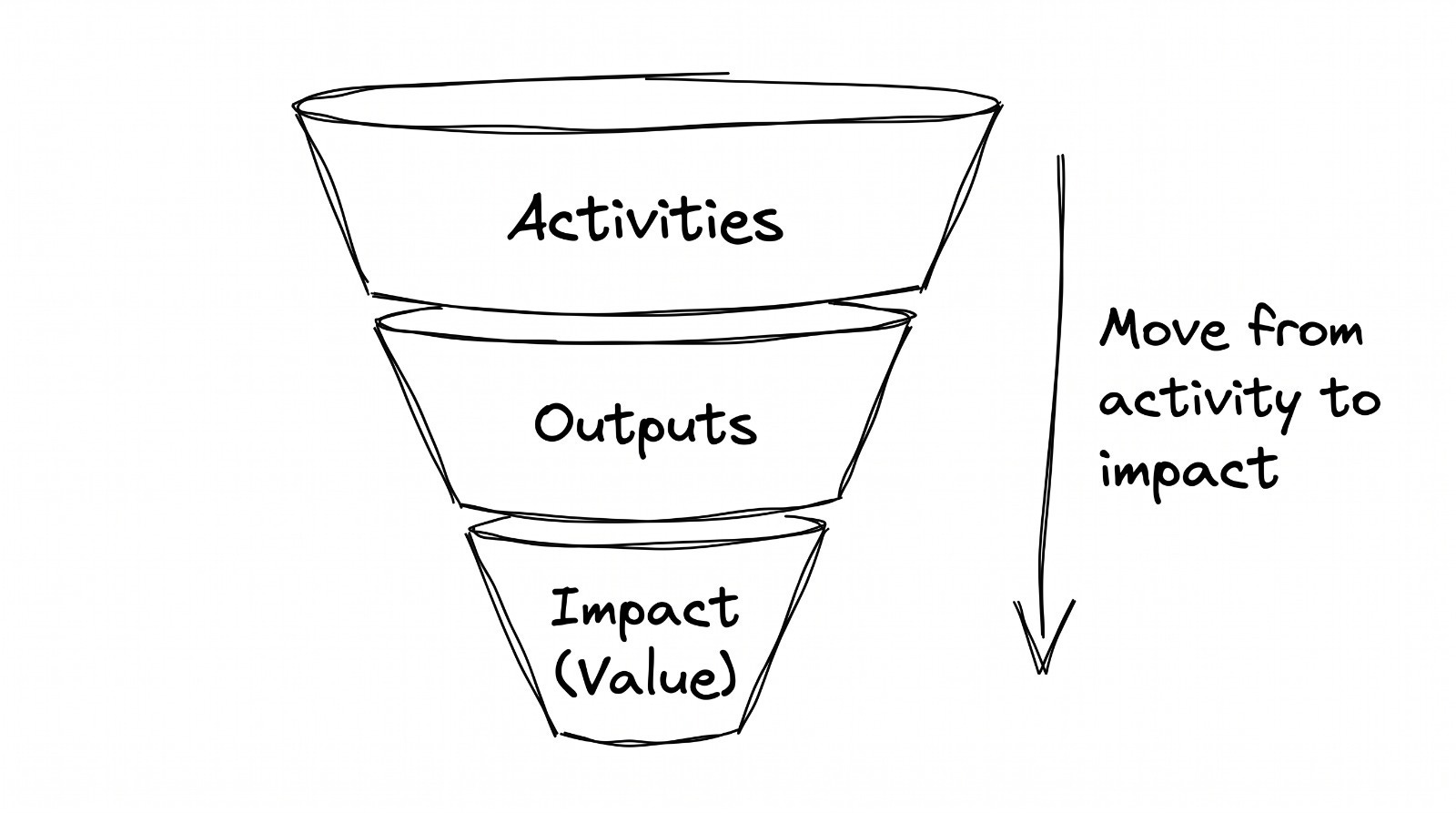
Most people are comfortable explaining what they worked on. The harder part is connecting that work to its results.
Think about Anna’s project at three levels:
Activity: “I worked on the deployment pipeline.”
Output: “I rebuilt the retry logic and added automated rollback.”
Impact: “Deployment failures dropped from about 20% to 2%, and the team now ships twice as often.”
Each level adds useful information. The activity explains where she spent her time. The output describes what she built. The impact shows why the work mattered.
When you share an update, start with what changed. Add the technical details that help your audience understand the result, and explain who benefited.
A simple structure can help:
What changed? Describe the result, using numbers where possible.
Why does it matter? Explain the benefit to customers, the team, or the business.
What’s next? Share the next step, an outstanding risk, or a decision you need.
You don’t need to turn every update into a formal presentation. Often, one or two clear sentences are enough.
What this looks like in everyday situations
Here are five situations where a little context can make your work easier to understand.
1. During your weekly 1:1
Instead of saying:
❌ “Busy week. Mostly pipeline stuff.”
Try:
✅ “Quick update on the pipeline. Since the retry change went in, failures have dropped from about one in five deployments to one in fifty. The payments team says they’ve stopped babysitting releases. Next, I want to look at the test suite because it’s now the slowest part of the process.”
This takes about twenty seconds. Your manager gets the result, hears how another team benefited, and knows what you’re planning next.
2. Sharing a team win in a public channel
You could write:
✅ “We shipped the new onboarding flow today. Big thanks to Riya for the API changes and Sam for testing on low-end devices. Early numbers look good: completion is up from 62% to 71% in the first 48 hours. I’ll share a fuller readout next Friday.”
This update celebrates the team’s work and gives people something specific to take away from it.
Giving credit to colleagues also helps others understand how the work came together. It shows that you can collaborate across teams and recognize the contributions that made a result possible.
3. When a senior leader asks, “What are you working on?”
It can be tempting to answer with details about what you're actually doing. However, a senior leader usually wants to hear the outcome first and anything that they need to be made aware of.
For example:
✅ “The main focus is reducing our cloud spend. We’ve cut costs by about 18% so far, mostly through right-sizing batch jobs. Storage is the next big opportunity, and I’ll need a decision from the data team on retention policy by the end of the month.”
This gives the leader a clear picture of progress and identifies where their help may be needed. You can go into the implementation details if they ask.
4. Explaining work that prevented a problem
Some of the most valuable work is difficult to notice because success means a problem never occurs.
You might share an update like this:
✅ “During last week’s sale, traffic reached three times normal levels and checkout stayed under 300 milliseconds. The caching work we did in August helped us handle that load. Our tests had suggested we’d start seeing timeouts at around twice normal traffic without those changes.”
This connects an otherwise quiet engineering improvement to a result the wider business can understand. It also gives your team credit for preparing ahead of time.
5. Writing your self-review or promotion document
Consider this example:
❌ “Led the queue migration project.”
✅ “Led the migration of 40 services off our legacy queue, coordinating across three teams, with zero customer-facing incidents. The change removed the system responsible for about 30% of our on-call pages, giving each engineer back roughly a day per sprint.”
The description explains the scale of the project, the coordination involved, and the benefit to the team. These details help reviewers understand the scope of your contribution and the problems you can take on.
Keeping your updates grounded and credible
If talking about your achievements feels uncomfortable, a few simple practices can help.
Use evidence. Words like “huge,” “massive,” and “game-changing” don’t tell people much on their own. Explain what improved, how much it improved, or what became possible as a result.
Give credit where it’s due. If others contributed, name them. You can describe your own role clearly while recognizing the people who helped deliver the result.
Choose what to share. You don’t need to announce every task you complete. Focus on work that improved a process, helped a customer, reduced a risk, saved time, or moved a project forward.
Adjust the detail for your audience. Your manager may want to understand the technical approach. A director may care more about the outcome, the cost, the risk, or a decision that needs to be made.
Be clear about your contribution. If you led the work, explain what you led. If you contributed to a team effort, describe your part and the shared result. Specific details make your account easier to trust.
You don’t need a grand announcement to communicate your work well. A calm, factual update is often enough.
Build a simple habit around it
The people who do this well tend to keep track of their work as they go. They don’t have to reconstruct an entire quarter from memory when review season arrives.
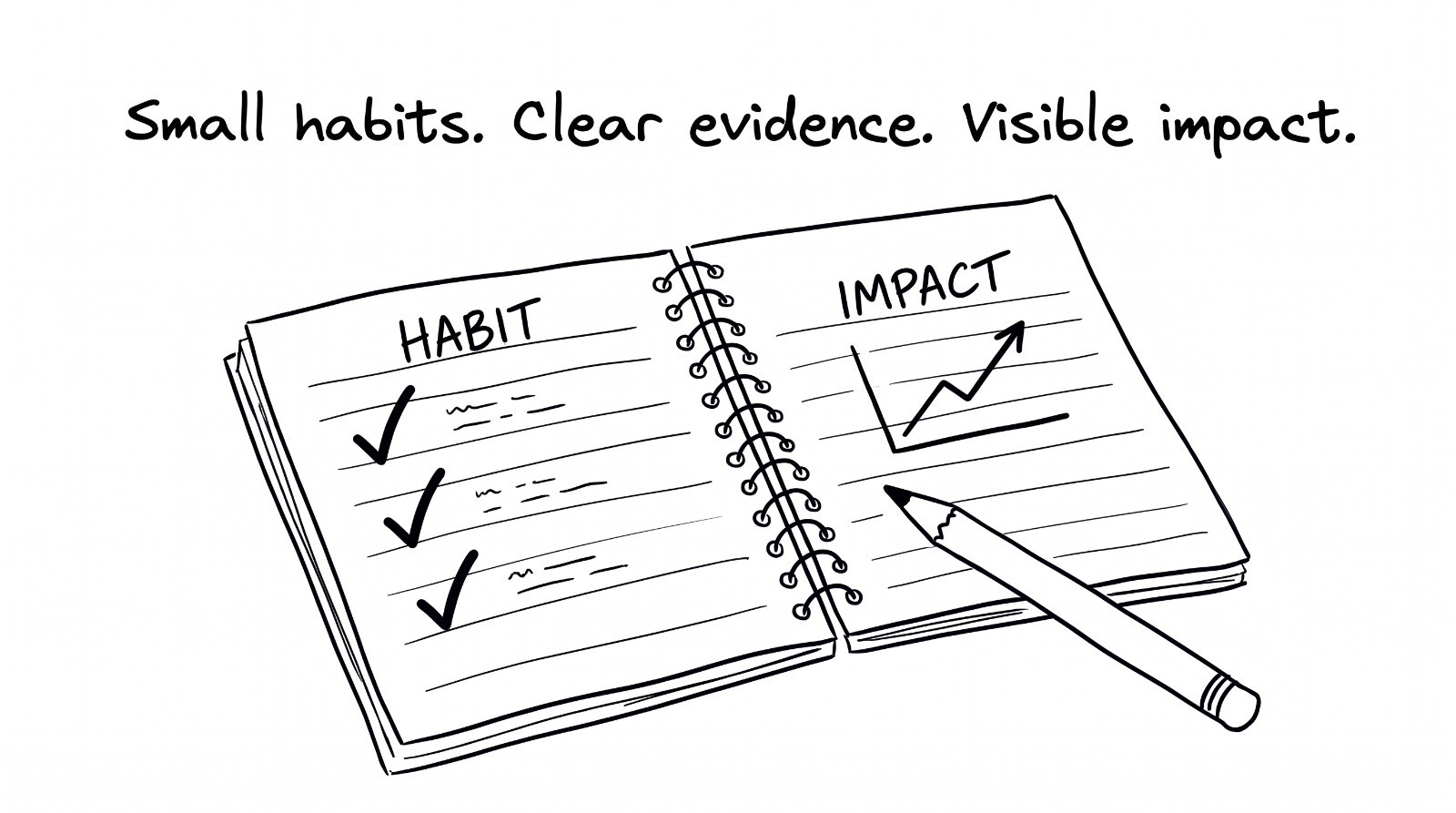
Here are a few ways to make that easier.
Keep a short impact log. Spend five minutes every Friday noting what changed that week, any useful numbers, and who benefited. By review season, you’ll have a record of specific contributions rather than a vague recollection of being busy.
Capture the starting point. Before fixing a slow page, a flaky process, or an expensive system, record how it performs today. That gives you a meaningful comparison when the work is done.
Share updates regularly. A short note during your weekly 1:1 and a brief summary at the end of a project are often enough. Regular updates help people remember the work while the details are still fresh.
Ask others to share their experience. If a partner team benefited from your work, ask whether they’d be comfortable sharing that feedback with your manager. Their perspective can help explain the impact in ways your own update might miss.
These habits take very little time, and they make performance conversations much easier for everyone involved.
What happened with Anna
Anna started applying these ideas in real life (nothing revolutionary, just these ideas). There was no significant change in her work process; she started giving a two-line update in each 1:1, sharing a quick note with her manager after a successful release, and keeping an impact log each Friday.
Two review cycles later, her manager described her in the calibration conversation as ‘the person who made our whole team faster.’
She continued to be the same brilliant engineer as before, delivering the same high-quality code. However, her manager now had real-life examples and could effectively communicate her impact and value to the leaders.
As you can see, impactful work requires your time and effort. At the same time, explaining your contributions benefits everyone, including you, in terms of recognition and rewards. Therefore, practicing explaining what, how, and for whom you do what you do will undoubtedly make you a more valuable team member.
Try this before your next 1:1
Pick one piece of work from the past month and write down three things:
What changed: What did you improve, build, or resolve?
Why it matters: What difference did it make? Include a number if you have one.
Who benefited: Which customers, colleagues, or teams are better off because of it?
Share those points with your manager this week. It should take less than a minute.
One clear example can give your manager a much better understanding of your work, and give you a useful starting point for the next conversation about your growth.
See you next Thursday,
Prasad Rao
Hey, Prasad here. I’m the voice behind the weekly newsletter Big Tech Careers. I share practical strategies for Big Tech interviews, behavioral storytelling, technical careers, and professional growth every Thursday.
New to Big Tech Careers? Subscribe to join a tribe of 37k+ and level up alongside engineers and architects.
Many good pieces of advice here
Thank you