

Most candidates I speak to prepare for behavioral interviews in one of two ways. One approach uses heavy AI input; a candidate uploads their resume and asks for STAR answers and practices the results. The other uses a coach, figuring that a few sessions will be sufficient to uncover great stories and allow them to walk into the interview room with confidence.
Both can leave a candidate with suboptimal results.
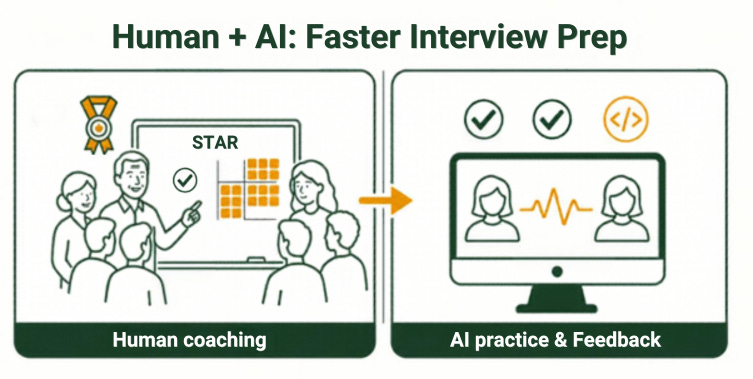
While AI can certainly help you excavate relevant experience from your resume, organize your thoughts, ask pertinent follow-up questions in order to root out any missing STAR components and give you the repetitions needed to prepare for an interview, it does so without the benefit of knowing which stories reflect your experience level, impact, or contribution most effectively, or if the story is authentic to you.
A human coach or recruiter can identify stories that demonstrate the right scope, challenge, contribution, and impact, help you reposition if you’re overestimating your role, and advise you on when a given story isn’t reflective of the experience level you’re attempting to convey.
The faster and better path is to combine the two.
Use human expertise where judgment matters. Use AI where volume and repetition matter.
That’s the approach behind my next cohort, Big Tech Interviews: Build Your Story Bank in 4 Weeks, starting October 16. Over four weeks, we’ll work on the stories themselves with direct feedback from me, then use AI to help you build, refine, and rehearse those stories between sessions.
The goal isn’t to choose between a human coach and AI. It’s to use each for what it does best: human expertise for judgment, and AI for scale and repetition.
Build Your Story Bank With Me in 4 Weeks
Big Tech Interviews: Build Your Story Bank in 4 Weeks
📅 October 16 to November 8, 2026
🚀 Have questions before you enroll in the cohort?
Why your stories still need human expertise
Crafting a compelling behavioral narrative is partially a matter of structure, but mostly of judgment.
You have hundreds of hours of experience to choose from, but what matters is the judgment to decide what to talk about, what to reveal and conceal about your role and responsibility in each, what the interviewer will want to hear, and how much detail a Big Tech interviewer would expect to hear from you at your level.
This is where human judgment is of the essence.
A good coach can help you:
Choose the right experiences. I build story banks around eight behavioral themes: Customer / User Focus, Success, Failure, Conflict, Problem-Solving, Learning / Growth Mindset, Leadership, and Time Management. Most people have strong material for three or four of these and very thin material for the rest.
Move from “We” to “I.” Interviewers want to understand your decisions and your contribution. A coach will keep asking what you did until it’s visible in the story.
Get the STAR structure right. Situation and Task set the context. Action and Result carry the weight, and they’re usually where first drafts are weakest.
Tell the story at the right level. A story can be factually strong and still undersell your scope. Someone who has been on the other side of the table can often spot this quickly.
AI can help with many of these tasks, it can mine your resume for potential stories, ask you clarifying questions, push you to recall further details on a given STAR element, and structure your response.
But judgment about what to include and what to omit is still a human task.
Why AI changes how you build and practice
Once you’ve got direction, AI is incredibly valuable. The thing is, AI can help you earlier in your preparation than just doing mock interviews.
You could start with your resume and ask your AI to flag potential story candidates. Then you can walk through the stories out loud, with your AI coach digging into the fine details: What did you specifically do? What decision did you make? What did you achieve? What did you learn?
This process could take a vague memory from your past, and help you to shape it a story for your interview, while maintaining the details to your experience.
The important thing about that process is that you’re starting with your actual experience, not asking AI to make up a story for you. You can also rely on AI to flag opportunities you may not have thought of, dig into the detail required for a good STAR response, and organize your stories into a categorized library for later use. That’s all a big difference from just asking a chatbot to “write me a STAR answer.”
Another element of preparation is rehearsal. Having developed your stories, you need to actually practice them out loud. You need to become comfortable with the setup, learn how to handle follow-up questions, and identify when you become too preoccupied with the Situation and not focused enough on the Action or Result.
That takes time and practice. That’s where AI can help you to get the repetition and practice you need without using up too much of your time.
You can run mock interviews, repeat the same story, work on the same follow-up questions, and practice what to say without worrying about “how good” your response is. You can experiment and fail and try again without needing to get feedback from coaching each time.
But repetition doesn’t replace the value of practicing with a human. The mock interview process, with real humans, can help you to get comfortable telling your stories in different ways depending on how the conversation goes, how comfortable you are, and how much the interviewer is probing.
That’s why I think the two things complement each other: AI gives you the opportunity for practice and repetition, but a coach can give you valuable judgment and perspective, as well as the experience of an actual human interviewer. You need both.
Human judgment + AI repetition
The best way to think about the combination is not Human vs. AI. It’s Human judgment + AI scale.
The best preparation cycle would look something like this:
Use AI assistance to uncover your own raw material. Start with your resume and experiences. Identify potential stories across the eight behavioral themes.
Use human expertise to select and shape the strongest stories. Decide which experiences demonstrate the right level of ownership, impact, leadership, judgment, and growth.
Use AI to build depth. Talk through each story out loud. Let the AI probe for missing STAR elements, weak actions, unclear decisions, and measurable results.
Use AI and human practice to rehearse. AI can give you the repetition you need to practice different questions, follow-ups, and variations of your stories. Human mock interviews add something different: the experience of answering a real person who can react to your answer, notice what you’re emphasizing or avoiding, and push you in unexpected directions.
Bring your stories back to a human expert. A final human perspective can tell you whether the story actually lands, whether you’re demonstrating the right level, and where an experienced interviewer is likely to push harder.
The human time goes where judgment matters most. The AI time goes where volume matters most. That’s the combination that makes preparation both more effective and more scalable.
The fastest path to better interview preparation isn’t Human vs. AI. It’s human judgment + AI repetition.
Build Your Story Bank With Me in 4 Weeks
Big Tech Interviews: Build Your Story Bank in 4 Weeks
📅 October 16 to November 8, 2026
🚀 Have questions before you enroll in the cohort?
The cohort brings the human side of this approach into a structured four-week program. We’ll collaboratively work on the stories that matter most, with direct feedback from me, while you use AI between sessions to build depth and get the repetitions that are difficult to fit into limited coaching time.
The idea isn’t to replace coaching with AI. It’s to make the coaching more valuable by using AI for the work that benefits from repetition.
Over four weeks, you’ll build your story bank, practice delivering it, and get feedback along the way.
By the end of 4 weeks, you’ll have:
8 to 12 stories covering all 8 behavioral themes, including Customer / User Focus, Success, Failure, Conflict, Problem-Solving, Learning & Growth, Leadership, and Time Management.
Senior-level STAR stories that showcase your contributions, decisions, scope, and impact.
Technical achievements positioned as business-impact and leadership stories to demonstrate the power of your technical skills.
Practiced “Tell Me About Yourself” and stronger delivery, including vocal and non-verbal communication.
The resume optimized for Big Tech, communicating your achievements to both ATS systems and recruiters.
A custom AI-powered tool to prepare for interviews between our sessions, practicing stories, addressing gaps, and answering common behavioral questions.
The goal isn’t to memorize eight answers. It’s to build a flexible story bank that becomes your interview playbook.
What this is and What it isn’t
This is a behavioral and leadership interview preparation course.
We will focus on your story bank for behavioral and leadership interviews, senior-level positioning, resume, communication, delivery, and mock interviews.
As a result, you will have 8-12 stories for each of the 8 behavioral themes to demonstrate your leadership qualities in big tech behavioral and leadership interviews.
It is a behavioral interview preparation course, and it is NOT about DSA or system design. If you are looking to master coding challenges or system design interviews, this is not the right course for you.
If you want to learn how to tell your success story to Big Tech recruiters and interviewers confidently and credibly, this is the right course for you.
Before your next interview
AI has changed interview preparation in a meaningful way. You can now turn your resume into potential story candidates, talk through experiences with an AI coach, get probed for missing STAR details, organize your stories into a library, and run repeated mock interviews. It gives you a powerful way to develop and practice your stories between coaching sessions.
But AI doesn’t eliminate the need for judgment.
You still need to know which stories best represent you, whether your contribution demonstrates the right level, whether your examples show the leadership and impact you’re capable of, and whether the story sounds authentic when you’re sitting across from an interviewer.
That’s why I don’t see this as human expertise vs. AI. I see it as human expertise + AI.
Use a human expert for judgment, perspective, and feedback. Use AI for story development, practice, and repetition. And use the combination to build a story bank you can actually trust when the interview starts.
I’d like to hear how you’re using AI in your preparation right now. What’s working, and where has it let you down? Leave a comment.
See you next Thursday,
Prasad Rao
Hey, Prasad here 👋 I’m the voice behind the weekly newsletter Big Tech Careers. I share practical strategies for Big Tech interviews, behavioral storytelling, technical careers, and professional growth every Thursday.
New to Big Tech Careers?
Subscribe to join a tribe of 37k+ and level up alongside engineers and architects.