

Hey, Prasad here 👋 I’m the voice behind the weekly newsletter “Big Tech Careers.”
In this week’s article, I share how to standout during technical interviews by sharing your experience and showcasing your behavioral skills.
If you like the article, click the ❤️ icon. That helps me know you enjoy reading my content.
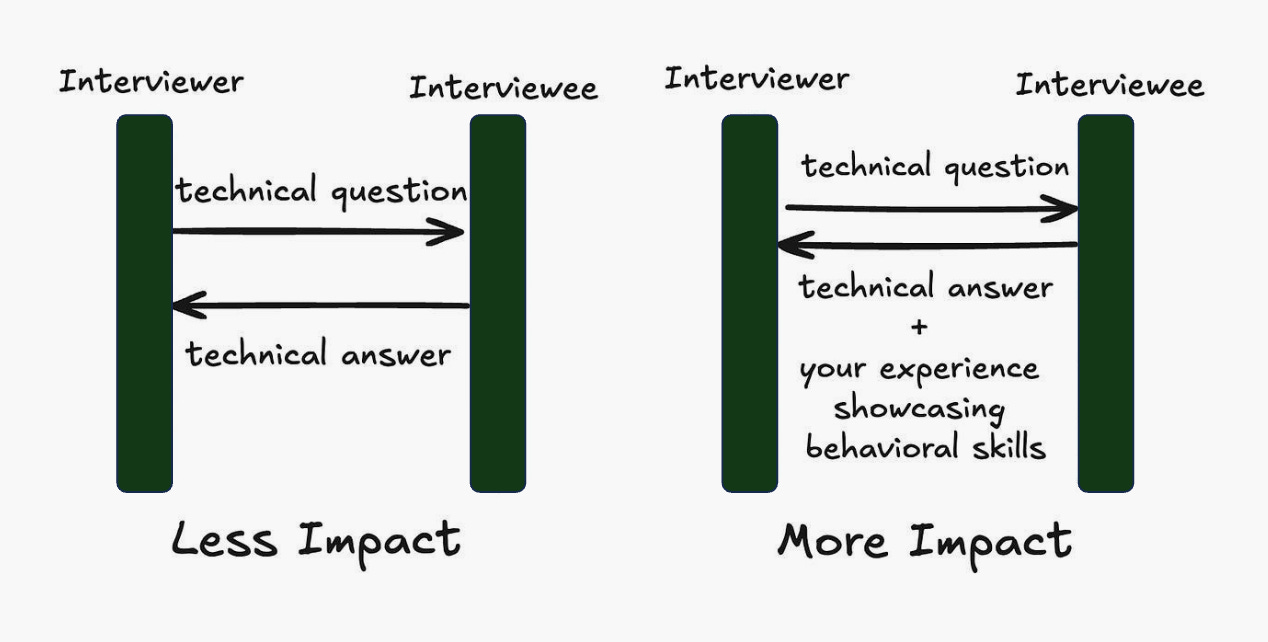
When answering pure technical questions, if possible, extend with one of the following:
Your work experience of when you have tackled that technical scenario
If you do not have direct experience, talk about how you have learned about it or how you would approach it
Put simply, do not stop at just answering the technical question.
Add your authentic experience to stand out.
Let me start this section with a personal anecdote.
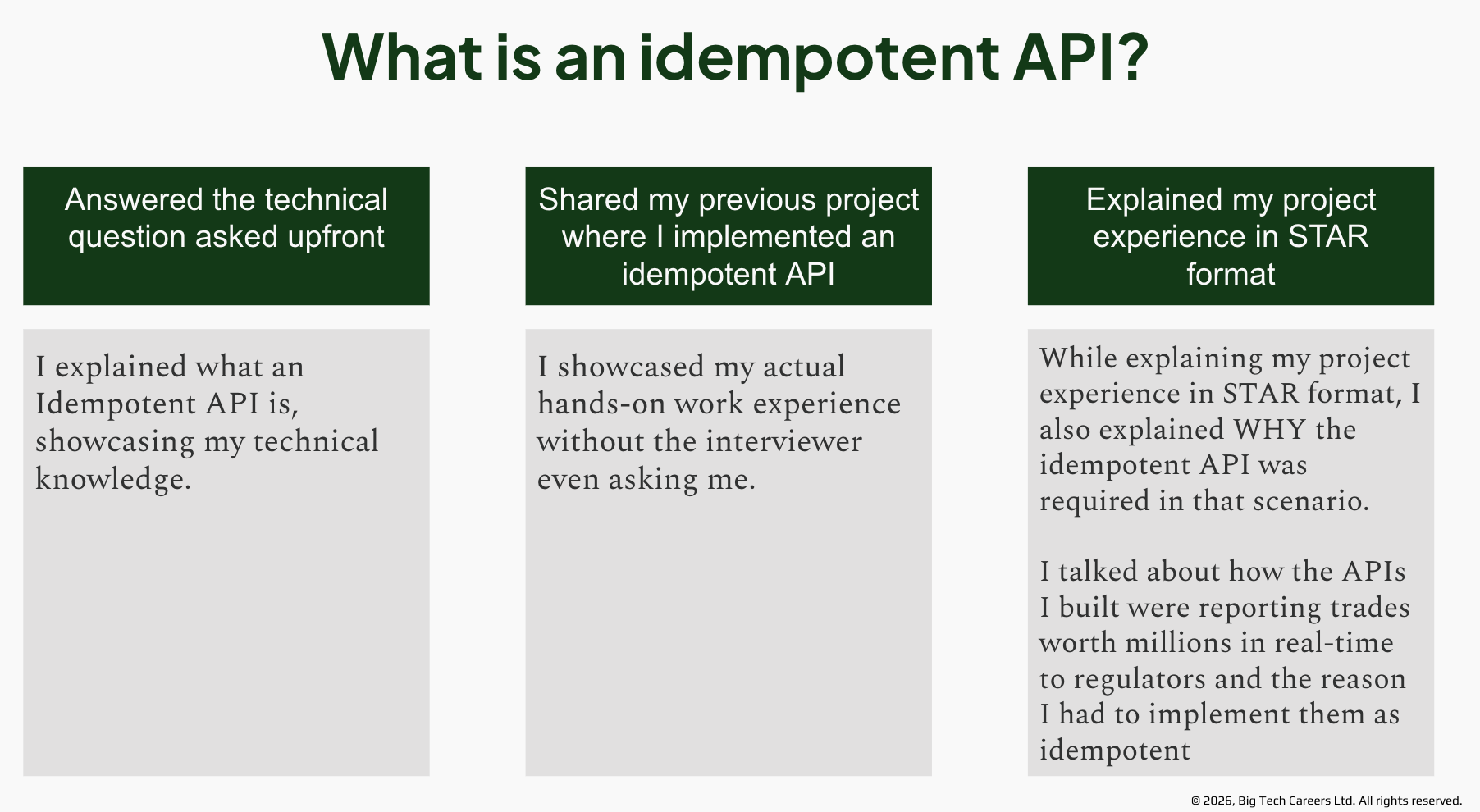
In one of my technical interview I was asked, “What is an Idempotent API?”
My response was in 3 steps:
Answered the technical question asked upfront
I explained what an Idempotent API is, showcasing my technical knowledge.
Shared my previous project where I implemented an idempotent API
I showcased my actual hands-on work experience without the interviewer even asking me.
Explained my project experience in STAR format
While explaining my project experience in STAR format, I also explained WHY the idempotent API was required in that scenario. I talked about how the APIs I built were reporting trades worth millions in real-time to regulators and the reason I had to implement them as idempotent.
This is where I showcased my behavioral skills. I demonstrated I understand the business impact of the technical solutions I build.
This article is based on a lesson from the course Ace Your Big Tech Interviews with Proven Strategies, which focuses on mastering the art of behavioral storytelling and effective communication for interviews with MAANG+ companies.
The Problem with Pure Technical Answers
Many candidates show off their technical knowledge in technical interviews, and most get the technical answers right.
Let’s say 10 people interview:
7 of them answered the technical questions correctly. You’re one of those 7. So why should the interviewer pick you?
You need to stand out.
How? By sharing your real-world experience and behavioral skills.
While technical answers showcase that you have knowledge, they don’t paint a complete picture of your ability to succeed in a role.
For example, all engineers know what an idempotent API is. But how many can connect it to their experience in an interview and share real-world examples to boost the interviewer’s confidence in their skills? You stand out from other candidates by showing your experience and behavioral skills while you answer technical questions.
This also ensures that your interviewer does not downlevel you.
Let’s look at a couple of common technical questions…
I’ll show you how to answer them in a way that also shows off your behavioral skills and experience.
Question: “What are microservices, and what are their advantages and disadvantages?”
Purely Technical Approach
“Microservices are an architectural style where an application is built as a collection of small, independent services. The advantages include scalability, flexibility, and easier maintenance. Disadvantages include increased complexity and potential performance overhead due to network communication.”
(This is just an example. You’ll have your own version of a technical answer with much more depth to it!)
Behavioral Skills Showcase Approach
After you provide the technical answer, add your personal experience to it.
“In fact, in one of my previous projects when I was consulting for a manufacturing company in 2022, I led a team that modernized our e-commerce platform by transitioning from a monolith to microservices.
We decided to make this shift because our monolithic application was becoming increasingly difficult to maintain and scale. For instance, deploying even small changes required testing the entire application, leading to a release cycle of 6 weeks.
To begin the transition, I initiated and facilitated an event storming session with stakeholders from development, operations, and business teams. This collaborative approach helped us identify natural service boundaries and ensured buy-in from all departments.
We started by extracting the product catalog service, as it was relatively self-contained. We faced several challenges, such as increased operational complexity and data consistency issues. I saw these as opportunities for the team to learn and grow. We invested time in upskilling, bringing in external experts for workshops on distributed systems and organizing internal knowledge-sharing sessions.
I’m happy to dive deep more into my experience. I’ve seen firsthand in this project the advantages of microservices and the challenges that come along with it.”
This response not only demonstrates technical knowledge but also showcases your experience and several behavioral skills:
Leadership: Leading the modernization project
Communication: Facilitating sessions with various stakeholders
Problem-solving: Addressing challenges that arose during the transition
Learning mindset and adaptability: Learning and applying new technologies
Now, let’s look into another question.
Question: “What factors would you consider when choosing between SQL and NoSQL databases?”
Purely Technical Approach:
“When choosing between SQL and NoSQL databases, several factors come into play.
Data structures are a primary consideration, with SQL being ideal for structured, relational data, while NoSQL is better suited for unstructured or semi-structured data.
Scalability needs often favor NoSQL, which typically scales horizontally more easily.
SQL databases offer stronger ACID compliance and excel at complex queries involving joins and transactions. However, NoSQL databases provide greater schema flexibility, allowing for more dynamic data models.
Performance requirements are also crucial, as NoSQL can offer faster read/write speeds for certain use cases.
Data consistency needs should be evaluated, with SQL providing immediate consistency and some NoSQL databases offering eventual consistency.
The choice ultimately depends on the specific requirements and constraints of the project at hand.”
This is a good answer and will probably make the cut. But as I mentioned, most candidates will be able to provide this level of answer. You need to strive to go above and beyond.
Behavioral Skills Showcase Approach:
I understand you cannot have work experience for every technical question asked in an interview. And that is absolutely fine. Complement the technical answer above with how you would approach such a scenario.
“To understand the requirements and constraints, I would organize a requirements gathering session with various stakeholders like the development team, product managers and, if possible, end-users. During this session, I would ask key questions such as:
How structured is the data? Do we need a fixed schema or flexibility for evolving structures?
What are our scalability requirements? What are the expected read/write ratios?
Do we need strong consistency for all operations, or is eventual consistency acceptable for some data?
What are our typical query patterns? Do we need complex joins and transactions?
How frequently will our data model change?
Once we have these answers, I would analyze them in the context of ACID (Atomicity, Consistency, Isolation, Durability) properties typically associated with SQL databases, and BASE (Basically Available, Soft state, Eventually consistent) properties often seen in NoSQL systems.
I would also consider the CAP theorem (Consistency, Availability, Partition tolerance) which states that in a distributed system, you can only have two of these three guarantees.
And most modern systems often benefit from a polyglot persistence approach, using different databases for different purposes within the same application.
For example:
PostgreSQL for user accounts and financial transactions, where ACID properties were crucial. MongoDB for storing product catalogs with varying attributes. Redis for caching and real-time analytics
This decision cannot be made in isolation. I would consider trade-offs of each approach, challenge assumptions and provide alternative viewpoints.”
This response shows several behavioral skills:
Analytical thinking: Systematically considering various factors
Stakeholder management: Involving different teams in the decision-making process
Communication: Organizing and facilitating requirements gathering and review sessions
Decision-making: Weighing pros and cons to arrive at a solution
By answering technical questions in a way that showcases both your technical knowledge and behavioral skills, you present yourself as a well-rounded candidate who can not only do the job but also work effectively within a team and contribute to the company culture.
Companies are looking for more than just technical expertise. They want employees who can communicate effectively, work collaboratively, adapt to changing circumstances, and drive innovation.
So, as you prepare for your next technical interview, reflect not just on your technical accomplishments, but also on how you’ve demonstrated these crucial behavioral skills in your work.
Quick Recap
By answering technical questions in a way that showcases both your technical knowledge and behavioral skills, you present yourself as a well-rounded candidate who can not only do the job but also work effectively within a team and contribute to the company culture.
Go Beyond Technical Knowledge: While answering technical questions correctly is important, it’s often not enough to stand out among other qualified candidates.
Showcase Real-World Experience: After providing a technical answer, share relevant work experiences or projects where you’ve applied this knowledge.
Demonstrate Behavioral Skills: Use your answers to highlight important soft skills such as leadership, communication, problem-solving, and adaptability.
Connect Technical Solutions to Business Impact: Show that you understand how your technical decisions and implementations affect the broader business goals.
Approach Hypothetical Scenarios Comprehensively: Even if you lack direct experience, explain how you would approach a problem, considering stakeholders, requirements gathering, and decision-making processes.
Show Depth of Understanding: Discuss trade-offs, alternative approaches, and industry best practices to demonstrate a thorough grasp of the subject matter.
Companies are looking for more than just technical expertise. They want employees who can communicate effectively, work collaboratively, adapt to changing circumstances, and drive innovation.
So, as you prepare for your next technical interview, reflect not just on your technical accomplishments, but also on how you’ve demonstrated these crucial behavioral skills in your work.
If you found these insights valuable, you might benefit from the complete interview preparation system in my course Ace Your Big Tech Interviews with Proven Strategies. The course expands on these concepts with detailed frameworks for crafting compelling technical stories, mastering the STAR format, and communicating leadership experiences effectively. It includes practical exercises, real-world examples, and strategies specifically designed for securing roles at Big Tech companies. For more details, explore the full curriculum.
Have questions? Send email at info@bigtechcareers.com