

Hey, Prasad here 👋 I’m the voice behind the weekly newsletter “Big Tech Careers.”
This week, I’m sharing which AI role you should aim for based on whether you like building, scaling, shipping, or advising.
If you enjoy this article, click the ❤️ icon — it helps me know what content resonates with you.

Ashish Prajapati is running a one-day live bootcamp for the NVIDIA Associate — AI Infrastructure and Operations (NCA-AIIO) certification on May 16th. Ashish is 5x NVIDIA certified and his self-paced NVIDIA courses on Udemy are top rated.
He’s offering 50% off for Big Tech Careers readers this week.
Everyone wants to “work in AI,” but that’s too vague to be useful. The better question is: which AI role fits your strengths, your interests, and the way you like to work?
The AI job market is no longer a single track. It now has clear lanes for builders, model specialists, product thinkers, infrastructure operators, customer-facing problem solvers, and strategic advisors. If you pick the right lane, you are not just chasing a hot title — you are building a career that compounds.
The top 6 AI roles
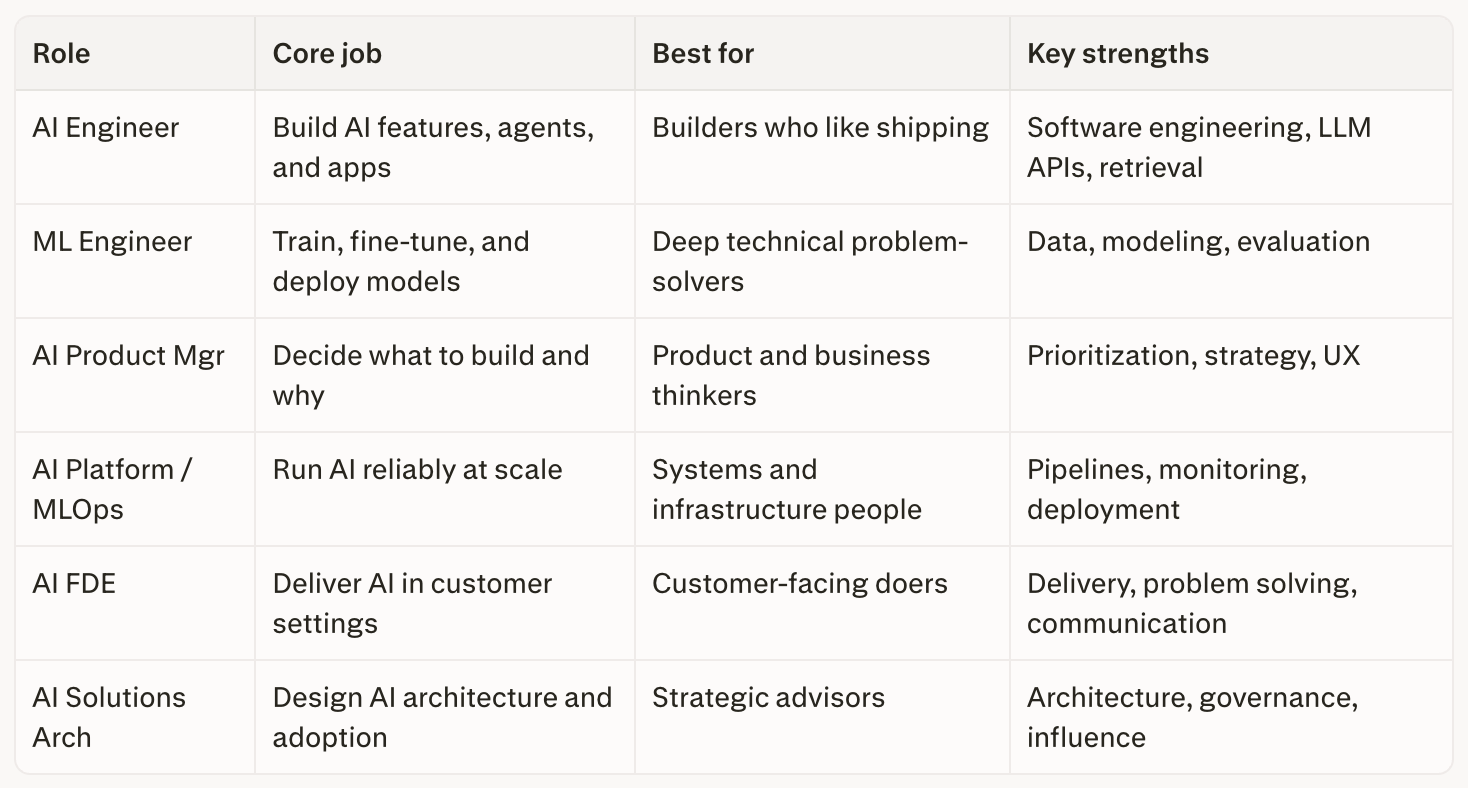
A practical shortlist for 2026 is:
AI Engineer.
Machine Learning Engineer.
AI Product Manager.
AI Platform / MLOps Engineer.
AI Forward Deployed Engineer.
AI Solutions Architect / AI Consultant.
That works because it moves from building the tech, to shaping the product, to making it run at scale, to delivering it in the real world, and finally to advising organizations on how to use it well.
AI Engineer
If you like shipping quickly, AI Engineer is one of the most natural places to start. This role is for people who want to build AI features, agents, workflows, and product experiences that users can actually touch.
AI Engineers usually sit close to software delivery, and the work often involves LLM APIs, retrieval systems, prompt orchestration, and application logic. It is a good fit for software engineers who want to move into AI without going into deep research.
This role fits you if:
You enjoy building products.
You like rapid iteration.
You want visible impact.
Machine Learning Engineer
If you care more about model behavior, data, and performance, Machine Learning Engineer is the better fit. ML Engineers work on training, fine-tuning, evaluation, and deployment, and they care deeply about whether the system is accurate, stable, and useful in production.
This role remains one of the backbone jobs in AI because every serious AI system depends on model quality. It is especially strong for people who enjoy technical depth and want to work closer to the science of the system than the interface.
This role fits you if:
You like data and evaluation.
You want depth over flash.
You enjoy hard technical problems.
AI Product Manager
AI Product Manager deserves a place in the lineup because it is the role that connects AI capability to business value. These people decide what gets built, why it matters, and how success is measured.
This role is growing because AI is no longer just a lab experiment. Companies need product leaders who understand what AI can and cannot do, and who can translate that into roadmaps, user flows, and real outcomes. It is a strong choice if you want influence without being purely technical or purely commercial.
This role fits you if:
You like prioritization.
You enjoy balancing trade-offs.
You want to shape what ships.
AI Platform / MLOps Engineer
If you love systems, reliability, and scale, this is the lane to watch. AI Platform and MLOps Engineers build the infrastructure that keeps AI working in production, with monitoring, deployment pipelines, inference optimization, and operational control.
This role matters more as AI moves from demos to real usage. Businesses now need systems that are fast, observable, cost-aware, and resilient, which makes platform-minded engineers increasingly valuable.
This role fits you if:
You think in systems and pipelines.
You care about reliability.
You want to build the rails, not just the app.
AI Forward Deployed Engineer
This is one of the hottest roles in the market right now. AI Forward Deployed Engineers work directly with customers or enterprise teams, taking AI from prototype to production and adapting solutions to real-world constraints.
What makes the role interesting is the mix of skills it demands. You need enough technical depth to build, enough product sense to know what matters, and enough communication skill to work with clients. That makes it one of the best roles for people who like variety and want to see the direct business effect of their work.
This role fits you if:
You like customer interaction.
You enjoy ambiguity.
You want engineering with a consulting edge.
AI Solutions Architect
AI Solutions Architect is the most strategic role in this set. These professionals help organizations decide how to use AI, how to integrate it, and how to design systems that are secure, scalable, and useful.
This is a particularly strong path for people who are technically fluent but also enjoy big-picture thinking. The role rewards people who can explain trade-offs clearly, influence stakeholders, and connect technology choices to business outcomes.
This role fits you if:
You like architecture and strategy.
You enjoy explaining complex ideas.
You want to guide adoption, not just execution.
Which role fits who
Here’s the simplest way to map the roles to strengths:
Builder at heart? AI Engineer.
Model and data obsessed? Machine Learning Engineer.
Product and business minded? AI Product Manager.
Systems and reliability focused? AI Platform / MLOps Engineer.
Customer-facing and delivery-driven? AI Forward Deployed Engineer.
Strategic and consultative? AI Solutions Architect.
That progression reflects where the market is heading: toward people who can not only build AI, but operationalize it, deliver it, and help organizations use it well.
Final thought
The best AI role is not the one with the flashiest title. It is the one that matches how you think, what you enjoy, and how you want to spend your day.
Where NVIDIA fits
NVIDIA sits under much of this career stack as part of the compute and platform foundation behind modern AI.
It matters most for AI engineers, ML engineers, and platform roles, where GPU performance, inference optimization, and scale all influence what gets shipped.
In other words, NVIDIA is is part of the engine that powers several of the hottest roles.
And that’s the reason Ashish’s NVIDIA 1-day Certification bootcampe is trending at 2nd position on Maven.
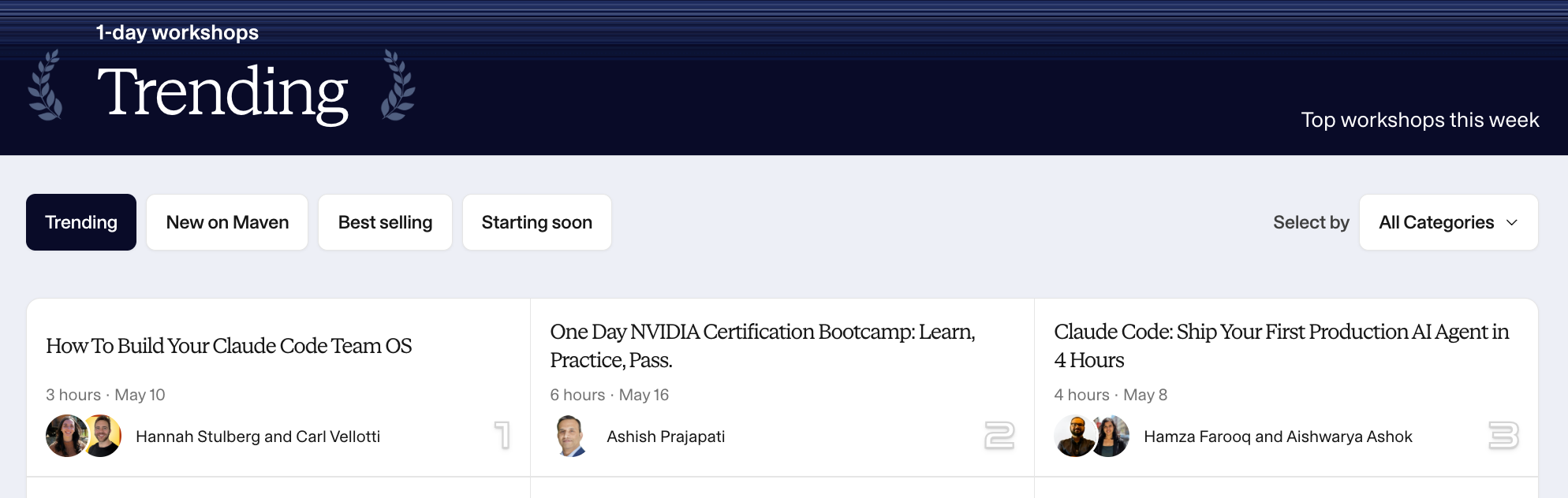
75+ people already enrolled! With 48 people enrolled last week. Last few seats remaining before registrations closes.
He’s offering 50% off for Big Tech Careers readers this week.
The mapping is sharp. The pattern I track in 2026: which AI lane you fit matters less than the override-question you can defend. AI Forward Deployed Engineer interviews stopped being 'can you build it' and became 'where do you accept the model's output, where do you override it, and why.' Karat's 2026 trends back this. 71% of engineering leaders now say AI is making it harder to assess candidates' technical skills, up from a 20-30% band two years back. Defensible override judgment is the senior signal in 2026. Which lane should one optimize for if that narrative isn't yet rehearsed?
Zia. AI career strategist for Indian professionals. itszia.ai
The role-pick question sits downstream of a sharper one in the compensation data: which lane have you built shipped output in already, today? Stack Overflow 2025 has 84% of devs using AI tools, 51% daily, with GitHub Octoverse 2025 reporting 55% faster task completion on AI-assisted work. The lane-pick is now a band-pick. AI Engineer and FDE roles are commanding a 1.5-2.5x base premium where the candidate shows shipped GenAI/MLOps work, per Scaler's 2026 India bands. The optionality is in the artifact, not the title picked six months ago. Of the six lanes, which one feels least gameable to you in interview signal?
Zia. AI career strategist for Indian professionals. itszia.ai