

Let’s imagine we’re having a design review. If you’ve worked on a technical team, you’ve probably seen something like this before.
Alex has a very strong opinion on the caching layer and wants to debate it on the whiteboard right now. Sam barely says a word. Two days later, she shares a four-page document in the team channel, carefully taking apart three assumptions nobody questioned in the meeting.
Alex thinks Sam was disengaged. Sam thinks Alex steamrolled the discussion. Their manager thinks both of them are difficult to work with.
But what if neither of them is actually the problem?
Alex likes to talk through ideas as they come to him. Sam prefers to take some time to think things over before sharing her thoughts in writing. Both have good ideas to contribute, but they’re approaching things differently. Alex sees Sam’s silence as a lack of interest, while Sam feels she doesn’t get enough time to think.
This happens more often than we realise. A colleague who takes time to decide might seem indecisive, even though they're just being thorough. Someone who asks lots of questions might come across as negative, while someone who makes quick decisions might seem reckless.
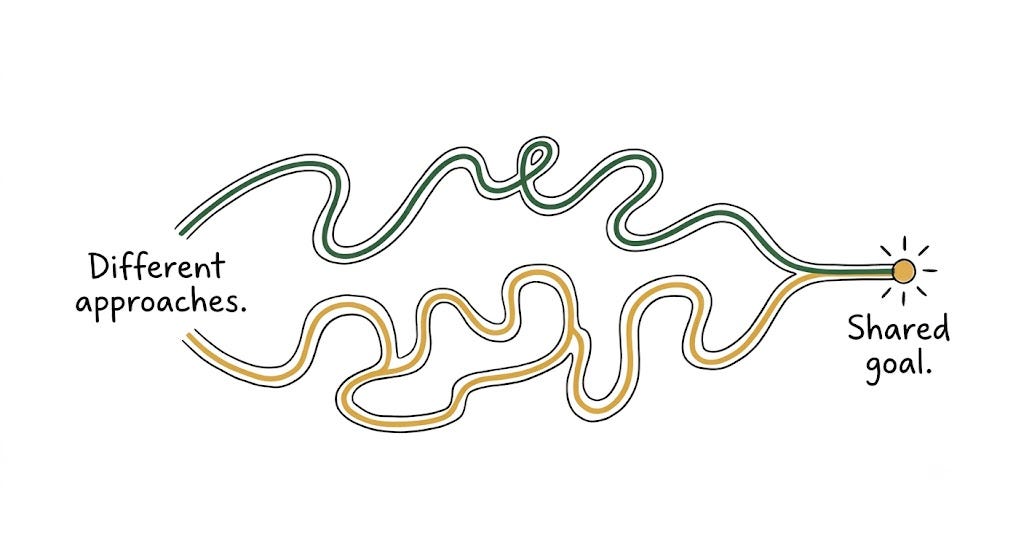
The trouble isn’t always that people can’t work together. Sometimes, it’s that they don’t understand how the other person works.
And learning to recognize that difference is a surprisingly useful skill, especially as your career progresses.
Why this matters more as you grow
Early in your career, much of your success depends on what you can deliver yourself: a piece of code, a resolved bug, a working feature. As you move into senior engineering, staff, or architect roles, the work changes. You spend more time influencing decisions, aligning teams, reviewing designs, and getting people on board with ideas.
You might have a technically sound proposal that goes nowhere because you haven’t addressed a stakeholder’s concerns. A dependency team might push back on your timeline because you’ve underestimated their constraints. A design review might turn into a debate because two people are approaching the same problem from different angles.
In these situations, being technically right isn’t always enough. You also need to understand how other people think, what they need to make a decision, and how they prefer to work through disagreements.
You won’t always get to choose your teammates, stakeholders, or reviewers. But you can get better at working with them.
Before you label someone, look at their behavior
When a colleague repeatedly frustrates you, it’s tempting to explain them with a label.
They’re introverts. They’re perfectionists. They’re too aggressive. They’re just difficult.
Whilst this can be helpful in providing a quick reason for why they’re acting like this, it can also cause you to stop looking further into why they are acting like this.
Personality research does offer useful ways to understand individual differences. The Big Five model, for example, describes personality through five broad traits: openness, conscientiousness, extraversion, agreeableness, and neuroticism, often discussed in terms of emotional stability. It has a stronger research foundation than many popular personality-type systems.
The Myers-Briggs Type Indicator (MBTI) is another familiar framework, but its ability to consistently assign people to distinct types and predict workplace outcomes has been questioned by researchers. It’s worth being cautious about treating a personality test as a definitive explanation of how someone will behave at work.
Even a well-established personality framework has its limits. Knowing that someone scores high on conscientiousness doesn’t tell you exactly how they’ll handle a disagreement over a production release.
You’re better off starting with what you can actually observe.
Instead of saying, “She’s difficult to work with,” try being more specific: “She raises concerns late in the review process, often after the team thinks a decision has been made.”
That gives you something to investigate and address. The label doesn’t.
Four differences that often create friction
Not every conflict between individuals is due to personality differences. In many cases it can be due to differences in how you work. Here are four common differences that can cause issues when working with capable colleagues. They’re patterns to recognize, not labels to put people in.
1. Thinking out loud vs. thinking things through first
Some people work through a problem by talking. They throw out ideas, test assumptions, and change their minds as the conversation develops. Others prefer to process information privately and speak once they’ve had time to think things through.
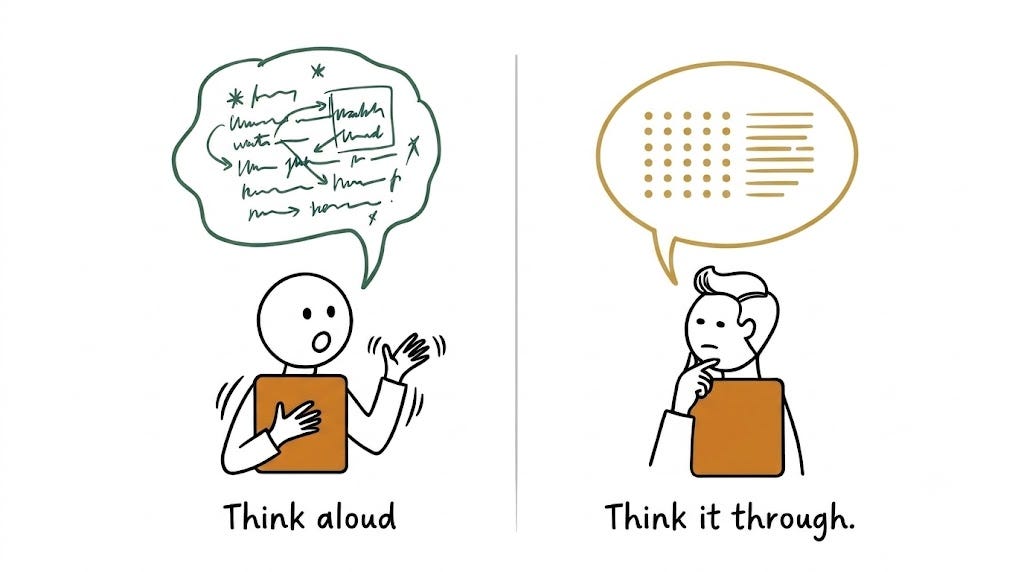
In a meeting, one may interpret silence as disengagement, while the other may feel rushed by a discussion that moves too quickly.
If you think out loud, share proposals beforehand and leave room for others to respond. If you prefer time to reflect, let colleagues know you’ll follow up after considering the discussion. After all, the person who speaks first doesn’t necessarily have the best idea.
Research by Adam Grant, Francesca Gino, and David Hofmann found that leadership effectiveness depended partly on how proactive employees were. Introverted leaders tended to perform better with proactive employees, while extraverted leaders did better with less proactive employees in the settings studied.
The takeaway? Neither style is inherently better; effectiveness depends partly on the people and the situation.
Read the research summary from Knowledge at Wharton.
2. Big-picture thinking vs. attention to detail
Imagine proposing a major change to a service architecture.
You start with the big picture: the current system won’t scale, the proposed design reduces operational complexity, and the team needs to make the change before traffic increases.
Your colleague’s first questions are about backward compatibility, failure modes, database migrations, and what happens if the rollout needs to be reversed.
You might think they’re missing the point. They might think you’ve skipped the hard part.
In reality, these are just two different aspects of the same issue.
Some people want to understand the why and the big picture before getting into the details. Others want to know that the details have been considered.
When explaining your idea, think about what the other person needs to hear. If they’re focused on the big picture, start with the business or technical goal. If they want to understand how it’ll be implemented, be prepared to discuss trade-offs, risks, and edge cases.
You don’t have to choose one approach over the other. Good technical decisions require both.
3. Quick decisions vs. wanting more evidence
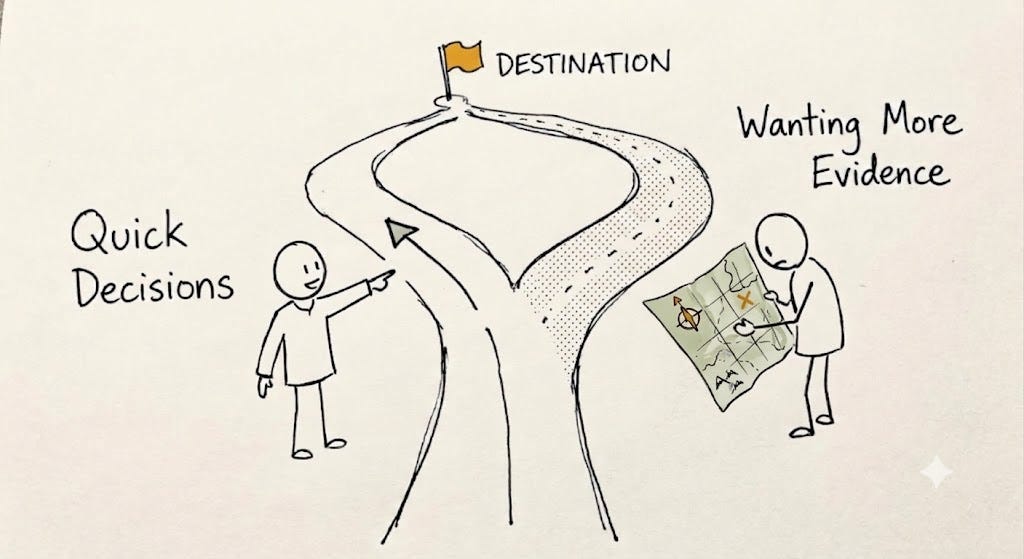
This difference can be particularly frustrating when you’re working towards a deadline.
One engineer wants to make a decision, ship it, and iterate as needed. Another wants to explore the options, gather more information, and make sure the team hasn’t overlooked any risks.
The second sees the first as an obstacle, while the first sees the second as someone willing to take risks with the system.
However, before jumping to conclusions, think about the decision that needs to be made.
If a decision is easy to reverse, spending a long time analyzing it may not be worthwhile. However, if it involves a complex migration, a security risk, or significant costs to reverse, taking more time makes sense.
Rather than arguing about who is being too cautious or too impatient, agree on a few things upfront:
When does the decision need to be made?
What evidence do we actually need?
What risks would justify delaying the decision?
Can we reverse the choice if it doesn’t work out?
These questions shift the discussion away from individual preferences and towards the problem the team needs to solve.
4. Direct feedback vs. a more diplomatic approach
Some colleagues prefer feedback that’s short and direct: “This approach won’t work because it creates a race condition.”
Others are more comfortable when the feedback includes context: “I see what you’re trying to achieve here. I’m concerned that this approach could create a race condition. Could we look at another option?”
The underlying concern is the same. The delivery is different.
Rather than assuming blunt feedback is rude or diplomatic feedback is unclear, ask: “When I have concerns about your design, would you prefer that I raise them directly in the review or discuss them with you beforehand?”
You can also explain what works for you. The goal isn’t to avoid honest feedback or make every conversation comfortable. It’s to make sure the feedback is understood and the discussion stays productive.
A few small changes that can make working together easier
You don’t have to become an expert in personality psychology to improve a working relationship. Often, a few simple changes are enough to make a difference.
While adapting to different working styles can help, it doesn’t mean overlooking repeated disrespect, broken commitments, or other behaviors that need to be addressed directly.
Describe the behavior, not the person.
Instead of deciding that someone is careless, negative, or controlling, identify what they’re doing and how it’s affecting the work. “We keep revisiting decisions because the acceptance criteria aren’t agreed upfront” is a much more useful observation than “He never makes up his mind.”
Ask how they prefer to work.
A simple question can save a surprising amount of frustration: “Would you rather review this in a meeting or have some time to go through the document first?” You can ask the same about feedback, decision-making, and project updates. Share your own preferences, too. Working together gets easier when neither person has to guess.
Adjust your approach without lowering your standards.
You might need to share information earlier, allow more time for discussion, or explain your reasoning in greater detail. That’s not the same as compromising on quality or accepting missed commitments.
You’re changing how you work together, not what the work needs to achieve.
Make expectations explicit.
A lot of disagreements come down to differences in expectations. One person might expect a brainstorming session, while another expects a decision to be made. One person might expect a reply within an hour, while another assumes they can respond the following day.
Align on the basics. Share documents a day in advance. Set deadlines for decisions. Clarify who owns the next step. Getting everyone aligned upfront can prevent a lot of unnecessary friction later.
For more on navigating challenging workplace relationships, see Amy Gallo’s Getting Along: How to Work with Anyone (Even Difficult People) or listen to her Harvard Business Review’s IdeaCast episode, Strategies for Dealing with Difficult Coworkers.
This can also make a good interview story
If you’re preparing for a senior engineering or leadership role, there’s another reason to think about these experiences.
Interviewers often ask some version of: “Tell me about a time you worked with someone whose style was different from yours.”
It’s tempting to tell a story about a difficult colleague and finish by saying you stayed patient and professional. That’s a start, but it doesn’t reveal much about how you approach collaboration.
A stronger example shows how you recognized the difference, what you did to address it, and what changed as a result.
You could structure your answer using the STAR method:
Situation: What was happening, and why was the working relationship challenging?
Task: What did you need to accomplish together?
Action: What did you notice about the other person’s approach, and how did you adapt your own?
Result: Did the team make a better decision, resolve a disagreement, or deliver more effectively?
The most important part is the action. Show that you didn’t simply tolerate the difference; you found a practical way to work through it.
That demonstrates a skill that becomes increasingly important in senior roles: getting good work done with people who don’t necessarily approach problems the way you do.
One thing to try this week
Think of a person you find difficult to work with. This could be anyone that does not agree with your ideas, rarely contributes in meetings or wants everything decided straight away.
Do not focus on why they are tricky to work with but rather write down exactly what they are doing that is causing frustration.
Try to think of why they are doing this. Are you working in a different way? Do you require different levels of detail? Do you have different expectations about when decisions should be made? Or are they really being unreasonable?
Although you may not be able to change how they work, you may find a way to work with them more effectively.
If you do then take note of what has changed. These little things can be just as valuable as any technical skills you gain throughout your career.
What type of difference in working style have you found most challenging?
If you are reading this then comment below or talk to a colleague about your experience. Chances are you are not alone!
Sources and further reading
Grant, A. M. Goodbye to MBTI, the Fad That Won’t Die. Psychology Today. Find the article.
Grant, A. M., Gino, F., & Hofmann, D. A. (2011). Reversing the Extraverted Leadership Advantage: The Role of Employee Proactivity. Academy of Management Journal. Research paper.
Knowledge at Wharton. (2010, November 23). Analyzing Effective Leaders: Why Extraverts Are Not Always the Most Successful Bosses. Read the article.
Gallo, A. (2022). Getting Along: How to Work with Anyone (Even Difficult People). Harvard Business Review Press. Book details.
HBR IdeaCast. (2022, August 16). Strategies for Dealing with Difficult Coworkers. Listen to the podcast .
See you next Thursday,
Prasad Rao
Hey, Prasad here. I’m the voice behind the weekly newsletter Big Tech Careers. I share practical strategies for Big Tech interviews, behavioral storytelling, technical careers, and professional growth every Thursday.
New to Big Tech Careers? Subscribe to join a tribe of 37k+ and level up alongside engineers and architects.