

Hey, Prasad here 👋 I’m the voice behind the weekly newsletter “Big Tech Careers.”
In this week’s article, I cover the new Claude certification announcements. Anthropic just went from one Claude certification to four.
If you like the article, click the ❤️ icon. That helps me know you enjoy reading my content.
If you’ve been building a career around Claude, AWS, or the wider AI ecosystem, this is a moment worth paying attention to. A single certification turning into a full certification track is a strong signal that Anthropic is serious about building a professional ecosystem around Claude, the same way AWS, Google Cloud, and Azure did with their own cloud certifications.
I passed the original certification, Claude Certified Architect – Foundations (CCA-F), back before this expansion. If you want the full story on how I prepared and what the exam covered, I wrote about it here: How I Passed the Claude Architect Certification.
Today I want to walk through what’s new, why it matters, and which certification actually fits your role.
From one certification to a full track
Until now, there was exactly one Claude certification available: CCA-F. It launched as Anthropic’s first official credential, built for solution architects designing and shipping production Claude applications.
Anthropic has now expanded that into four certifications spanning three roles: Associate, Developer, and Architect.
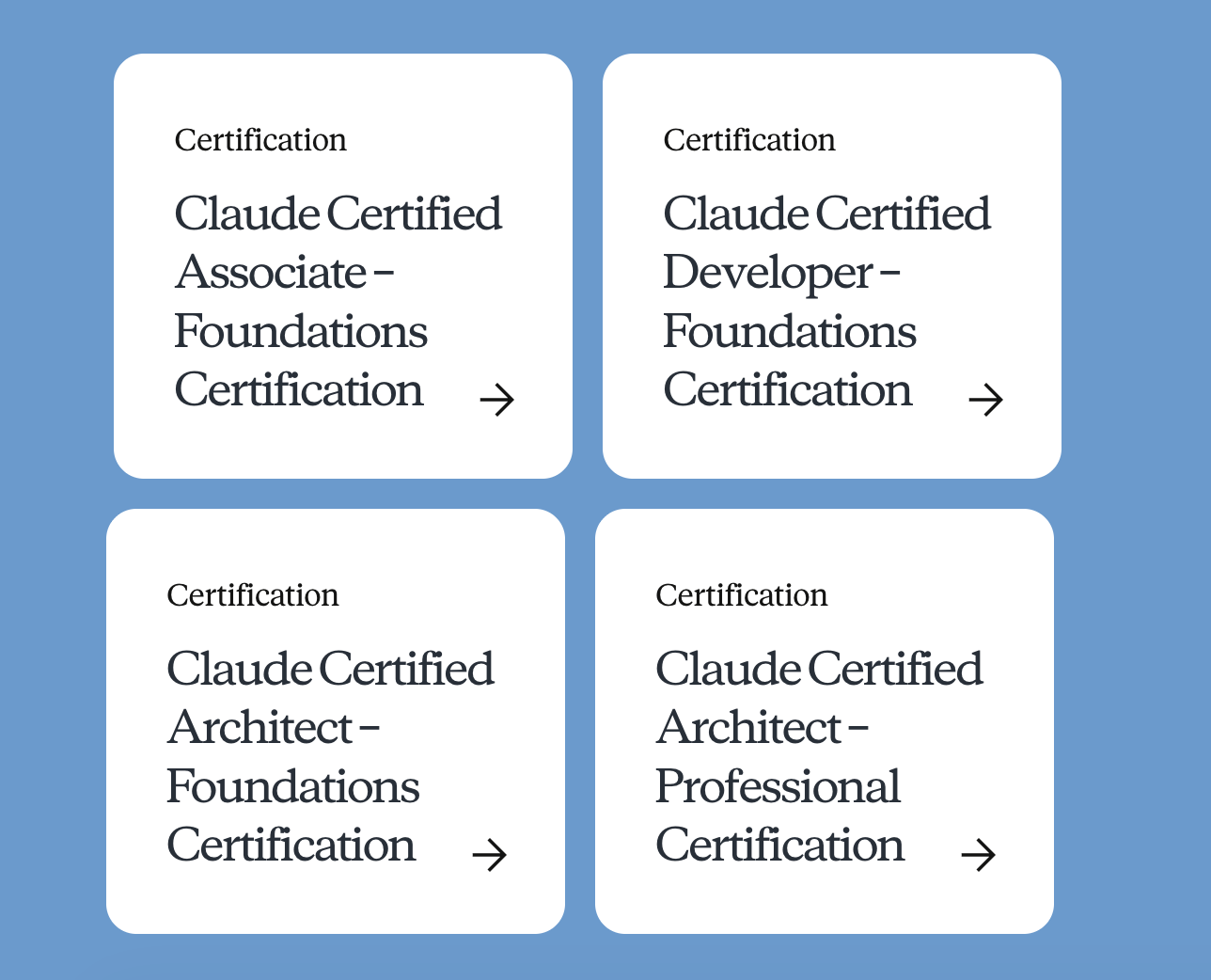
Architect has two levels, Foundations and Professional, so it becomes a proper ladder rather than a single checkpoint.
Here’s the full lineup:
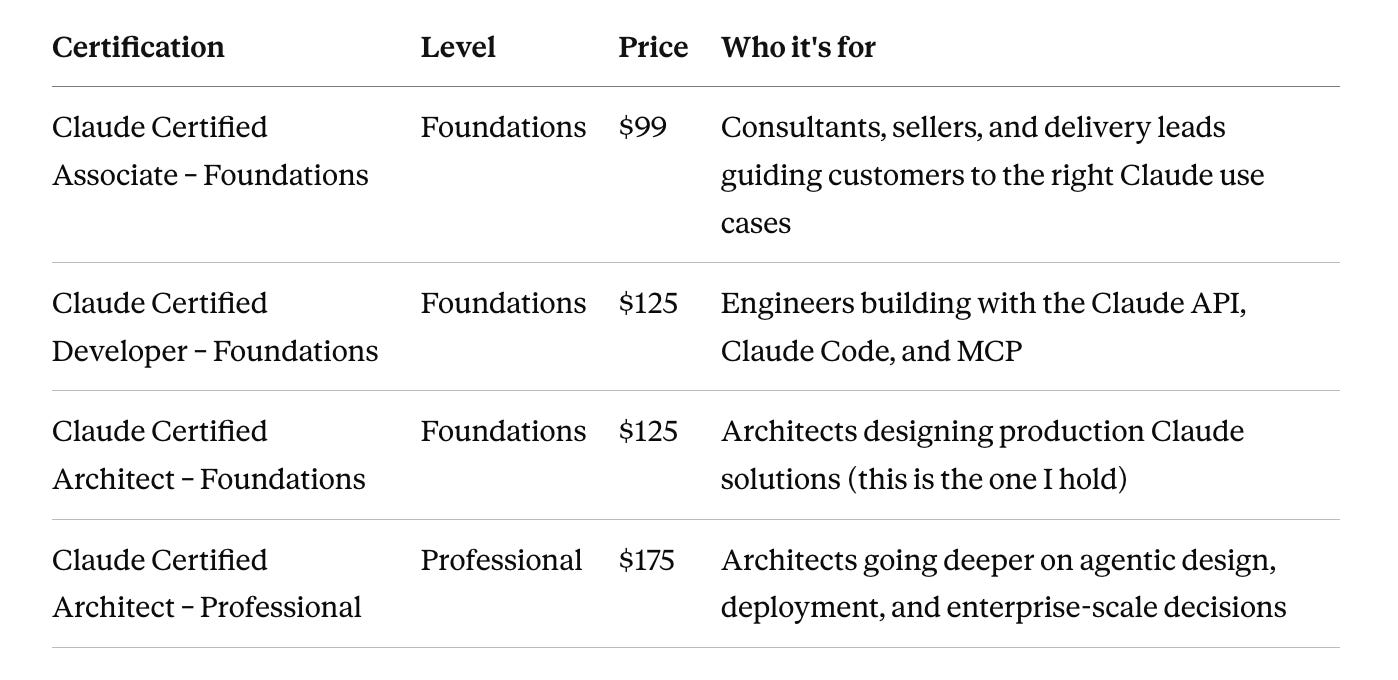
The new exams open on July 13th.
The 3 new certifications, broken down
I pulled the actual exam guides for all three new certifications, so here’s the real detail on format, domains, and who each one is built for, not just the marketing copy.
1. Claude Certified Associate – Foundations ($99, exam code CCAO-F)
This one is aimed at people who advise rather than build. It validates that someone can apply Claude to business and productivity tasks with minimal guidance, using built-in platform features to streamline workflows, and knowing when to escalate technical work to a Developer or Architect. Anthropic is explicit that this is not for software developers or people building agentic systems. It’s built for operations, marketing, project management, education, and communications roles, plus consultants who support implementation and use-case identification.
Format: 60 questions, 120 minutes, passing score of 720 out of 1,000. No mandatory prerequisites.
The exam blueprint breaks down into seven domains:
Output Evaluation and Validation (21%) — the single biggest domain. Catching hallucinations, fact-checking, and knowing when human review is required
Workflow Integration and Solution Design (16%)
Governance, Risk, and Responsible Use (15%) — data sensitivity, organizational AI policy, ethical use
Prompting and Task Execution (14%)
Product and Model Selection (12%) — knowing when to reach for Haiku vs. Sonnet vs. Opus
Configuration and Knowledge Management (12%) — Projects, connectors, system instructions
Troubleshooting and Optimization (10%)
2. Claude Certified Developer – Foundations ($125, exam code CCDV-F)
This is the hands-on builder certification. It validates that someone can build, integrate, and ship production-grade applications, agents, and workflows using Claude at a foundational level. Anthropic recommends one to five years of software engineering experience and at least six months hands-on with Claude or a comparable LLM system, plus proficiency in Python and/or TypeScript.
Format: 53 questions, 120 minutes, passing score of 720 out of 1,000.
Eight domains, and the weighting tells you exactly where Anthropic thinks the real skill gap is:
Applications and Integration (33.1%) — by far the largest domain, covering Claude API mechanics, software engineering foundations, application design across interfaces, and configuration management
Model Selection and Optimization (16.8%) — LLM fundamentals, cost and token management, caching
Agents and Workflows (14.7%) — agent architecture, construction with the Claude Agent SDK, agentic frameworks like LangGraph and PydanticAI
Prompt and Context Engineering (11.0%)
Tools and MCPs (10.6%) — building custom tools, MCP servers, weighing built-in tools vs. custom tools vs. Skills vs. MCPs
Security and Safety (8.1%) — prompt injection defense, guardrails, hooks, secrets management
Claude Code (3.1%)
Eval, Testing, and Debugging (2.6%)
3. Claude Certified Architect – Foundations ($125, exam code CCAR-F) — the one I hold
This is where I started. It validates that practitioners can make informed decisions about tradeoffs when implementing real-world solutions with Claude. The exam tests foundational knowledge across Claude Code, the Claude Agent SDK, the Claude API, and MCP, the core technologies behind production-grade Claude applications. Anthropic recommends 6+ months of hands-on experience building with these tools.
Format: 60 questions, 120 minutes, closed-book and proctored. You’re presented with 4 of 6 possible scenario contexts, randomly selected, and answer scenario-based questions grounded in each one. It’s not a trivia exam. You’re making architectural decisions about multi-agent systems, debugging tool selection issues, and deciding when a support agent should escalate to a human versus handle something autonomously.
Five domains:
Agentic Architecture & Orchestration (27%) — the single largest domain. Agentic loops, multi-agent coordinator-subagent patterns, session state management, task decomposition, hub-and-spoke orchestration
Claude Code Configuration & Workflows (20%) — CLAUDE.md hierarchy, custom commands and skills, plan mode, CI/CD integration, batch processing
Prompt Engineering & Structured Output (20%)
Tool Design & MCP Integration (18%) — tool description best practices, structured error responses, MCP server configuration, built-in vs. custom tools
Context Management & Reliability (15%)
I wrote up my full prep process and what the exam actually felt like here: How I Passed the Claude Architect Certification.
4. Claude Certified Architect – Professional ($175, exam code CCAR-P)
This is the one I’m most curious about, since it sits directly above CCA-F, the certification I hold. It’s aimed at mid- to senior-level solution architects, AI/ML engineers, and technical leads who own the full lifecycle of a Claude-powered system, including stakeholder engagement and executive-level architectural decisions. Anthropic recommends 3+ years in systems architecture or platform engineering and 6+ months of hands-on production experience with Claude.
Format: 63 questions, 120 minutes, passing score of 720 out of 1,000. This is the longest exam of the four.
Seven domains:
Integration (19%) — RAG pipeline design, chunking and indexing strategy, MCP vs. API/CLI vs. agent-to-agent protocol selection, authentication and authorization gaps
Solution Design & Architecture (17%) — translating business problems into architectures, multi-agent orchestration, choosing workflow vs. agentic vs. augmented-LLM patterns
Evaluation, Testing & Optimization (16%) — eval datasets, A/B testing, diagnosing hallucinations and model mismatch
Governance, Safety & Risk Management (14%) — guardrails, human-in-the-loop validation, GDPR/HIPAA/FedRAMP compliance
Stakeholder Communication & Lifecycle Management (14%) — discovery, documentation, SLA management
Claude Models, Prompting & Context Engineering (13%)
Developer Productivity & Operational Enablement (7%)
One detail worth flagging across all four exams: retakes follow an escalating waiting period, 14 days after a first fail, 30 days after a second, 90 days after a third, capped at four attempts in a rolling 12 months. The credential itself is valid for 12 months, with a free non-proctored renewal assessment if you recertify on time.
Why this matters for your career
Anthropic building out Foundations-to-Professional tiers mirrors exactly what AWS did with its own certification maturity. A single cert, then a broadening into role-based paths, then advanced tiers layered on top. If that pattern holds, expect specialty certifications next.
The practical takeaway is that you don’t need all four. You need the one that matches where you actually sit today.
If you’re advising customers and shaping deals, Associate is your lane.
If you’re building integrations and agents day to day, Developer is your lane.
If you’re designing the end-to-end solution, Architect is your lane, and Professional is where you head once you’ve got Foundations under your belt.
What carries over from my CCAR-F experience
I passed CCA-F through Anthropic’s own Skilljar-hosted courses rather than third-party prep material, and I’d recommend the same approach here. The course library covers the Claude API, MCP, Claude Code configuration, and agentic patterns, and a good chunk of that foundation will carry across all four exams, not just Architect.
Here is the preparation roadmap I created
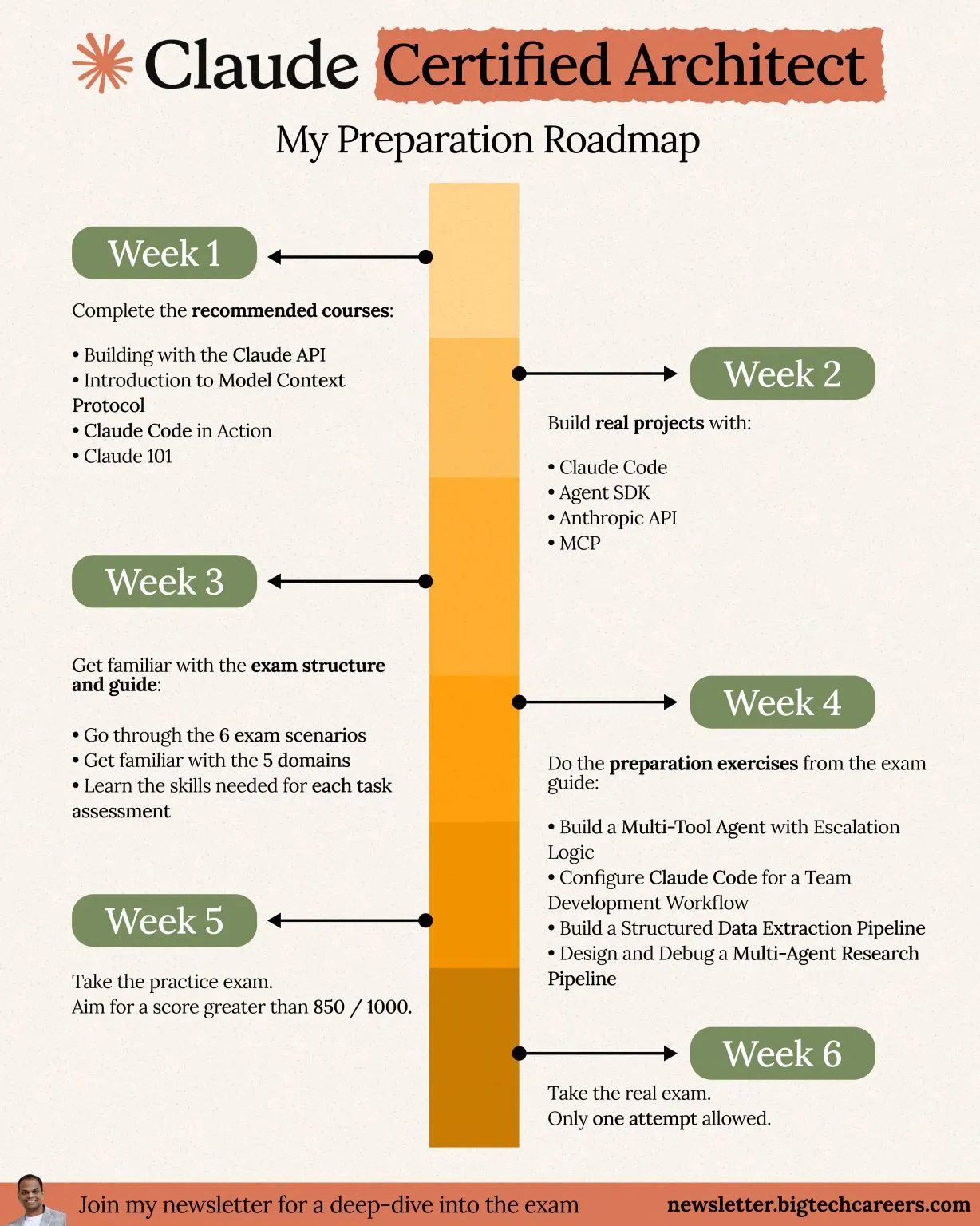
If you’re deciding where to start, my full writeup on preparing for CCA-F is still the best reference I can point you to: How I Passed the Claude Architect Certification.
Should you get one?
Don’t chase all four. Pick the certification that matches your actual role today, and treat the next tier as where you’re heading rather than something to rush into immediately.
The AI certification market is still early. Getting certified now, while the credential pool is small, tends to carry more weight than getting certified once everyone else has caught up.
Please note that this certification only available for Anthropic Partners at this point. See more details at Anthropic Partner Academy
Looking to get your team Claude Certified?
If you’re an enterprise or a company looking to get your employees enabled on Claude, I run a custom corporate training program called Enterprise AI Solutions Architecture with Claude, built for teams who want to move past experimentation and build production ready Agentic AI solutions with Claude. It includes getting Claude certifications.
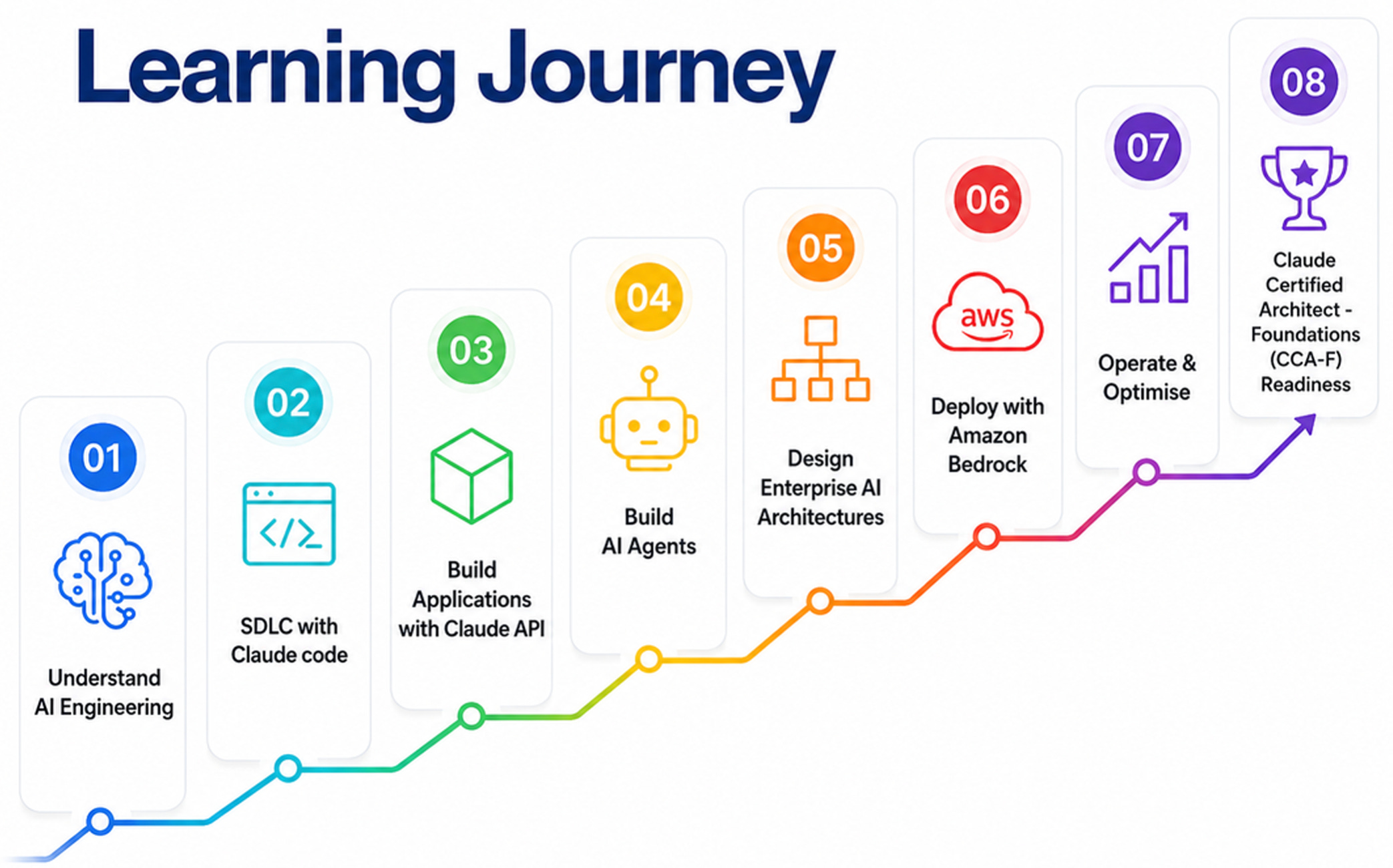
Reply to this email or reach out at info@bigtechcareers.com and we can talk through what that could look like for your team. Every engagement is tailored to align with your organisation’s AI strategy, technical maturity and business objectives.
Want to go deeper on your career, your certifications, or your positioning? I offer 1:1 coaching sessions and multi-session packages built around getting you ROI that outweighs the cost. Reach out at info@bigtechcareers.com.