

Hey, Prasad here 👋 I’m the voice behind the weekly newsletter “Big Tech Careers.”
A few months ago I shared my preparation roadmap for the Claude Certified Architect exam on LinkedIn, and it went semi-viral. This week, it’s my turn to close the loop — what I actually followed from my own roadmap, what I didn’t, the resources that got me there, and what you can expect on exam day.
If you like the article, click the ❤️ icon. That helps me know you enjoy reading my content.
The Roadmap I Originally Posted
Here’s the six-week roadmap I shared on LinkedIn a few months back:
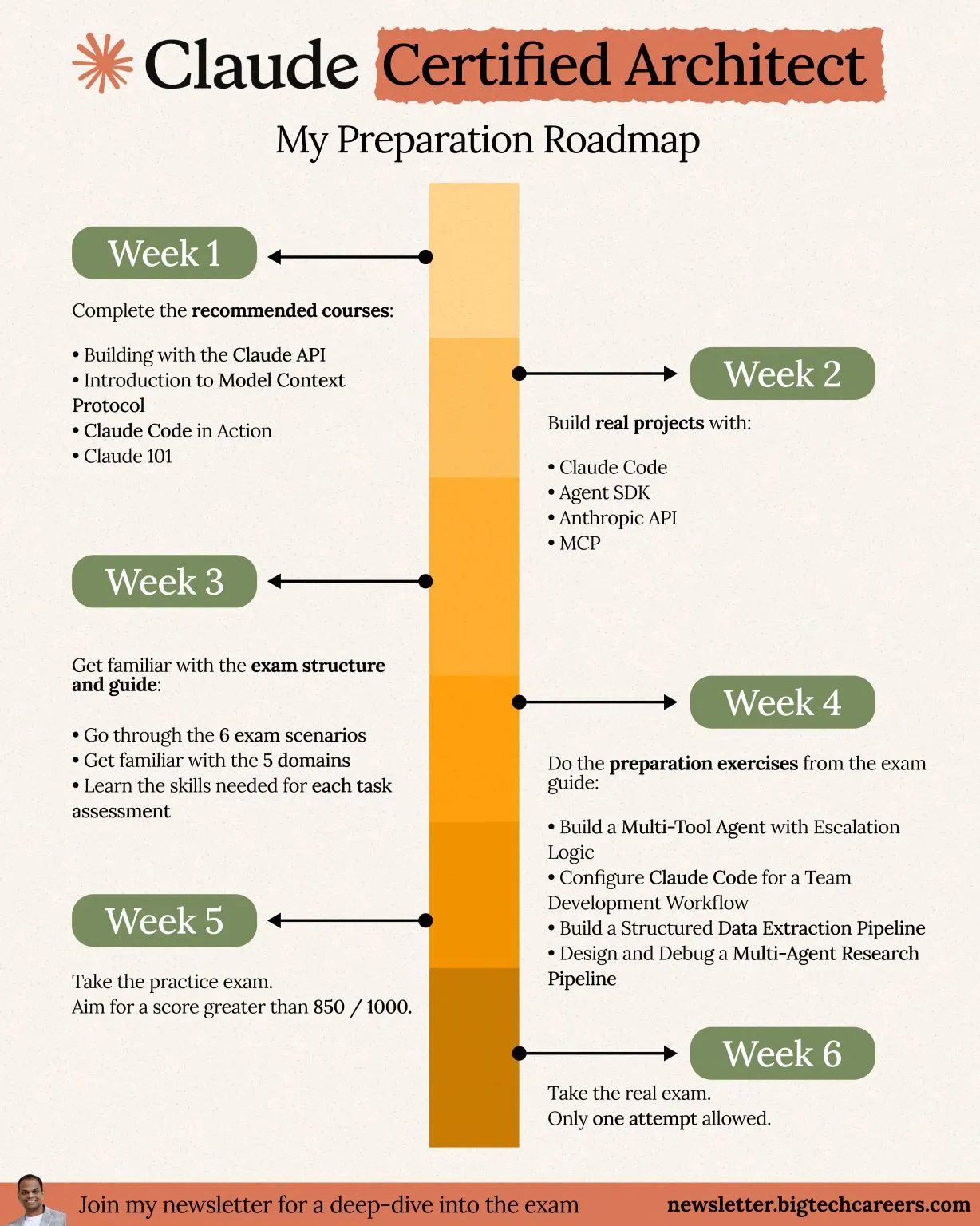
The plan, in short:
Week 1: Complete the recommended courses — Building with the Claude API, Introduction to Model Context Protocol, Claude Code in Action, Claude 101
Week 2: Build real projects with Claude Code, Agent SDK, the Anthropic API, and MCP
Week 3: Get familiar with the exam structure and guide — go through the 6 exam scenarios, get familiar with the 5 domains, learn the skills needed for each task statement
Week 4: Do the preparation exercises from the exam guide — build a multi-tool agent with escalation logic, configure Claude Code for a team development workflow, build a structured data extraction pipeline, design and debug a multi-agent research pipeline
Week 5: Take the practice exam, aiming for a score greater than 850/1000
Week 6: Take the real exam — only one attempt allowed
That roadmap got a genuinely good response when I posted it. When I created the plan, I thought I’d follow it. I never actually got a six-week window to do that.
Instead, here’s what I did. I want to walk through what actually happened, because I think the gap between “the plan” and “the execution” is more useful to you than the plan alone.
What I Followed, What I Didn’t, and Why
Weeks came and went, but I was never able to get onto the six-week plan. I kept opening the roadmap, looking at Week 1, and closing my laptop because there were other higher-priority items that week. This is the part nobody puts in their LinkedIn post: the plan sat untouched for couple of months.
A two-week window opened up where my regular workload eased off. I went all in and compressed the entire six-week roadmap into those two weeks.
A few things made that compression possible for me specifically, and I want to be upfront about them rather than imply this is universally achievable:
I already have a solution architecture background. I was mapping existing knowledge onto Claude-specific patterns, not building those patterns from scratch.
I had two weeks of genuinely focused time. At least couple of hours daily for 2 weeks.
If you’re starting fresh — new to agentic architecture concepts, new to Claude’s tooling, or only able to carve out a few hours a week — the original six-week plan is a far more realistic target than my two-week compression. Calibrate to your own starting point and bandwidth.
The Resources I Actually Used
Here’s the real sequence, in order.
1. Five Skilljar Courses
Anthropic Academy has 15+ free courses on Skilljar, and you don’t need all of them. I completed five:
Building with the Claude API
Claude Code in Action
Introduction to Model Context Protocol
Introduction to Agent Skills
Introduction to Sub Agents
These five cover the practical surface area tested across the 5 Domains (more on it shortly). I picked these based on which domains felt least familiar to me. I’d encourage you to do the same with your own gaps, instead of working through the full catalog.
2. Official Practice Test — First Attempt: 700
Once I’d worked through the courses, I sat the official practice exam cold, with no additional review. I scored 700. Given the real exam’s passing score is 720, that result told me exactly where the gaps were, without the pressure of a real attempt.
3. The Book — Read End to End
This is the resource I’d recommend even if you weren’t taking the exam at all: Architecting Agentic Solutions with Claude by Vladimir Provorov.
Provorov passed the CCA-F exam in its first week of availability, and this book grew directly out of his own preparation notes.
I’d recommend this book to anyone designing production LLM systems, certification or not. The architectural principles — how to think about tool design, escalation logic, context management, and reliability at scale — are the same principles you need whether or not you ever sit the exam. What makes it genuinely useful for the exam is the self-check questions with detailed answers after each of the 12 chapters.
4. Official Practice Test — Second Attempt: 950+
After finishing the book, I retook the official practice exam. This time I scored 950+. That gap from 700 to 950+ was almost entirely the book closing conceptual gaps the courses alone hadn’t covered. At that point, I knew I was ready.
5. Exam Morning: A Chapter-by-Chapter Scenario Refresher
On the morning of the exam, I didn’t start anything new. I went back through the book and revisited the self-check questions at the end of each chapter — on average about five per chapter. It was pure pattern reinforcement right before attempting the main exam.
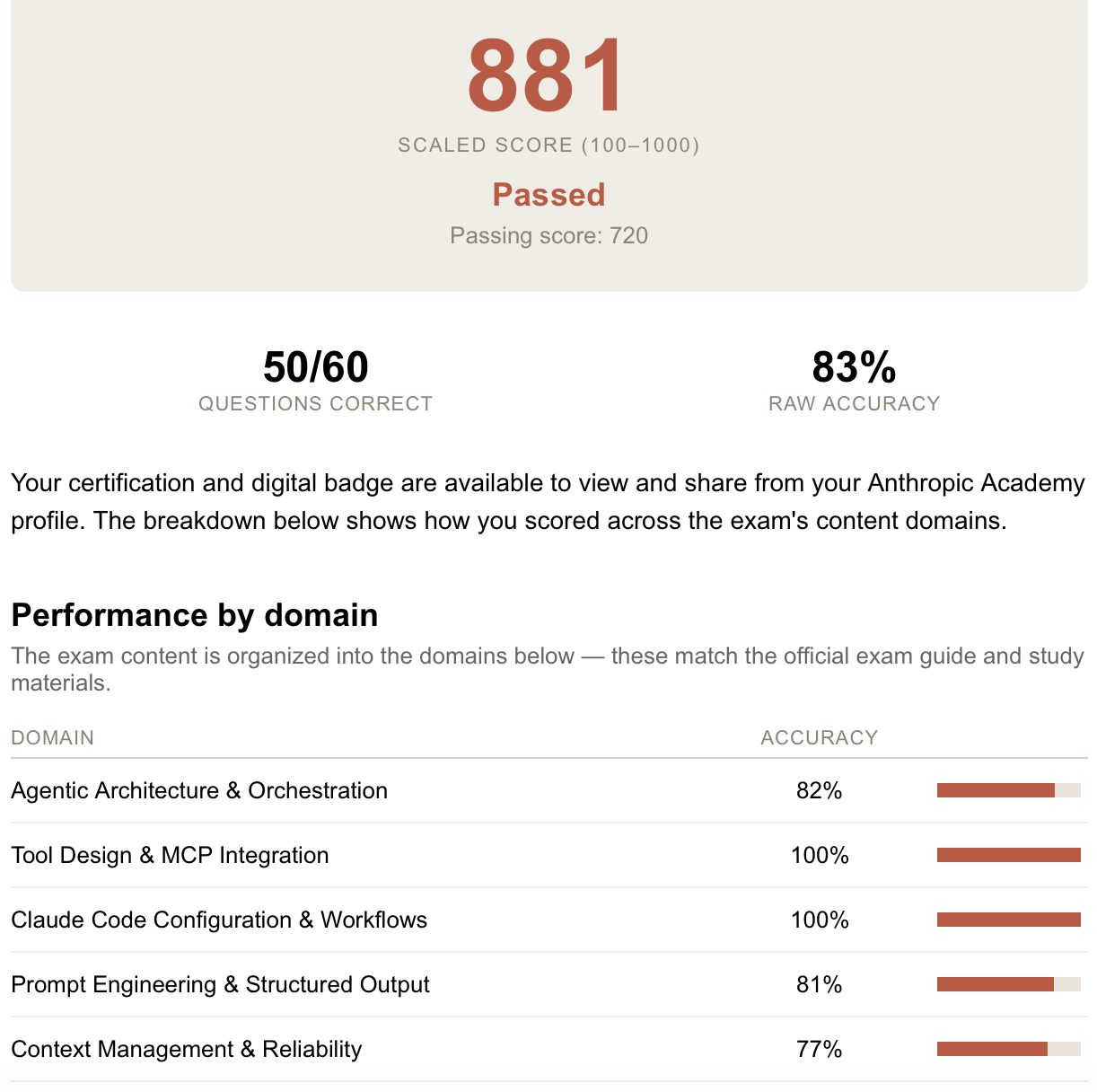
6. The Exam: 881, Passed
I scored 881 on the real exam — comfortably above the 720 passing threshold, though notably lower than my second practice test score. That gap is worth mentioning honestly: the real exam scenarios carry more layered detail and ambiguity than practice questions typically do, even when your practice scores look strong.
Here is the breakdwn:
What You Can Expect From the Exam
Pulling directly from Anthropic’s official exam guide, here’s what the CCA-F exam actually looks like:
Target audience: solutions architects, technical leads, and developers within the Anthropic Partner Network. Anthropic recommends at least 6 months of hands-on, practical experience with Claude’s API, Agent SDK, Claude Code, and MCP before attempting it — this isn’t an entry-level credential.
Exam format: 60 questions, 120 minutes, closed-book, proctored — built to assess real-world systems design rather than theoretical knowledge. No AI assistance is permitted during the exam itself. It’s scored on a scaled range of 100–1,000, with a passing score of 720, and delivered online proctored through Anthropic’s Skilljar platform.
Key topics tested:
6 real-world scenarios (4 randomly chosen for your exam, 15 questions each)
across 5 domains:
→ Agentic Architecture & Orchestration
→ Claude Code Configuration & Workflow
→ Prompt Engineering & Structured Output
→ Tool Design & MCP Integration
→ Context Management & Reliability
Availability and Cost: Available only Anthropic Partners and free for the first 5,000 partner company employees during the early-access phase, and now available at $99 per attempt.
The scenario structure: the exam draws from a pool of 6 production scenarios — things like a customer support resolution agent, a multi-agent research system, and a code review CI/CD pipeline — with 4 of the 6 randomly selected for your particular sitting.
How the time and the questions actually felt: 60 questions in 120 minutes felt comfortable for me — I finished with 12 minutes to spare. I’d always thought AWS had mastered the art of “close enough” options, where passing often comes down to sharp elimination skills more than full certainty. Anthropic has quietly raised the bar here. Some questions made me pause, re-read, and genuinely think — closer to working through an actual production tradeoff than picking the best-worded answer on a multiple-choice test.
The Bottom Line
My roadmap said six weeks. My reality was a long stretch of procrastination followed by two weeks of focused execution — and that only worked because of a background and bandwidth that not everyone starting this exam will have. If you’re earlier in your Claude journey, the original six-week plan is the more honest target. My two-week number is one data point shaped by a specific starting line — calibrate to your own.
Have you started prepping for the CCA-F exam, or are you considering it? Feel free to ask questions in the comments!
Enjoyed this article? You might also like these popular posts from Big Tech Careers:
How to Stand Out When 95,000 Tech Workers Are Job Hunting at the Same Time
How to Transition from a Developer or Architect to AI FDE Roles
The Quiet Signs Your Company Is About to Do Layoffs — And What to Do Right Now
Big Tech Interview Preparation Course
While I share everything for free here in this newsletter, if you are preparing for behavioral interviews, I have a self-paced course for you.
Check the course page for more details.