

Hey, Prasad here 👋 I’m the voice behind the weekly newsletter “Big Tech Careers.”
In this week’s article, I make the case for a skill that most tech professionals never formally develop i.e. facilitation skills
If you like the article, click the ❤️ icon. That helps me know you enjoy reading my content.
You’re in a room or on a call with a customer or a set of stakeholders. There are three competing technical opinions on the table. A decision-maker who hasn’t said a word in twenty minutes. A conversation that’s been going in circles for the past half hour. And a decision that needs to be made before end of day.
The person who moves that room forward is almost never the most technically brilliant person in it. It’s the person who knows how to facilitate.
I’ve sat in hundreds of technical meetings across my career. The single most consistent pattern I’ve noticed: your functional skills and technical depth gets you into the room. Facilitation is what makes you valuable once you’re in it.
And yet almost nobody in tech ever formally develops this skill. It’s not in your computer science degree. It’s not in your company onboarding. It’s barely mentioned in most leadership development programmes. It’s assumed or it’s not thought about at all.
This article is about what facilitation actually looks like in a technical context, why it gets ignored, and how to build it deliberately.
What Facilitation Actually Means in a Technical Context
Facilitation is the deliberate act of guiding a group toward a decision or outcome. That sounds simple. In practice, it covers a set of distinct skills: managing the energy of a room, surfacing blockers before they derail progress, handling competing opinions without letting them become personal, and ensuring that by the time the meeting ends, something has actually been decided.
It’s worth being specific about what it is not. It’s not presenting. Presenting is one person sharing information with others. It’s not chairing a meeting. Chairing is largely procedural. It’s also not about being “good in rooms” in some vague, social sense that some people have and others don’t.
Facilitation is harder in technical settings than in most others, for a few reasons. Technical people tend to have strong opinions. Domain expertise often gets used as a proxy for authority. The person who knows the most speaks loudest, and speaking loudest isn’t the same as being right. There’s also a real fear of being wrong in front of peers, which makes people dig in on positions rather than explore alternatives.
If your work regularly involves rooms where multiple people with different opinions need to reach a shared decision, facilitation directly affects how effective you are.
Why It Gets Ignored
Technical skills are visible and measurable. You can test them, certify them, demonstrate them in a pull request or a system design interview. Facilitation skills are none of those things, which makes them easy to deprioritise.
Most tech professionals are also rewarded through performance reviews, promotions, and peer recognition for being right. Being the person with the correct technical answer is celebrated. Over time, this shapes how people show up in meetings: optimising for correctness rather than for helping the group move forward.
The result is a gap that almost never gets named directly. The distance between senior and staff or principal level at most big tech companies is almost always, at its root, a facilitation gap. The promotion feedback says something like “needs to demonstrate broader influence” or “should drive decisions/outcomes across teams.” What it often means, underneath, is: this person is technically excellent but hasn’t yet learned how to move a room.
Degrees don’t teach it. Onboarding doesn’t teach it. Most tech training programmes skip it entirely.
And in 2026, this matters more than it ever has. As AI handles more of the technical execution, the humans who remain genuinely difficult to replace are the ones who can orchestrate the human decisions that AI can’t. Facilitation is precisely that skill.
What Great Facilitation Looks Like in Practice
Here are the specific things I’ve seen great facilitators do, that most people in tech don’t do consistently.
Set up before you walk in. Know who’s in the room before the meeting starts. Understand their stakes, their concerns, and what outcome they need. The facilitator who walks in cold is already behind. A five-minute pre-read of who you’re meeting with and what they care about changes how you open, how you frame questions, and how you manage the room.
Read the room in real time. There’s a meaningful difference between a discussion that’s generating momentum and one that’s going in circles. The second kind has a signature: the same points get made repeatedly, people start talking over each other, and energy drops. Recognising this early and intervening before it becomes entrenched is a core facilitation skill.
Use the parking lot. When a tangent comes up that’s genuinely worth discussing but isn’t the point of this meeting, name it and park it explicitly. “That’s an important point let’s add it to the parking lot and come back to it after we’ve resolved the main question.” This keeps momentum without dismissing valid concerns.
Learn to whiteboard. This is one of the most underused facilitation tools in technical settings. Drawing a rough diagram on a whiteboard or shared screen in real time does something that slides cannot: it makes the group’s thinking visible to everyone at the same time. When you draw a system, a flow, or a decision tree live, the conversation shifts. People correct the drawing rather than talking past each other. It becomes a shared object that the room can react to, build on, or push back against together. You don’t need to be a great artist. You need to be willing to draw something rough and use it as a thinking tool.
Name the decision out loud before you leave. This is the one I see skipped most often. A meeting ends, everyone goes back to their desks, and three people walk away with three different understandings of what was decided. The fix is simple: before the meeting closes, say out loud what you’ve agreed. “So what we’ve decided is X. The next steps are Y and Z, owned by these people.” Explicit is better than assumed every time.
Change the question when the room is stuck. When a discussion stops making progress, pushing harder on the same question rarely helps. What does help is reframing what’s being asked. If the group can’t agree on which technical approach to take, sometimes the unlock is asking “what outcome are we actually trying to achieve?” and working backward. The right question at the right moment is the most powerful facilitation tool there is.
How to Build It Deliberately
Facilitation is a learnable skill. It’s not a personality type. It’s a set of behaviours that can be practiced and improved with intention.
Take the facilitation role, not just the participant role. Volunteer to run internal sessions: design reviews, post-mortems, sprint retrospectives, team stand-ups. Most people attend these meetings. Facilitating them is a different experience entirely, and the gap between the two is where the learning happens.
Watch before you practice. Identify the people in your organisation who consistently move rooms forward. Observe specifically what they do: when they speak, when they hold back, how they handle interruptions, how they close. Then try it yourself in lower-stakes settings before you attempt it in high-stakes ones.
Learn to whiteboard. If you’re not already comfortable drawing architecture and flow diagrams live, start practicing. Do it in internal meetings first. The goal should be to get comfortable in externalising thinking in real time and using that visual as a shared anchor for the conversation.
Ask for feedback explicitly. After customer meetings or stakeholder sessions, ask: “Was that useful? Did we get to a decision?” Most people skip this because feedback is uncomfortable. It’s also the fastest path to improving. The facilitators who get consistently better are almost always the ones who actively seek to know where they fell short.
Practise in low-stakes settings first. Internal team meetings, brown bags, internal workshops are your training ground. Get comfortable moving a room of colleagues before you try it with a customer CTO or a steering committee.
The Career Payoff
The pattern I’ve observed is consistent across companies and career levels: the technical professionals who advance to senior, staff, and principal roles are the ones who combine deep technical credibility with the ability to move rooms. One without the other stalls. Both together is rare and is why those roles are hard to fill.
Facilitation is also what makes the difference between a technologist who delivers technically and one who makes customers and stakeholders feel they can move fast. The latter is genuinely difficult to find, genuinely difficult to replace, and compensated accordingly.
In an era where AI is increasingly handling the execution layer of technical work, the humans who earn and keep their seat at the table are the ones who can do what AI cannot: read the room, surface what’s unsaid, and help a group of people make a decision they’ll actually commit to.
Want to Build This Skill Alongside a Community?
BeSA Batch 10 starts 22 August and the entire behavioral track is built around Facilitation skills
Six sessions. Six Saturday mornings. Completely FREE.
Here’s the full behavioral track agenda:
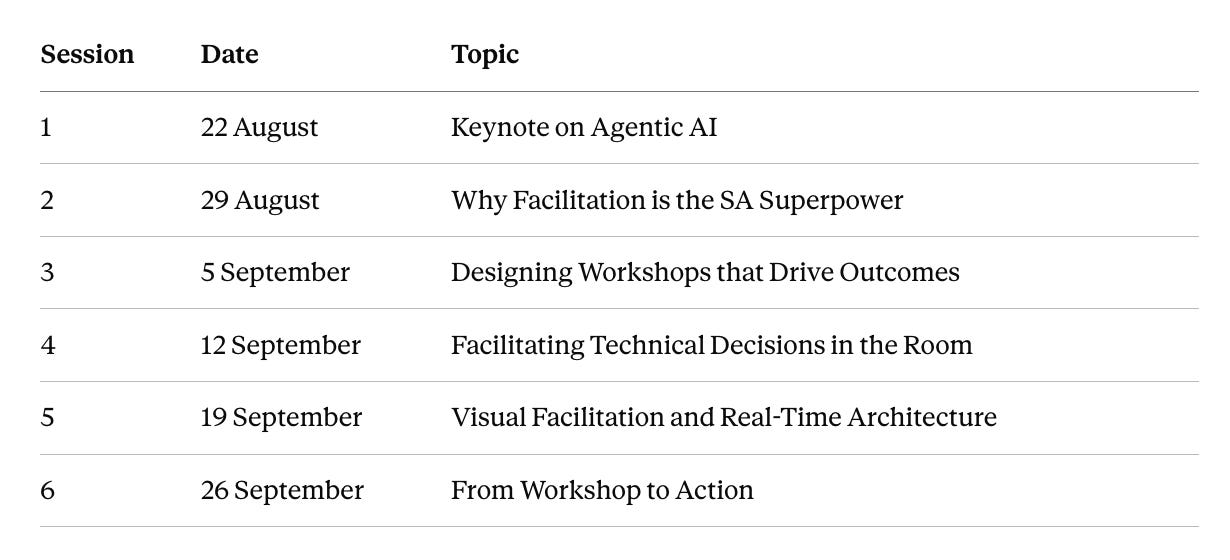
Sessions run live every Saturday and are streamed on the BeSA YouTube channel. The recordings go up after each session if you miss a week.
👉 Register here: https://besa.techexpert.io/program/self-paced-become-a-solutions-architect-agentic-ai-on-aws-3849
Enjoyed this article? You might also like these popular posts from Big Tech Careers:
The AI Job Market Has Split in Two. Here’s Which Side You Want to Be On.
How to Transition from a Developer or Architect to AI FDE Roles
When you’re ready, here’s how I can help:
1:1 long-term career coaching to fast-track your career growth at Big Tech
Behavioral Interview preparation course for MAANG+ companies
Mock interviews for your upcoming interviews
For more details, send an email to info@bigtechcareers.com
Thanks for sharing, Prasad Rao. I had never looked at facilitation from this perspective.