


Hey, Prasad here 👋 I’m the voice behind the weekly newsletter “Big Tech Careers.”
I have been wanting to bring you this story for a while. Shola studied Agricultural Economics in Nigeria, came to the UK with zero tech background, and is now an Enterprise Solutions Architect team at AWS. Oh, and he recently became an AWSome Legend — one of only 120 people globally to receive that recognition.
This is Part 1 of a two-part series. Today: the journey. Next week: the intentionality behind the award.
If you like the article, click the ❤️ icon. That helps me know you enjoy reading my content.
Over to you, Shola!
I Studied Agricultural Economics
I did not grow up thinking about technology. I grew up in Nigeria, where the practical choice seemed to be a degree in something tangible — something that would translate directly into employment. I chose Agricultural Economics at the University of Ibadan. I was good at it. I understood systems, resource allocation, the logic of how inputs become outputs. But I knew, somewhere in the back of my mind, that it was not where I was going to build my career.
I had no plan for what would come next. I just knew I needed to keep moving forward.
Moving to the UK With No Tech Background
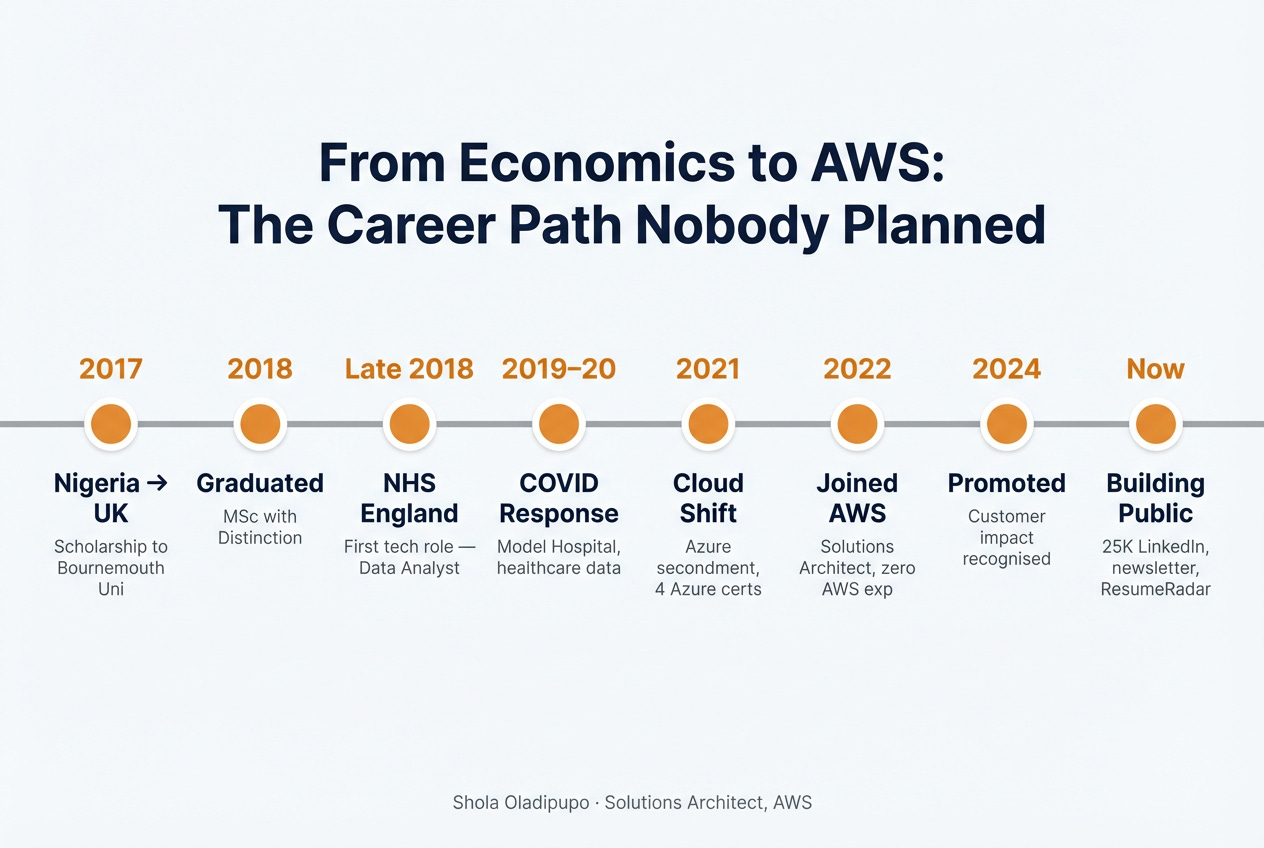
When I moved to the UK to pursue my master’s degree — an MSc in International Business — I arrived without a network, without a clear career path, and without any formal technology training. What I had was curiosity and a willingness to figure things out.
A lot of people underestimate how disorienting that phase is. You are in a new country, building from scratch, trying to understand a job market that was not designed with your background in mind. I spent a lot of time just observing — watching what skills employers actually wanted, what roles seemed to have longevity, and where the real opportunities were.
That observation period was not wasted time. It shaped everything that came after.
Discovering Data Analytics by Accident
My first real exposure to technology came through a role that had nothing to do with software engineering. I was working in a support function, and I started noticing that a lot of the decisions being made around me were based on data — but the data was messy, inconsistently tracked, and hard to interpret.
I started teaching myself Excel. Then SQL. Then Power BI. Not because anyone told me to, but because I could see the problem in front of me and I wanted to solve it. That is still how I approach most things — find the problem, then find the tool, not the other way around.
What I did not fully appreciate at the time was that this was a pivot. I was not just learning a tool. I was entering the technology industry through a side door.
Growing at NHS England
Eventually, I joined NHS England. Working in one of the largest health systems in the world gave me a perspective I could not have got anywhere else. The scale, the complexity, the stakes — it changes how you think about technology. You are not building for convenience. You are building for continuity.
I was working with data at scale — population health data, operational data, strategic reporting for national leadership. The work forced me to develop skills I did not know I needed: stakeholder communication, translating technical findings for non-technical audiences, operating under pressure.
But I also started to see the ceiling. Data analytics got me in the door. Cloud was where the industry was heading.
The Shift to Cloud Computing
I made a deliberate decision to move into cloud. I started with certifications — not because I believed certifications alone would get me hired, but because they gave me a structured framework for learning something I had no formal training in.
The AWS Cloud Practitioner was my first. Then the Solutions Architect Associate. I kept going. Over time, I accumulated nine cloud certifications — five AWS, four Azure. But the certifications were never the point. They were the on-ramp. The real learning happened when I started applying what I had studied to actual problems at work.
That combination — certifications to build the framework, real projects to build the depth — is what actually moved my career forward.
The Secondment That Changed Everything
The turning point came when I had the opportunity to take a secondment into a cloud architecture role. I almost did not apply. I did not feel fully ready. I did not have all the experience the role description asked for.
I applied anyway.
That secondment gave me direct exposure to cloud architecture at an enterprise level. I was working on real infrastructure decisions, real migrations, real trade-offs. I was in rooms where senior technical decisions were being made and I was expected to contribute.
That experience is what allowed me to make the leap to a cloud provider. Not because I had a perfect CV, but because I had done the work in a context that made the experience legible to a new employer.
Deciding to Work for a Cloud Provider
At a certain point, I realised that if I wanted to deeply understand cloud — not just use it, but truly understand how it is architected and where it is going — I needed to be on the inside. I needed to work for one of the providers.
That was not a small decision. The jump from a large public sector organisation to a hyperscaler is significant. The interview process is different. The expectations are different. The culture is different.
But I had spent years building both the technical depth and the ability to communicate it. Those two things together — being able to do the work and explain the work — are what get you through the door at a company like AWS.
Landing at AWS With Zero AWS Experience
Here is the part that surprises most people: when I joined AWS, I had no professional experience using AWS in a commercial context. Everything I knew had been built through self-study, certifications, and a relatively brief secondment.
I want to say that clearly, because I think a lot of people assume you need years of hands-on cloud experience to land at a cloud provider. You do not. What you need is evidence that you can learn fast, think architecturally, and communicate complex ideas clearly.
The first year at AWS was one of the most intense learning experiences of my career. But I had been preparing for that intensity for years — not by accumulating experience in a straight line, but by consistently choosing to stretch into discomfort.
Building in Public
Alongside the career, I started sharing. LinkedIn posts, newsletter editions, practical guides for people trying to break into cloud or navigate career transitions. I built ResumeRadar — a free CV scanning tool that has now been used by over three thousand people. I mentor, I answer questions, I show up.
Building in public did something unexpected: it accelerated everything else. The clarity you develop when you try to explain something to someone else is unlike any other form of learning. It sharpens your thinking. It builds a network. It creates opportunities that you cannot manufacture through a CV alone.
I now have 24,000 followers on LinkedIn — not because I set out to become an influencer, but because I decided to share what I was learning in real time, with honesty.
What I Have Learned So Far
If I were to distil this journey into the things I actually believe — not the advice people expect, but the things that actually proved true — it would be this:
Your background is not a limitation. It is a different angle. Agricultural Economics taught me systems thinking. That is exactly what cloud architecture requires. The non-linear path is not a liability — it is a lens.
Ask before you are ready. I applied for the secondment before I felt qualified. I applied for AWS before I had every box ticked. Readiness is something you build during, not before.
Certifications plus hands-on experience. Neither alone is enough. Certifications give you a map. Projects give you the territory. You need both.
You do not have to do it alone. The people I have learned from, the communities I joined, the mentors who gave me an hour of their time — those relationships compounded over years.
Start sharing before you feel ready. The clarity you develop when you try to explain something to someone else is unlike any other form of learning. It sharpens your thinking, builds your network, and creates inbound opportunities.
NEXT WEEK
I will share how I became an AWSome Legend — one of only 120 people globally to receive AWS’s highest recognition for community contribution.
Prasad here again 👋
I would like to extend a big thank you to Olushola Oladipupo for sharing his insights with Big Tech Careers readers.
I also encourage you to follow him on LinkedIn for further insights.
I hope you found Shola’s story as compelling as I did. The non-linear path — Economics degree to NHS to AWS — is a genuinely useful case study in how careers in tech are actually built, not how we imagine they are built.
Shola has put together two resources I want to make sure you know about:
FREE Roadmap to Your First Tech Job
A free guide covering the exact 4-phase framework Shola used to go from no tech background to a role in cloud. Domain selection, certifications, projects, personal brand — all mapped out.
FREE TOOL ResumeRadar — Free CV Scanner
Shola built a free tool that scans your CV against job descriptions and tells you exactly where the gaps are. Over 3,000 people have already used it.

Very inspirational. Thank you so much for sharing it.
Good piece