


Hey, Prasad here 👋 I’m the voice behind the weekly newsletter “Big Tech Careers.”
Last week, Shola shared his journey from Agricultural Economics to AWS Solutions Architect. This week, the part everyone wants to know. How he became an AWSome Legend, AWS’s highest recognition, awarded to only 120 people globally.
Shola story is about struggle, about being invisible despite doing great work, and about the uncomfortable decision to make your impact impossible to ignore.
If you like the article, click the ❤️ icon. That helps me know you enjoy reading my content.
Over to you, Shola!
The Award Nobody Plans For
When I joined AWS, I did not know this award existed. And honestly, I was not in any position to think about awards.
I joined as a Solutions Architect with zero AWS experience. None. My background was in .NET and Microsoft workloads. I had an Economics and Finance degree. Before AWS, I was working at the NHS. And before that, I was in Nigeria studying agricultural economics.
So when I walked into my first week at AWS, I did not feel like I belonged.
People around me were dropping service names I had never heard of. They were drawing architecture diagrams from memory. They had been building on AWS for years. I was Googling what an S3 bucket was.
The imposter syndrome was not a phase. It was a daily companion. Every customer call, I would prepare for two hours just to sound competent for thirty minutes. Every internal meeting, I stayed quiet unless I was certain. Every time a colleague casually referenced a service, I would write it down and study it that evening.
Nobody talks about this part. The part where you are technically in the room, but you feel like you are behind a glass wall watching everyone else do the job you were hired to do.
That lasted months.
The Gap Nobody Talks About
Here is what I wish someone had told me when I started: doing great work is not the same as being recognised for great work.
After about 18 months, I had found my rhythm. I was comfortable with customers. I was closing deals. I had already earned two quarterly recognition awards. By every internal metric, I was performing.
But I also noticed something. Other people who were doing comparable work were getting more visibility. Not because they were better. But because they were more intentional about making their work visible.
I would solve a critical customer problem on a Tuesday and forget to document it by Friday. I would deliver a workshop that got excellent feedback and never tell anyone except the customer. I would create a reusable framework and share it on Slack, where it disappeared into the scroll within a day.
Sound familiar?
Most of us work this way. We believe the work should speak for itself. And in theory, it should. But in a large global organisation, the work does not speak. You have to speak for it.
That was the first uncomfortable realisation.
The Shift From Tasks to Outcomes
The second realisation was about how I was measuring my own work.
Most of us are trained to measure ourselves by effort. Hours worked. Projects delivered. Meetings attended. But that is not how recognition works at a company like Amazon. Recognition comes from owning the result: the business problem solved, the metric changed, the customer impact created.
Here is the framework that changed everything:
1. What business problem are we solving?
Not: “I am building an architecture.” But: “This customer is losing revenue because their system cannot scale during peak hours. That is the problem.”
2. What metric changes if this works?
Not: “I deployed a solution.” But: “Their deployment time dropped by 40%. Their infrastructure costs decreased by 30%.”
3. What did we ship, and what improved?
The before and after. The evidence. Not: “I helped with a migration.” But: “We migrated dozens of workloads, automated infrastructure pipelines, and freed up hundreds of hours of manual work per quarter.”
4. Who can confirm the impact?
This is the part most people skip. You need witnesses. Customer testimonials. Manager confirmation. Internal stakeholders who saw the result. If nobody else can vouch for it, it did not happen.
I applied this framework to every customer engagement. Every technical crisis. Every project I owned. And I documented it as I went, not months later when I was trying to remember what happened.
The Customer Moment That Mattered
Let me give you a real example of what this looked like in practice.
A customer hit a critical issue that put a significant engagement at risk. It was the kind of problem where most people would escalate to the relevant service team and wait for a response.
I did escalate. But I did not wait.
I spent nearly two weeks embedded in the problem. Not just coordinating. Actually digging in. Working directly with the customer. Pulling together internal teams that do not normally collaborate. Going back and forth until we found a resolution.
But I did not stop there. I worked with the service team to make the fix permanent, so that other customers would never hit the same issue. What started as one customer’s problem became a lasting improvement.
That is the difference between doing your job and creating impact. Solving a problem is expected. Making sure nobody else hits the same wall? That is what gets remembered.
And I documented every step of it. Because I had learned: if you do not write it down, it did not happen.
Building in Public (When Nobody Was Watching)
The other dimension of my work that made a difference was content.
When I started posting on LinkedIn about AWS, I had maybe 100 followers. Nobody was reading. Nobody cared. I posted about certifications, about cloud concepts, about what I was learning. It felt like shouting into a void.
I kept going.
Over the next two years, something compounded. 25,000 followers. Millions of impressions. Posts that drove real, trackable traffic to AWS. One post led to a senior leader at a company reaching out through a LinkedIn DM, which turned into a real customer conversation.
What made this count was not the vanity metrics. It was that the impact was measurable. I could show how many people engaged with AWS because of my content. Not “I think my posts help” — actual numbers, actual outcomes.
That is not “I post on LinkedIn.” That is “I built a content engine that drives measurable business value.”
The difference? Documentation. Measurement. Intentionality.
Writing My Own Case
Now here is the part that made me most uncomfortable.
When the time came for my nomination, I did not wait for someone else to write it. I treated it the way I would treat any important career document. I wrote a detailed case for why my work mattered.
Pages of evidence. Customer stories with outcomes. Content metrics. Speaking engagements with feedback. Reusable frameworks that other Solutions Architects had adopted.
Then I went to two senior leaders — people I had built relationships with over the previous year — and asked them to support it.
That was terrifying. Not because they said no. They said yes immediately. It was terrifying because I had to ask. I had to say: “I believe my work deserves this recognition, and here is the evidence.”
Most people will never do this. Not because they do not deserve it. But because self-advocacy feels arrogant. It feels like you are being too much. It feels safer to wait and hope someone notices.
Nobody noticed until I made it impossible not to.
After that, the process took its course. I did not hear anything for weeks. You do not get updates. You do not get told whether it is progressing or not.
You just wait.
Seattle
In February 2026, I flew to Seattle.
When I got there, I met the other 119 Amazonians who had received the same honour. I sat with AWS leadership: VPs, the CEO. People who make company-wide decisions. And I had a moment of: Seven years ago, I was in Nigeria studying agricultural economics. How is this real?
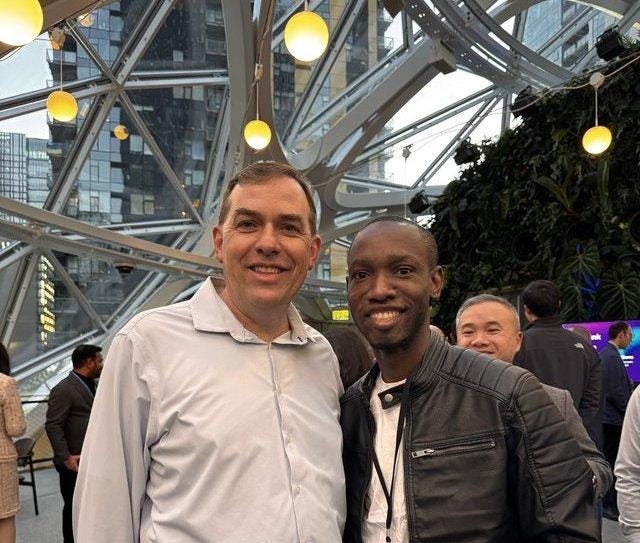
With AWS CEO Matt Garman at The Spheres, Seattle
That experience taught me five things:
1. Consistency beats talent. Nobody in that room was there because of one brilliant moment. We were there because of what we had done repeatedly, week after week, month after month. The work compounds.
2. Teach everything you know. The common thread across every person in that room: they were not gatekeeping. They shared what they learned. They mentored others. They built in public.
3. Build in public. Every single person I talked to had a presence beyond their day job. LinkedIn. Blogs. Speaking. Community involvement. Because they understood that your work only matters if people know about it.
4. Your story is your superpower. In a room full of brilliant engineers and architects, what set people apart was the clarity with which they could tell the story of why it mattered.
5. Imposter syndrome never leaves. I sat next to a VP and asked them: ‘Does it ever feel normal?’ They laughed. ‘No. Not once.’ The difference is the willingness to show up even when you do not feel ready.

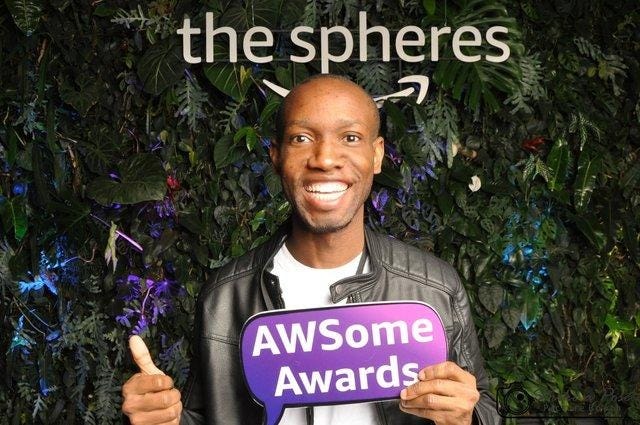
The AWSome Legend Award — one of 120 globally
Why I Am Telling You This
I am not telling you this story because I want you to win an award.
I am telling you because the system I used — documenting impact, building in public, measuring outcomes, writing my own case, asking for what I wanted — is the same system that works for promotions. For job offers. For career transitions. For any moment where you need someone to see your value.
And most people never do it. Not because they cannot. But because nobody told them they were allowed to.
So here is your permission.
You are allowed to document your wins. You are allowed to tell people what you have accomplished. You are allowed to write your own case and hand it to someone and say: “This is what I have done. I believe it matters.”
You are allowed to be intentional about your career in a way that feels uncomfortable at first.
I started with a degree that had nothing to do with technology. I started at the NHS with no cloud experience. I started at AWS with zero certifications. I started posting on LinkedIn when nobody was reading.
Every single time, I did not feel ready.
Every single time, I showed up anyway.
And that is the real story behind the award.
Prasad here again 👋
Two-part story from Shola. From agricultural economics to AWS Solutions Architect to AWSome Legend.
What struck me most? It was not the award. It was the two weeks he spent embedded in a customer crisis when he could have just escalated and waited. It was the discomfort of writing his own case and asking senior leaders to back it. It was posting on LinkedIn when he had 100 followers and nobody was reading.
That is what intentionality actually looks like.
If you are working on building your own impact, here is how to connect with Shola:
🎯 Free resource: Roadmap to Your First Tech Job — sholastechnotes.com/roadmap-first-tech-job
📬 Stay connected: Shola’s Tech Notes — sholastechnotes.com
Thanks for reading, and I will catch you next week.