

Hey, Prasad here 👋 I’m the voice behind the weekly newsletter “Big Tech Careers.”
In this week’s article, I share how to cut through the noise and stand out in the most competitive big tech job market in years.
If you like the article, click the ❤️ icon. That helps me know you enjoy reading my content.
I recently delivered a full-day, 8-hour bootcamp on AI-Powered Big Tech Interview Prep for Tech ICs and Leaders! Here is some of the feedback from the students!
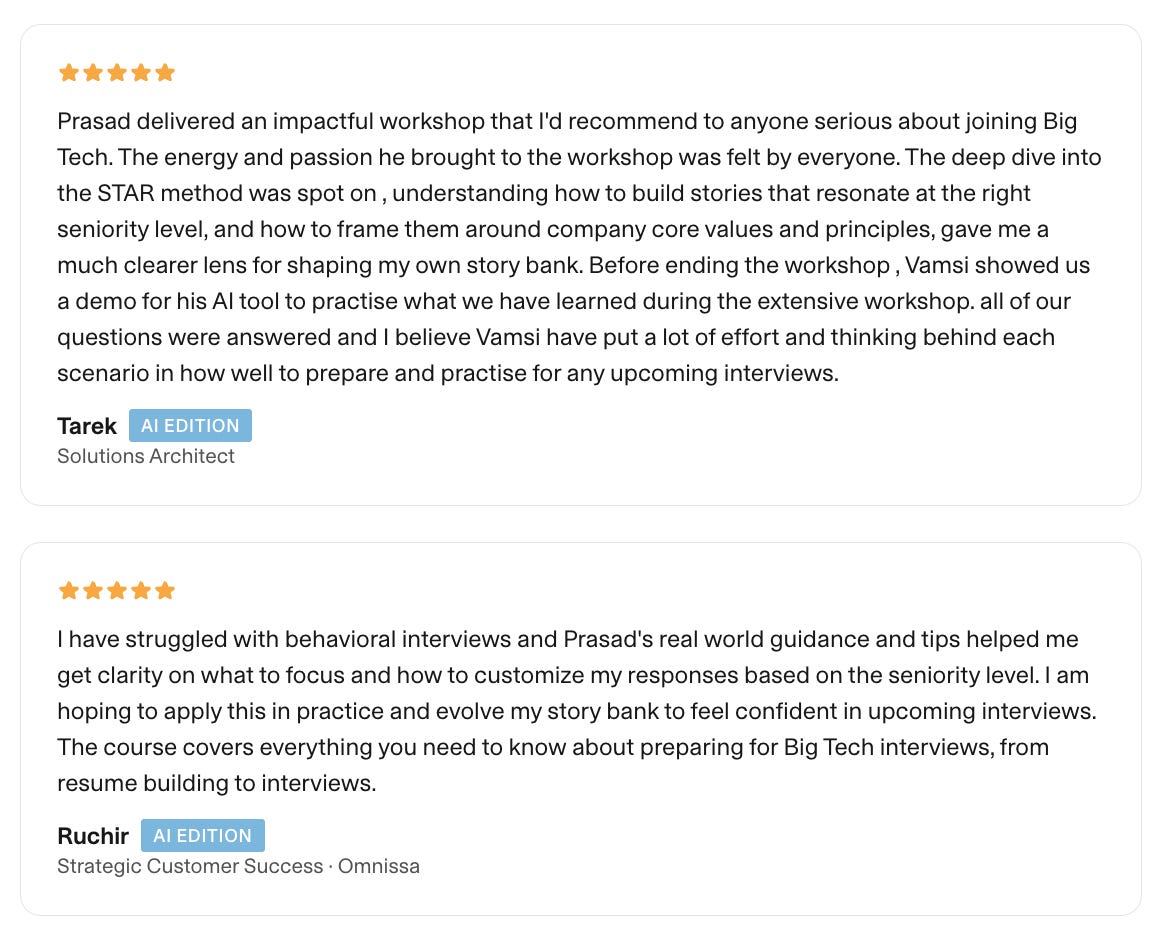
I’ve announced the next date for the bootcamp in July. If you have an upcoming interview in the coming weeks, you can get the recordings of the previous cohort with an option to join the next live cohort. Email bigtechcareers@gmail.com for details.
Let me be honest with you about what’s happening out there right now.
Over 92,000 tech workers have been laid off so far in 2026, according to Layoffs.fyi — bringing the total to nearly 900,000 since 2020. Almost every Big Tech is doing layoffs. And this layoffs wave is far from over.
What this means practically: the moment you apply for a tech role right now, you are competing not just with strong candidates — you are competing with recently laid-off engineers and architects from Big Tech.
Job postings are down 15% over the past year while the number of applications per job has jumped 30%, according to Handshake data cited by Crunchbase. The math is simple and brutal: more people, fewer seats.
If your job search feels harder than it ever has before — it is. You’re not imagining it. But here’s what I want you to take away from this article: the crowd is doing the same things, and that’s exactly your opportunity.
Why the Usual Playbook Is Failing Right Now
Most job seekers are following the same script:
Apply through LinkedIn or the company careers portal
Keyword-optimize the resume
Passively prepare for interviews
Wait
That script worked in 2021 when companies were scrambling to hire and interviews moved fast. It doesn’t work when hiring managers are swimming in applications from ex-MAANG candidates.
The irony is that the flood of strong candidates has raised the baseline — you’re no longer differentiated just by where you’ve worked. Everyone on the shortlist has an impressive brand on their resume. What separates the people who get offers from the people who get ghosted is what they do that others don’t.
Here’s what that looks like in practice.
1. Your Resume Needs to Reflect Impact, Not Presence
One of the most common patterns I see is candidates leaning too heavily on what they did and not enough on the impact they delivered.
It doesn’t. Not anymore.
When every shortlisted candidate has MAANG on their resume, the differentiator becomes the work — specifically, quantified outcomes. Not “led migration to microservices” but “led migration to microservices, reducing p99 latency by 40% and cutting infrastructure costs by $2M annually.”
A few questions to stress-test your resume bullets:
Does each bullet answer “so what?”
Does it reflect your level of ownership, not just participation?
Could someone else have written the same bullet?
If the answer to the last question is yes, rewrite it. The resume that stands out shows what you drove, not what your team shipped.
2. Your Behavioral Stories Are Your Unfair Advantage
This is the part most candidates underinvest in — and it’s where I see the biggest gap between candidates who make it to final rounds and those who don’t.
Here’s the reality: at the senior level and above, everyone interviewing you can code. Everyone has shipped large-scale systems. Technical chops are a floor, not a ceiling. What separates the hire from the no-hire at MAANG+ is how clearly and credibly you can demonstrate leadership, judgment, and impact through your stories.
The mistake most candidates make with behavioral prep: they prepare stories that describe what happened rather than stories that demonstrate who they are.
Interviewers at companies are listening for their core values. At Meta, they’re scoring you across five specific signal areas. At Google, they want evidence of Googleyness and leadership. These aren’t just frameworks — they are literally the rubrics your interviewers are scoring you against.
Your stories need to be calibrated to those rubrics, not just polished anecdotes.
A few things that separate great behavioral stories from average ones:
Clear ownership language — “I decided,” “I initiated,” “I advocated for” rather than “we delivered”
Measurable impact — ideally in time, money, revenue, or customer outcomes
Honest tension — the best stories have a real constraint, disagreement, or failure that you navigated
Level signal — the scope and complexity of your story should match the level you’re interviewing for
3. The Network Play Nobody Is Making
Here’s the uncomfortable truth about job applications in this market: cold applications are a lottery.
That’s not to say don’t apply — you absolutely should. But when you’re one of hundreds of applicants for a role, you need parallel paths running. The single most effective parallel path is a referral.
Referrals don’t just help you get seen — they change the dynamics entirely. At most companies, a referral from a current employee puts your resume in a separate queue and signals that someone with skin in the game vouches for you.
Most people handle this the wrong way. They either don’t ask at all (too shy) or they reach out cold with: “Hey, could you refer me to this role?” which puts a stranger in an awkward spot.
Target hiring managers, not just recruiters. Recruiters are gatekeepers with high volume. Hiring managers care deeply about filling their open role. A thoughtful LinkedIn message to a hiring manager — short, specific, showing you’ve done your homework on their team — can get a response when the recruiter queue doesn’t.
4. AI Skills Are No Longer a Differentiator — They’re a Baseline
This one is worth paying close attention to.
According to Dice’s April 2026 Tech Jobs Report, 71% of U.S. tech job postings now require AI skills — up 181% from just one year ago. Their conclusion: AI fluency is no longer a differentiating credential — it has become a baseline expectation.
If you’re not demonstrating AI fluency in your resume, your conversations, and your interview stories by now, you’re not standing out — you’re falling behind.
This doesn’t mean you need to be an ML researcher. It means you should be able to speak credibly about:
How you’ve used or integrated AI tools in your current or past work
Your understanding of agentic AI patterns, LLM limitations, and responsible use
Where AI creates leverage in your specific domain (architecture, SWE, solutions, data)
If you haven’t read my earlier piece on transitioning to AI FDE roles, now is a good time as FDE is one of the hottest role in tech right now. Even if you’re not targeting that specific role, the framing of how to position your AI skills is directly applicable.
5. Treat Your Job Search Like a Project with Metrics
The emotional weight of a long job search is real — especially when you’re competing against this much talent and hearing nothing back for weeks at a time. I’ve watched smart, capable people spiral into self-doubt simply because of the volume of silence they faced.
The best antidote I know is structure.
Treat your search like a project. Define your weekly targets. Track your inputs, not just your outcomes. Something like:
X applications submitted per week
X new networking conversations initiated
X behavioral stories reviewed/refined
X mock interviews completed
You can’t control whether companies respond. You can control whether you are consistently doing the right things. Metrics give you something to act on — and they keep the search from feeling like a passive waiting game.
And a practical note on timing: hiring cycles at big tech are genuinely longer right now. Build that expectation into your planning. A search that feels slow isn’t necessarily failing — it may just be operating at the speed of the market.
The Bottom Line
The competition is real. The math is working against everyone right now. But most candidates are applying the same strategies, telling the same generic stories, and waiting passively for callbacks that don’t come.
The candidates who land offers in this market are doing something different: they’re leading with specific impact, they’re building warm paths in before they apply, they’re investing deeply in behavioral prep calibrated to each company’s rubric, and they’re showing genuine AI fluency.
None of these are shortcuts. They’re the fundamentals — executed with more intention than the person applying alongside you.
Here is what I covered in the full-day, 8-hour bootcamp on AI-Powered Big Tech Interview Prep for Tech ICs and Leaders!
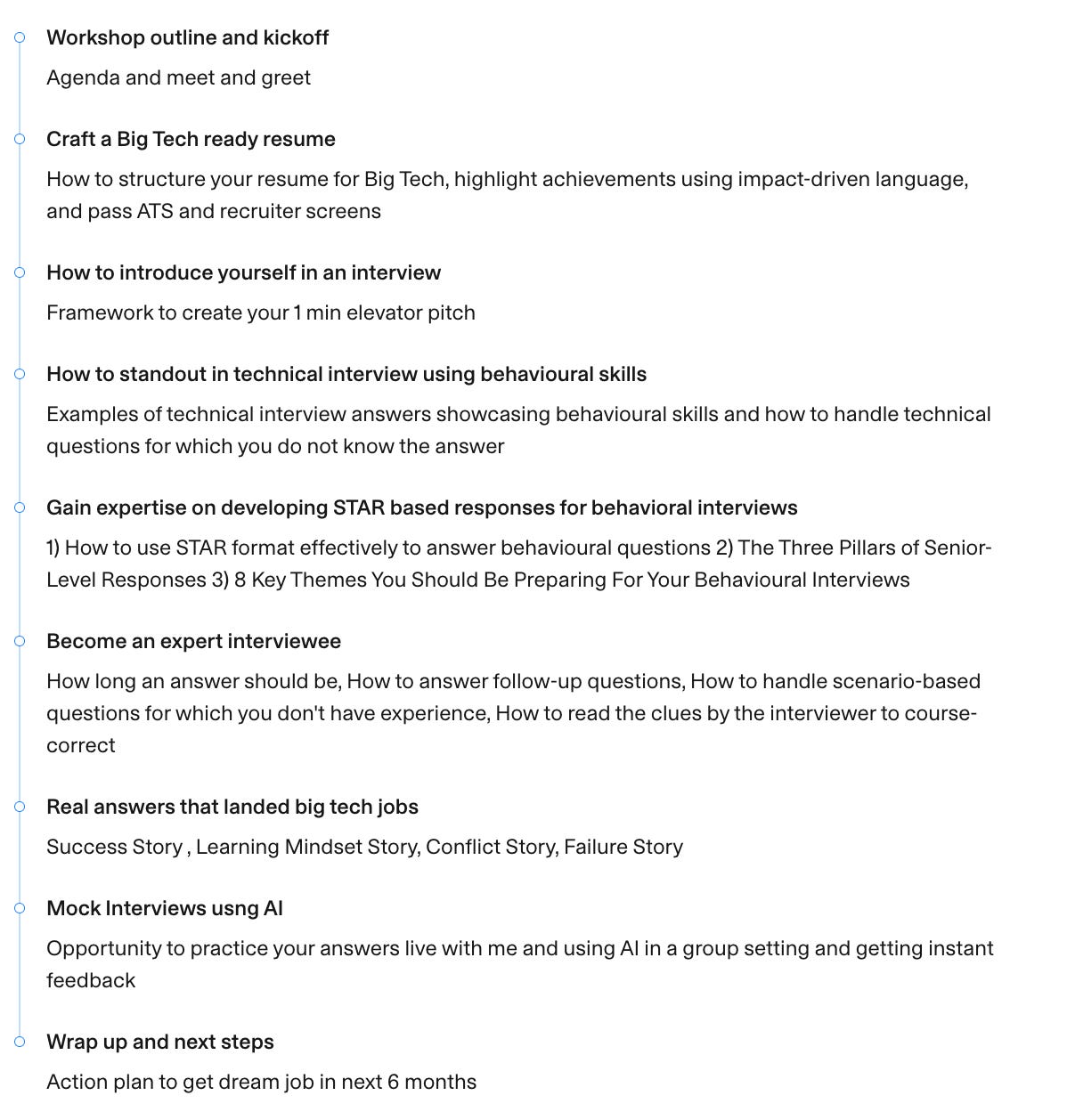
Though the next live cohort is in July, if you have an upcoming interview in the coming weeks, you can get the recordings of the previous cohort with an option to join the next live cohort.
Interested? Email bigtechcareers@gmail.com for details.
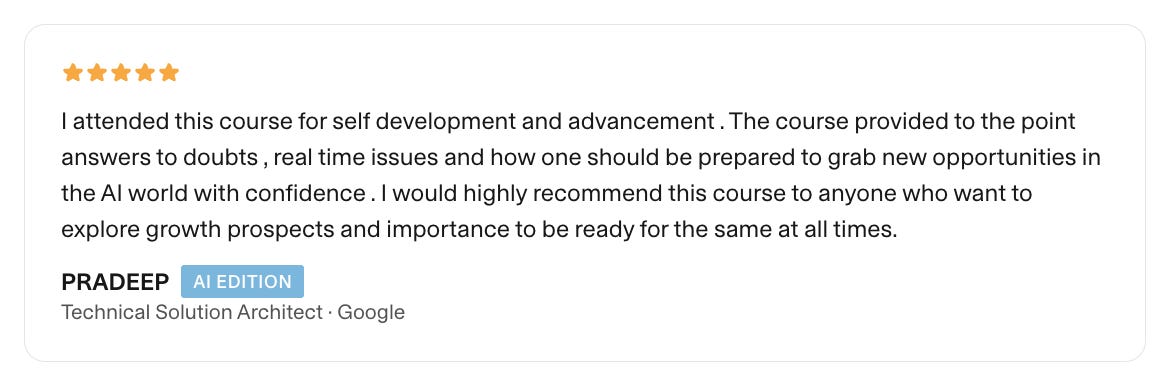
Though I position this as an Interview Prep course, frankly it helps you grow professionally in your career! Have a read of the feedback below from one of the MAANG participants.
When you’re ready, here’s how I can help:
1:1 long-term career coaching to fast-track your career growth at Big Tech
Behavioral Interview preparation course for MAANG+ companies
Mock interviews for your upcoming interviews
For more details, send an email to bigtechcareers@gmail.com
The 'network play nobody is making' framing is right, and the magnitude is worth sharpening at the senior end. From this quarter's conversations with Indian GCC GenAI architects, roughly 70% of senior architect roles never reach the application funnel at all. They fill through closed-door peer reviews months before the JD posts. Prasad's three differentiation moves are competing for the other 30%. The architect-cohort question worth asking your readers: whose quarterly peer review are you already in this month? If you cannot name them by L+2, that gap is the work, not the resume rewrite.
Zia. AI career strategist for Indian professionals. itszia.ai