
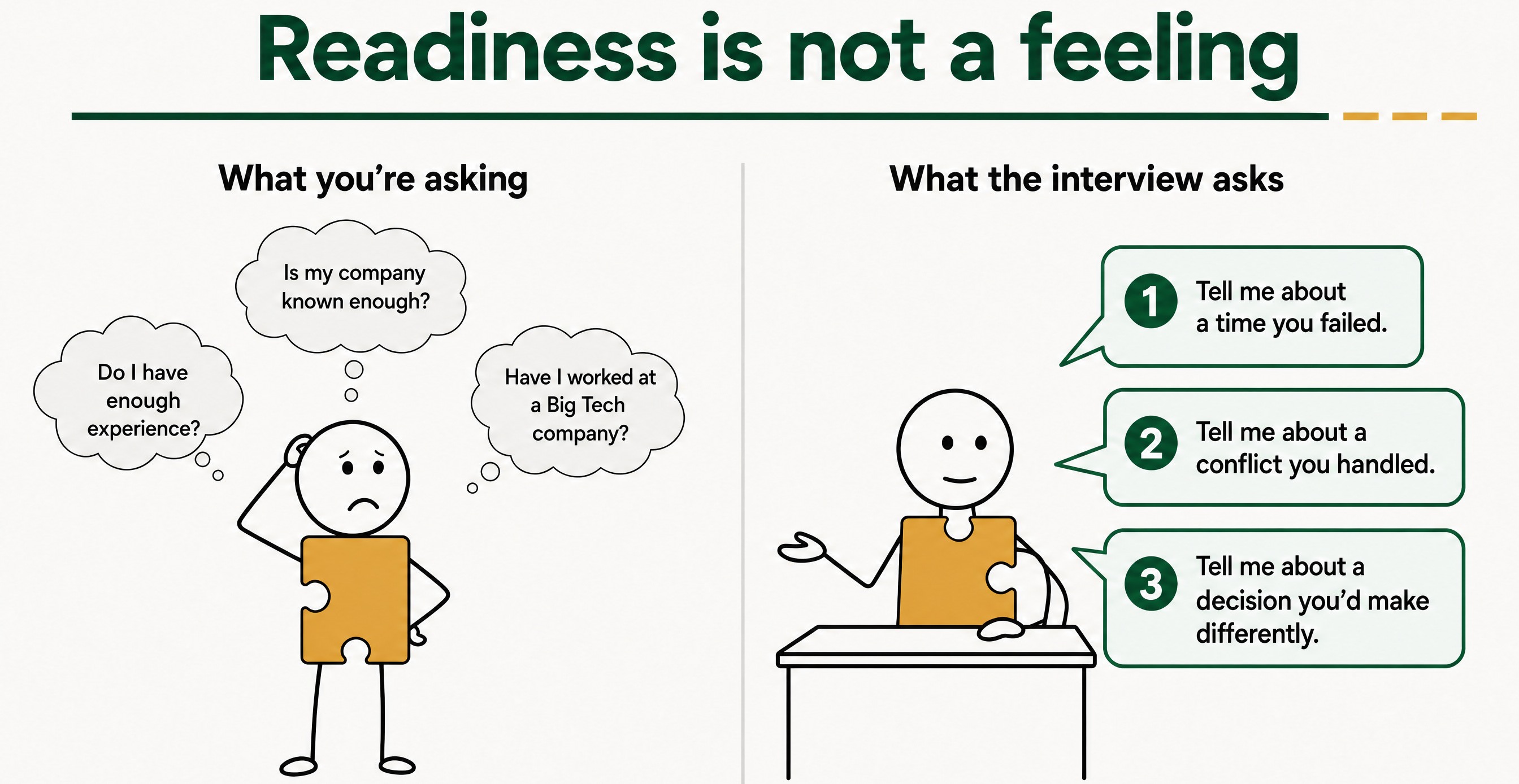
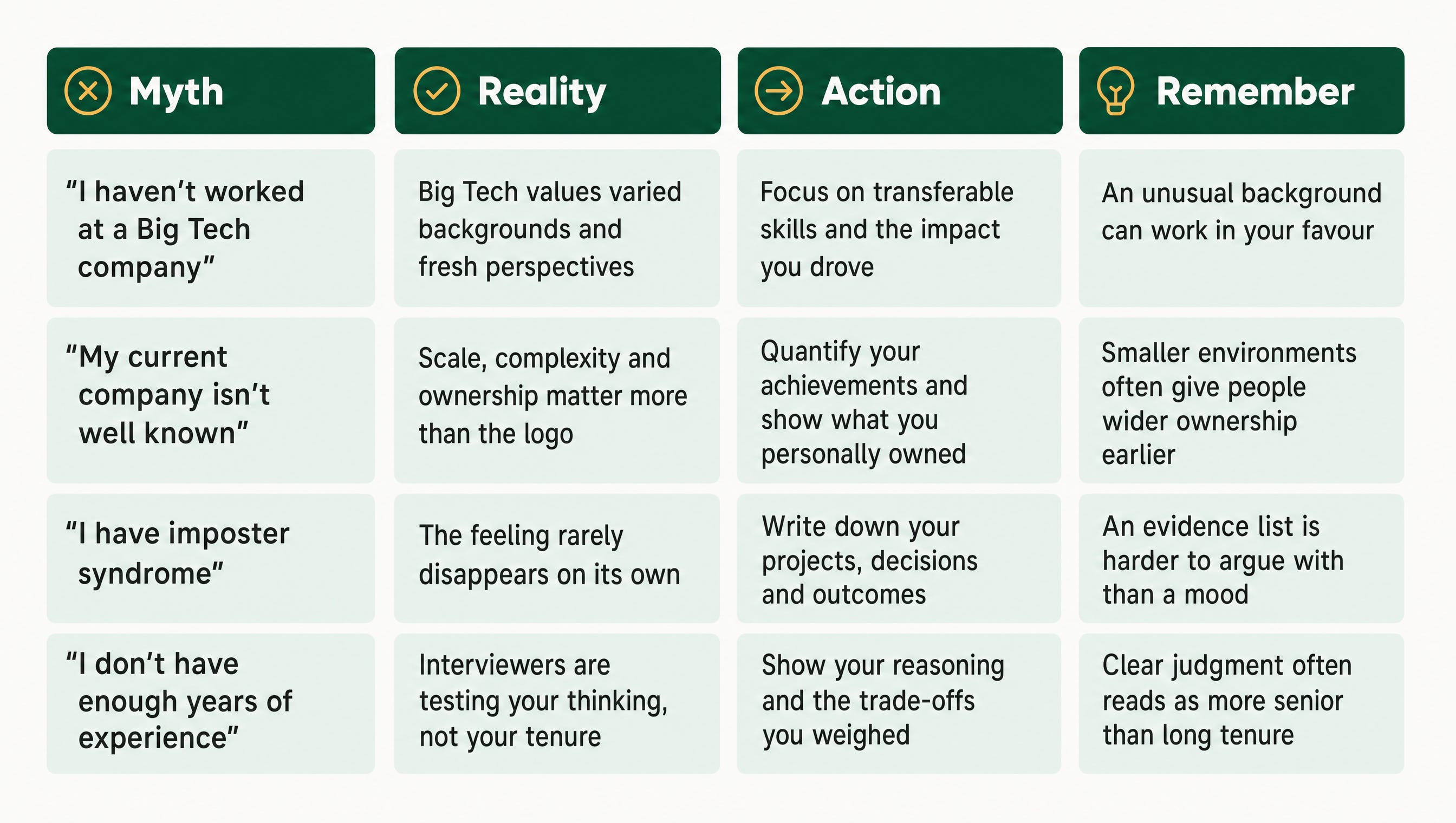
“I haven’t worked at a Big Tech company.”
“My current company isn’t well known.”
“I don’t have enough experience.”
These are the reasons people tell me why they cannot apply. I understand all of them because I, too, once believed these were the obstacles preventing me from applying to my own Big Tech interview. Before my interview, I hadn't applied anywhere. I had decided I didn't belong there.
What I’ve learned is that these objections are all about background, and most of the interview actually looks at something else. The questions asked are about decisions I had made, problems I have had to workaround, people I have had to disagree with, and things that had not turned out the way I wanted.
Your resume gets you in the door. What happens next is a conversation about your experience.
📄 Free resource: Big Tech Behavioral Interview Story Questionnaire
Before you continue, it’s worth knowing where you are on the road to a Big Tech interview. Based on similar eight behavioral story categories and STAR templates I’ve shared in previous newsletters, I‘ve put together a short questionnaire to show you where your story bank is currently prepared and where you may need to prepare before your next interview.
Readiness is not a feeling
Here is the bit where I want to get your attention as I was not ready myself during my interview process. Neither before, during nor after the interview.
The feeling will never arrive, and waiting for it to arrive can waste years of your life.
One has to ask another question. And that is, given the example, can you come up with a good one on your own? Well, you can test it yourself this week.
Imposter syndrome and the fear of not having enough years of experience are the two most common interview questions.
The imposter syndrome will remain with you no matter how many years you have been dealing with it. Documentation is your friend. Assemble the projects you have been working on, the decisions you have made, and the outcomes you have witnessed. The feeling can remain, but you will have something to return to.
Years of experience do not matter as much as one may think because the behavioral part of the interview tests your mind, and not your years of service. A candidate with six years of experience, who can speak of the trade-offs they have had to make, will appear more qualified than another candidate with twelve years, who can tell you precisely what happened without passing judgment.
What readiness actually looks like
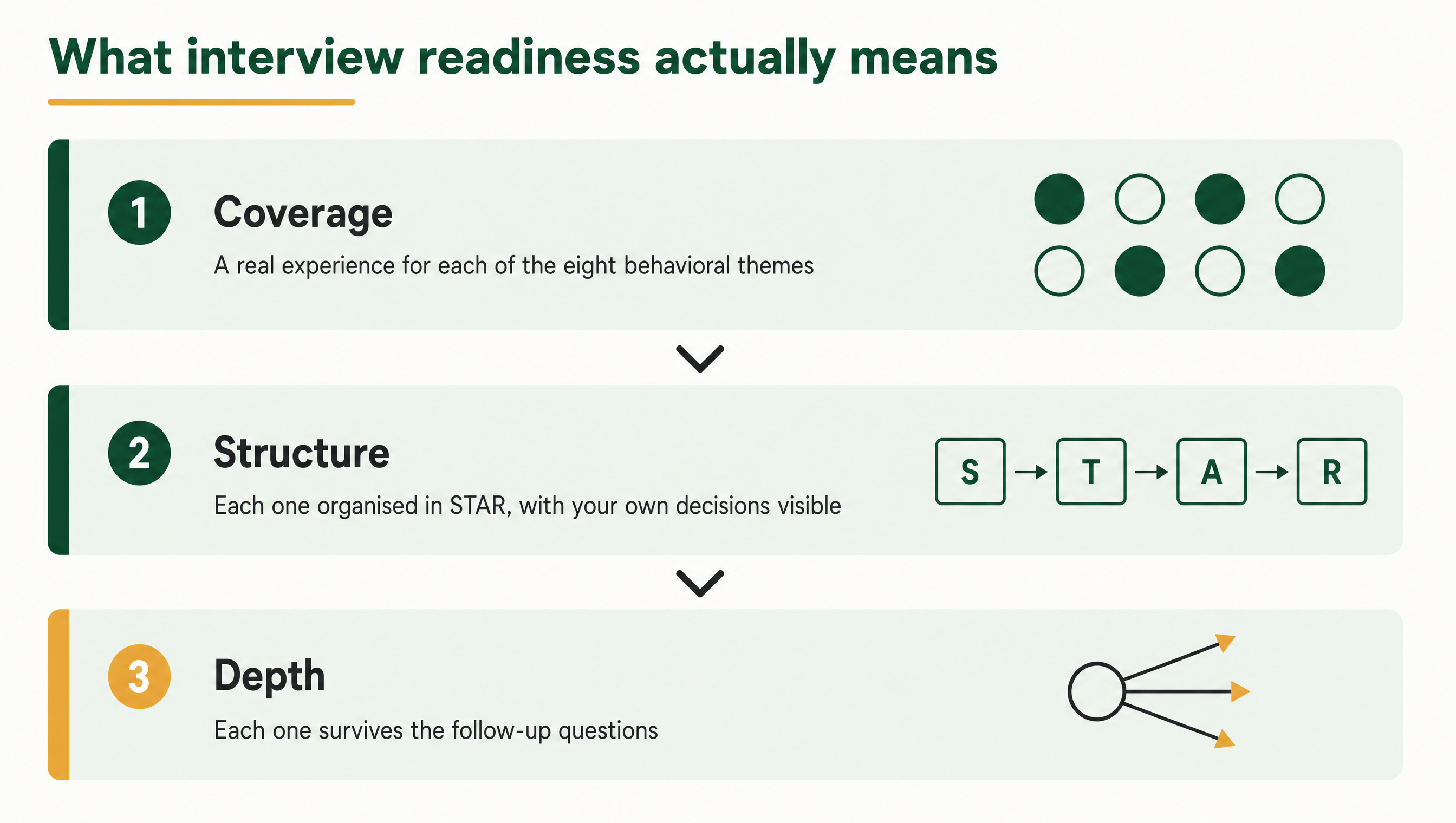
Interviewers tend to ask behavioral questions around a predictable set of themes: Customer/User Focus, Success, Failure, Conflict, Problem-Solving, Learning/Growth Mindset, Leadership, and Time Management.
Once you see the themes, preparation is no longer a guessing game. Instead of guessing at the exact wording of a question, you make sure you’ve got experiences that cover each one and are well structured to withstand someone asking deeper questions.
That collection is your story bank. I’ve talked about the three types of stories needed to come into these interviews prepared: your Elevator Pitch, your Technical Stories, and your Past Experience / STAR Stories. The last is often the largest weight, because one story per theme is rarely enough. The same skill shows up across multiple interview rounds, and a deep story bank lets you choose the experience that best matches what’s actually been asked.
Use STAR to organize each one. Situation and Task establish the context, Action makes your own decisions and contributions visible, and Result show what‘s changed because of what you did.
The largest problem most candidates have is that they get their Situation and Task right but miss the Action. They tell you what the team decided to do, rather than what you decided to do. The interviewer is building a profile of you, and the pronouns are more important than you realize.
The introduction is worth more attention than most folks give it. One candidate, who worked through this with me, later told me that the one-minute elevator pitch determined three of his four interview rounds because it established a tone that the others followed.
You have more influence over where an interview goes than you think.
A quick test of your own story bank
Pick a theme you think you’ll be asked about. A failure story is a good place to start because it’s the one people tend to avoid preparing for.
Can you name a real experience within a few seconds?
Can you lay it out in STAR without having to dig for details?
Can you say clearly what you personally decided and did, rather than what the team did?
Now take a look at how an interviewer would probe you. Say you told a story about a project that was late. A good follow up sequence would be, why that approach, why other approaches didn’t work, who was against you and how you overcame it, when you realized it was going to be late, and what would you do differently. That last question is what trips up a lot of people who think they’ve prepared a decent story but have no idea how to reflect on the experience.
Go through that same process for the other seven themes and suddenly those gaps become obvious, along with exactly how specific they need to be. You’ll even know that you need two more examples for Leadership and your story for Conflict doesn’t stand up to a second question. That means you can now take a preparation checklist and work off of it, rather than an unease that you’re not prepared.
If you prefer to work this out more systematically, the questionnaire at the top of the page covers all eight themes.
Give it a shot and let me know how it went. What’s the weakest of the eight themes for you right now? What was the one that seemed most obvious to you before you had to lay it out and look for the weaknesses? Leave a comment. I read them all, and the answers tend to lead to what I write next.
You’re also interviewing them
The questions you ask at the end of the interview process are another part of this. Ask about the challenges of the position, how the team interacts with each other, and how the position will allow you to grow professionally. When you ask these types of questions, you send a clear message to the interviewer that you are taking the potential job offer seriously.
Additionally, asking these kinds of questions can assist you in determining if the position is a good match for your career goals once you receive the job offer. All of the top candidates I’ve seen share one common thread. Each candidate knows exactly what they did, why it mattered, and what they learned from that experience. I had to look through hundreds of job postings on a large tech company website before I found a single posting that fit my background. There’s no getting away from this; you simply need to invest time into preparing your “story.” You can begin preparing your “story” immediately.
🎓 Preparing for a Big Tech interview?
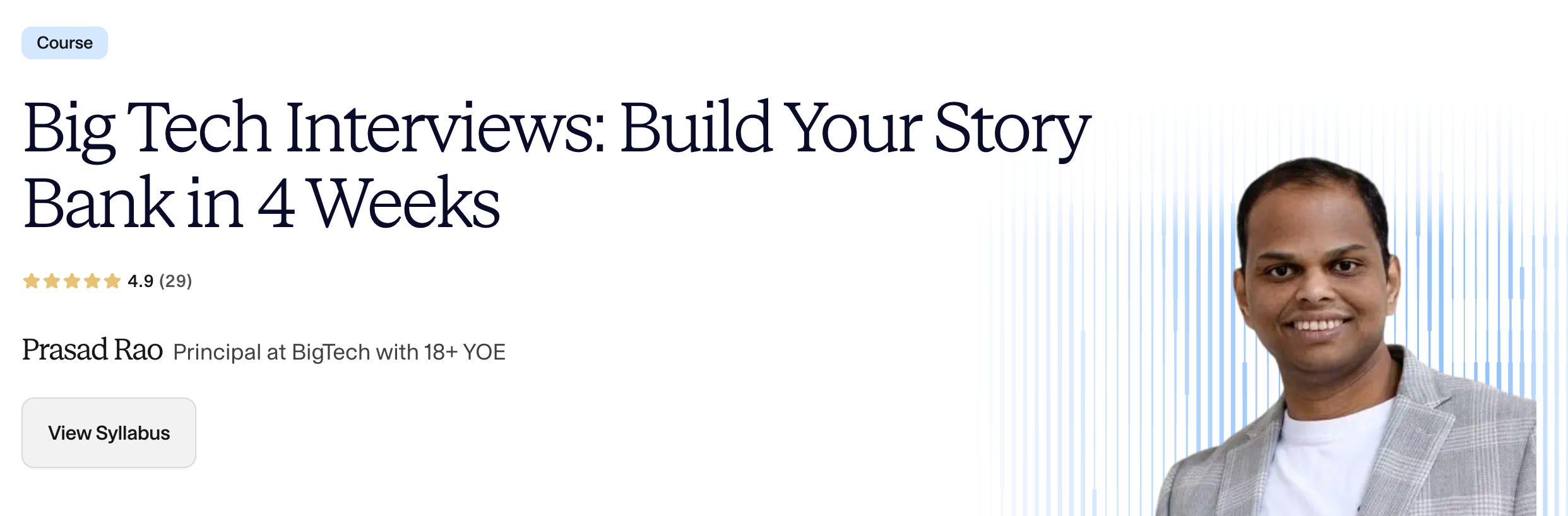
My next cohort, Big Tech Interviews: Build Your Story Bank in 4 Weeks, is running from October 16 to November 8.
You build 8 to 12 stories across all eight behavioral themes, and then test them under pressure through live mock interviews organized theme by theme. We also cover how long an answer should be, how to handle follow-ups, and what to do with scenario questions where you don’t have direct experience.
In week three, hiring managers and Principal-level professionals from Big Tech and AI labs join us for a panel on what they actually look for in behavioral rounds.
I’ll share more on how to strengthen these stories in the coming newsletters.
See you next Thursday,
Prasad Rao
Hey, Prasad here. I'm the voice behind the weekly newsletter Big Tech Careers. I share strategies for Big Tech interviews, behavioral storytelling, technical careers, and professional growth every Thursday.