

You can know the technical answer and still fail the interview.
Why?
Because interviewers aren’t only evaluating what you know.
They’re also trying to understand:
How do you actually operate at work?
How do you make decisions?
How do you handle trade-offs?
How do you work with others?
What do you take ownership of?
And what changed because of your contribution?
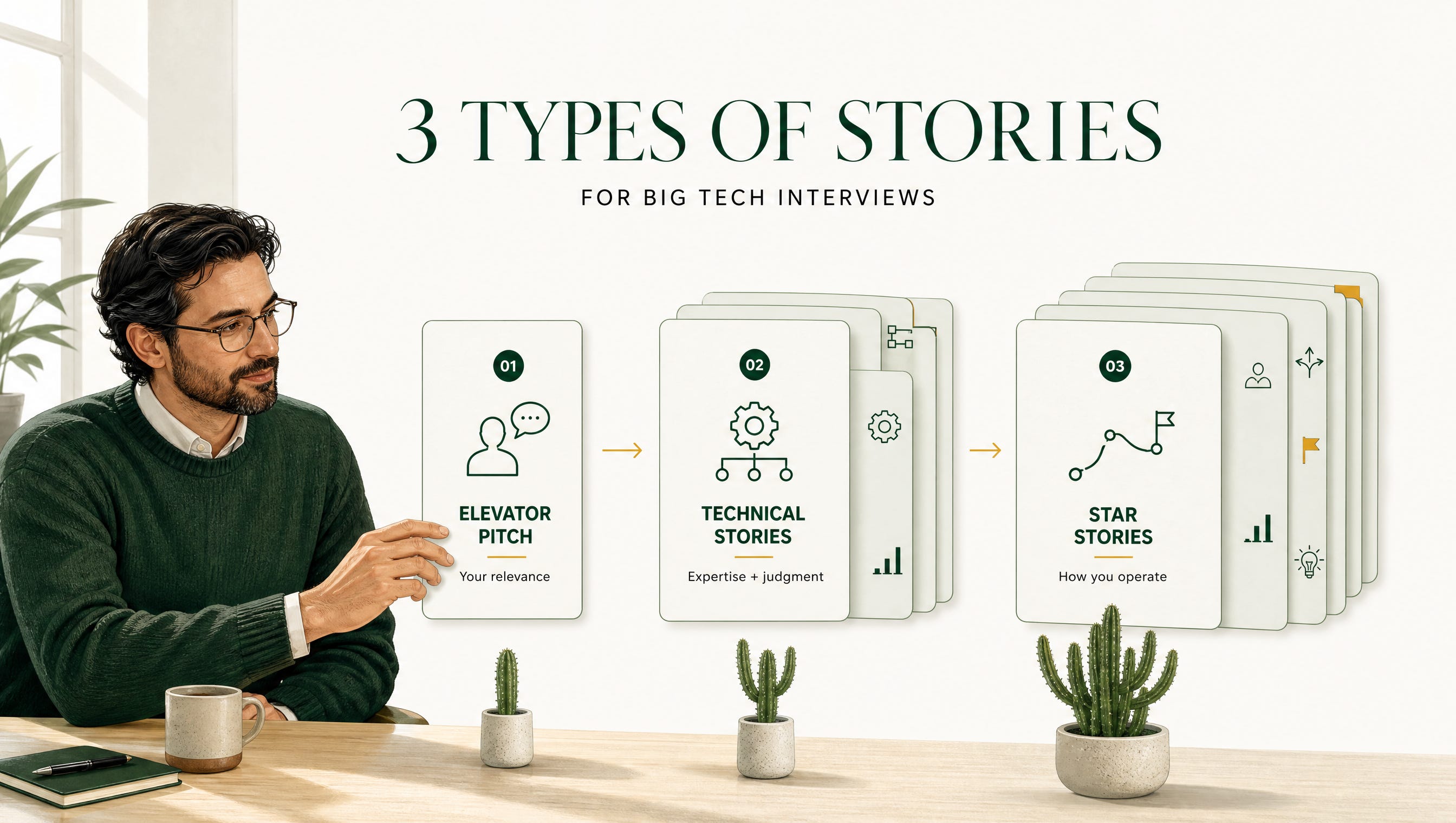
Before your next Big Tech interview, prepare 3 types of stories:
1. Your Elevator Pitch
Why you’re relevant.
2. Your Technical Stories
How you apply what you know.
3. Your Past Experience Stories
How you operate when the work gets difficult.
One important distinction:
I mean three types of stories not three stories in total.
Your elevator pitch may be one prepared introduction.
But you should build multiple technical stories across your career and a bank of past-experience stories that you can adapt to different behavioral questions.
That’s what we’re going to look at today.
Hey, Prasad here 👋
In my experience, some of the strongest candidates struggle in Big Tech interviews for a reason they don’t expect.
It’s not always because they lack technical knowledge.
They know the concepts.
They’ve worked on complex projects.
They may even give the technically correct answer.
But when the interview ends, the interviewer can still be trying to understand:
How does this person actually operate at work?
That’s the gap many technically strong professionals underestimate.
And it matters even more in today’s market.
Why This Matters in September 2026
Nearly 60% of active IT-services hiring demand across the world is concentrated in mid-senior and senior roles, while employers are increasingly prioritizing professionals who can apply AI, cloud and digital skills to real business problems.
So knowing the technology is important.
But demonstrating how you used it, why you made certain decisions, and what impact you created is what helps differentiate you.
Your stories provide that evidence.
Let’s look at each type.
1. Your Elevator Pitch: Don’t Tell Your Entire Career Story
Almost every interview starts with:
“Tell me about yourself.”
It’s predictable.
Yet many candidates still improvise it.
A common answer sounds like:
“I started at Company A, then moved to Company B, became a senior developer, and now I’m a tech lead…”
There may be nothing wrong with that information.
The problem is that the interviewer has to figure out what matters.
Your elevator pitch should do that work for them.
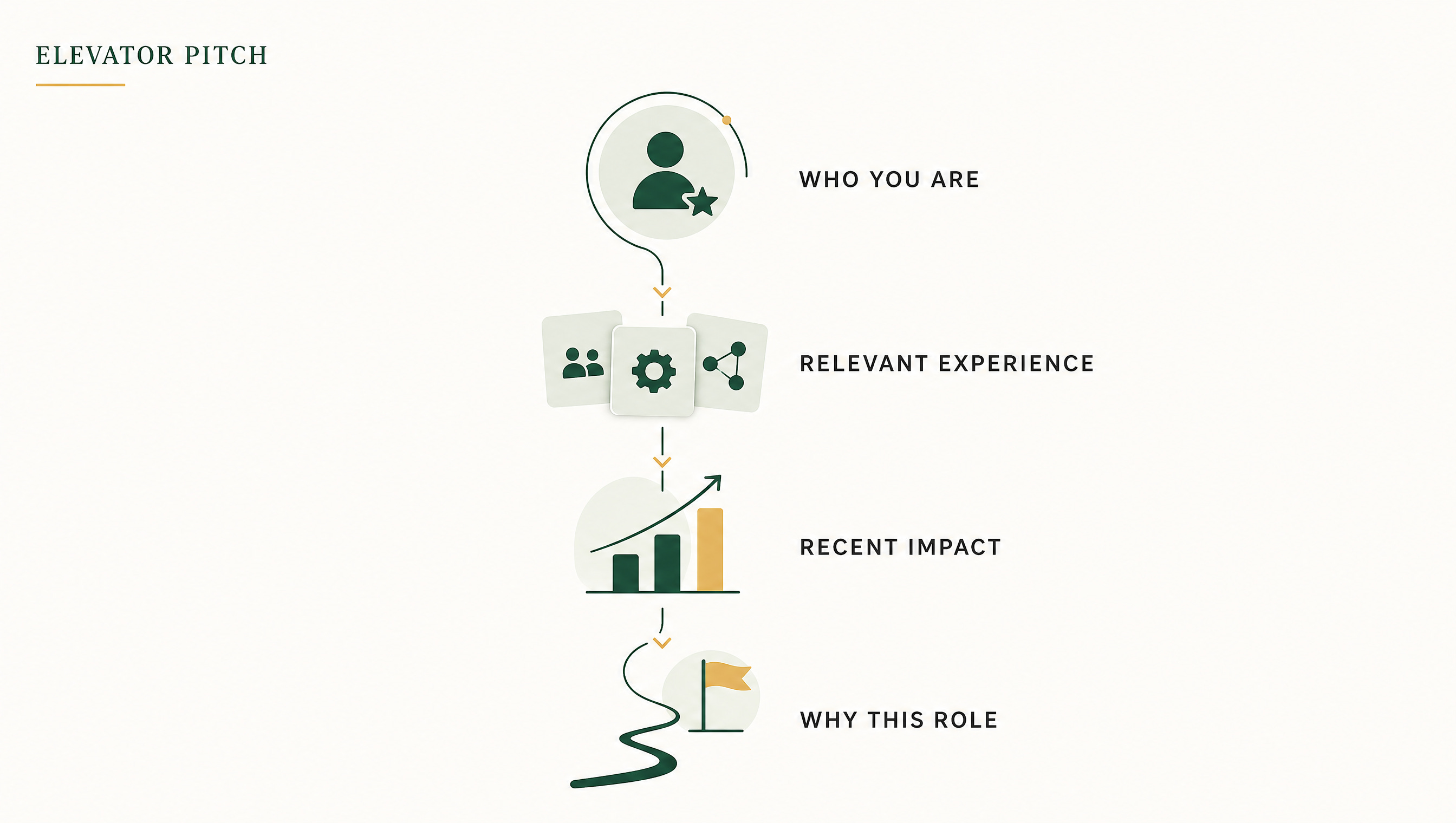
Think of it in three parts:
1. Who are you?
“I’m a tech lead with eight years of experience building cloud platforms.”
2. What’s the most relevant evidence?
“I currently lead a team focused on reliability and scalability of a customer-facing platform.”
3. What’s the impact and where are you heading?
“Recently, I helped redesign a critical service that improved uptime from 98.5% to 99.9%. I’m now looking to take on larger architecture and cross-functional leadership responsibilities.”
Notice what’s happening here.
The candidate hasn’t told me everything.
They’ve told me what I need to know to decide:
“I want to learn more about this person.”
Before your next interview, ask yourself one question:
If the interviewer remembers only one thing from my introduction, what do I want it to be?
Build your pitch around that.
2. Your Technical Stories: A Correct Answer Is Only the Starting Point
Imagine ten candidates interviewing for the same engineering role.
Seven answer the technical question correctly.
You’re one of those seven.
Why should the interviewer choose you?
Let’s say the question is:
“What is a load balancer?”
You might answer:
“A load balancer distributes network traffic across multiple servers to prevent one server from becoming overloaded. It improves availability and reliability by routing traffic to healthy servers.”
Correct.
But now imagine you’re the interviewer.
What did you learn about this candidate?
You know they understand load balancing.
That’s about it.
Now add real experience.
“In my previous role, our e-commerce platform experienced slowdowns during peak shopping periods. I worked with the infrastructure team to implement an Elastic Load Balancer using a least-connections approach.
This helped distribute traffic more effectively, allowed maintenance without disrupting users, and improved uptime from 98.5% to 99.9%.”
Now the answer is doing something different.
The interviewer can see:
Technical knowledge
Real-world application
Collaboration
Customer impact
Measurable results
But for an experienced candidate, I would still want to know more.
Why least-connections?
What did you personally own?
What alternatives did you consider?
What constraint affected the decision?
Did anyone disagree?
Those answers reveal something a definition never can:
Your judgment.
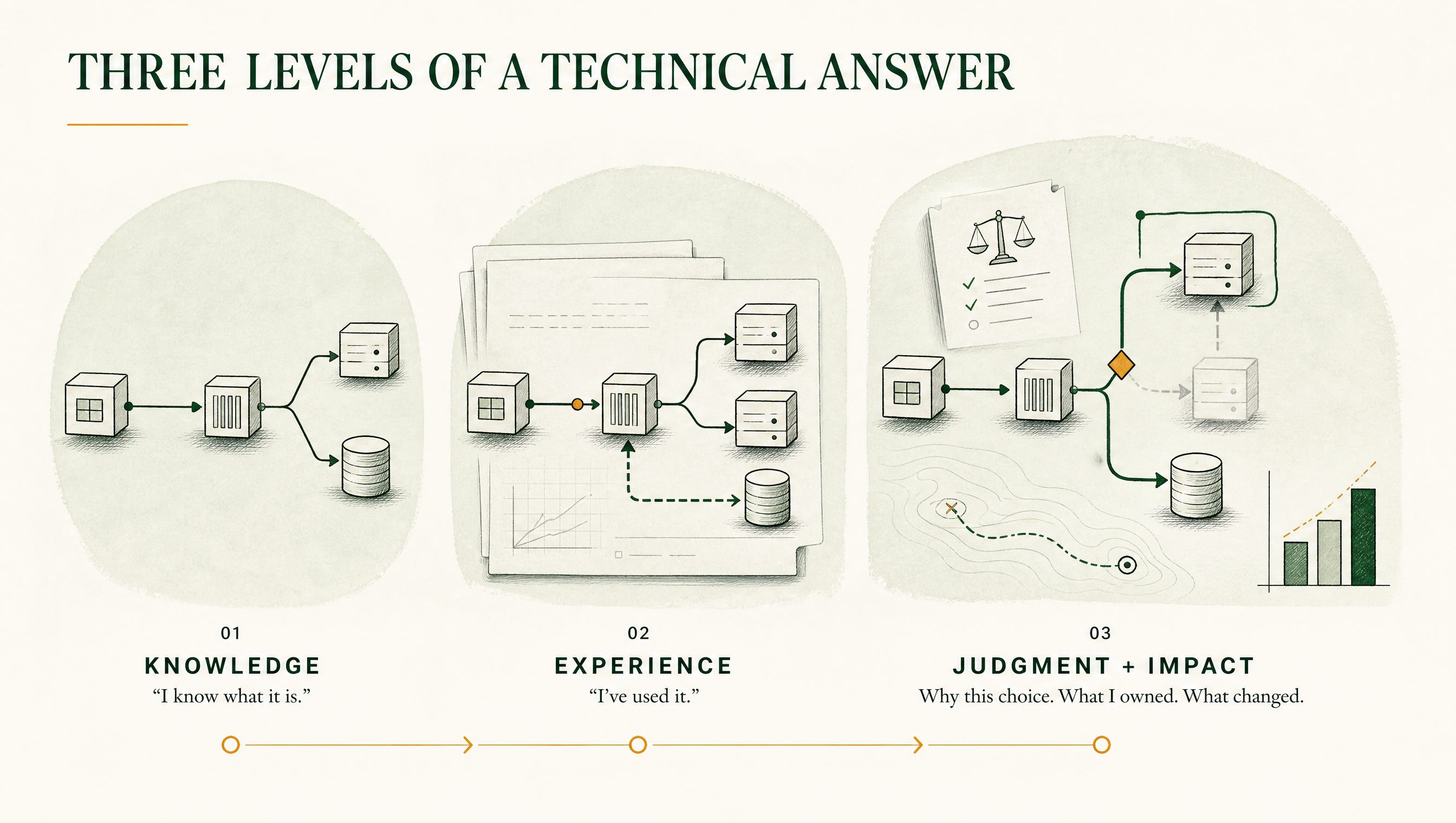
That’s the level you should be aiming for and multiple such technical stories for the strongest projects you’ve in your careers.
A Simple Way to Prepare Your Technical Stories
For one technical topic you expect in your next interview, answer:
The problem was: ______
My role was: ______
We decided to: ______
Because: ______
The alternatives or trade-offs were: ______
I personally owned: ______
I worked with: ______
The result was: ______
You don’t need to say every one of these lines during the interview.
The exercise simply forces you to understand your own story.
And that’s usually where candidates discover the real gap.
They often have enough experience.
They just haven’t identified which parts of that experience demonstrate ownership, judgment, collaboration and impact.
If You Want More Structure

This is also part of what I work on with candidates in my Big Tech Interviews: Build Your Story Bank in 4 Weeks cohort on Maven.
We work on turning real experience into interview-ready stories, using STAR effectively, translating technical wins into business impact, and pressure-testing those stories through practice.
But you don’t need to join a cohort to start doing this.
Use the exercise above and begin with one experience.
Then another.
The principle stays the same:
Don’t stop at what you know. Prepare the evidence of how you’ve used it.
3. Your Past Experience Stories: Show How You Operate
Most candidates already know STAR:
Situation → Task → Action → Result
So knowing the acronym isn’t the real problem.
The problem is how candidates use it.
A common behavioral answer spends most of the time explaining:
the project…
the company…
the team…
the technology…
the deadline…
And three minutes later, the interviewer still doesn’t know:
What did YOU actually do?
Your behavioral story isn’t a project summary.
It’s evidence of how you operate.
And STAR remains the core structure.
The important part is what you put inside that structure.
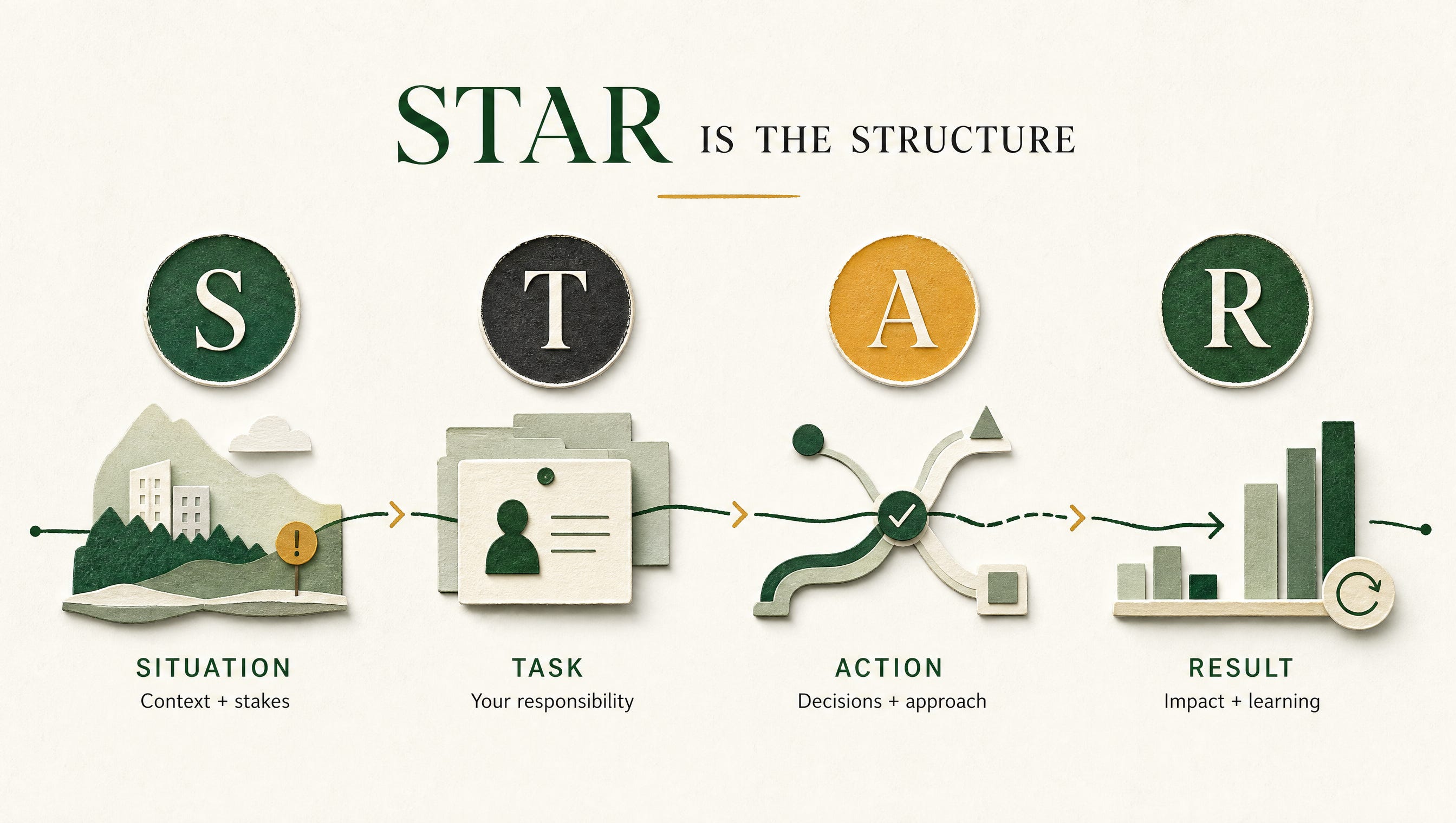
STAR gives you the structure.
Your context, decisions, judgment, collaboration and impact give the answer depth.
For example, saying:
“There was a disagreement in the team, but eventually we resolved it.”
doesn’t demonstrate much.
The interviewer wants to understand:
What was the disagreement?
What was your position?
What did the other person believe?
How did you approach the conversation?
Did you change your mind?
Did they?
What was the eventual result?
That’s where behavioral skills become visible.
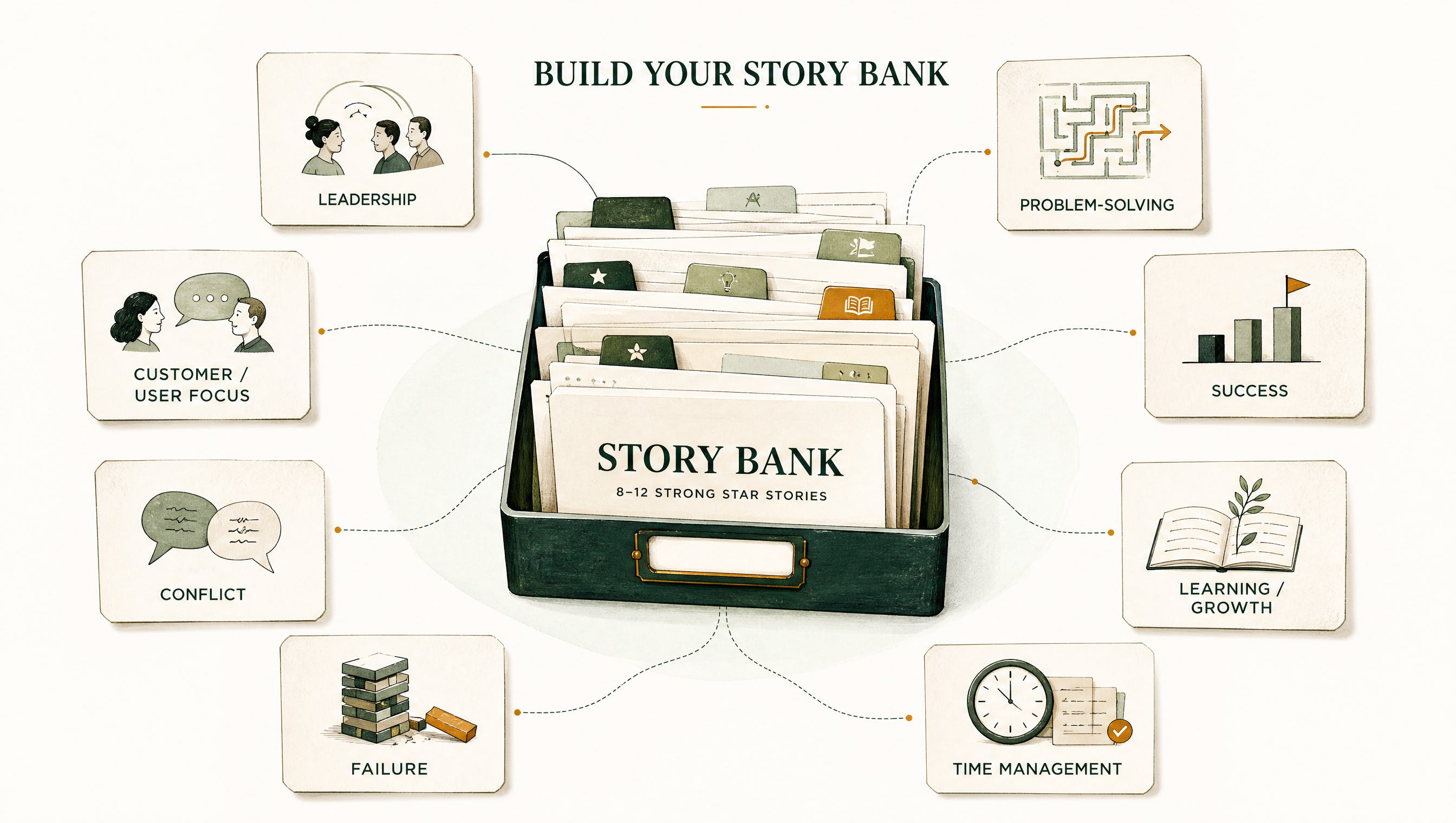
Build your Story Bank
There are hundreds of behavioral interview questions.
You don’t need hundreds of memorized answers.
Instead, build your story bank around the 8 behavioral themes:
1. Customer / User Focus
2. Success
3. Failure
4. Conflict
5. Problem-Solving
6. Learning / Growth Mindset
7. Leadership
8. Time Management
I have five questions for each of these eight themes.
That’s 40 questions you can use to test whether your preparation is strong enough.
But answering 40 questions does not mean memorising 40 different stories.
The goal is to build a smaller bank of strong experiences that you understand deeply enough to adapt naturally.
A strong story may help you answer more than one question depending on what the interviewer is evaluating.
For every story, ask:
What does this story prove about me?
If you can’t answer that clearly, the story probably needs more work.
The 3 Types of Stories Work Together
Your interview isn’t a collection of isolated questions.
The three types of stories build a picture of you.
Your Elevator Pitch says:
“Here’s why my background is relevant.”
Your Technical Stories say:
“Here’s proof that I can apply what I know, make decisions and create impact.”
Your Past Experience / STAR Stories say:
“Here’s how I operate when the work becomes difficult.”
Together, they help move the interviewer from:
“This candidate knows the material.”
to:
“I understand how this person could operate on our team.”
That’s the shift you’re trying to create.
So before your next Big Tech Interview, start preparing these 3 types of stories. Identify gaps in your stories and fill them as you prepare to ensure you get ace your interviews.

If you’re preparing for Big Tech interviews and want a more structured way to build and practice your story bank, I cover this in depth in Big Tech Interviews: Build Your Story Bank in 4 Weeks on Maven.
It’s there if you want the additional structure, practice and feedback.
See you next Thursday,
Prasad Rao
Hey, Prasad here I’m the voice behind the weekly newsletter Big Tech Careers. I share practical strategies for Big Tech interviews, behavioral storytelling, technical careers and professional growth every Thursday.