

Hey, Prasad here 👋 I’m the voice behind the weekly newsletter “Big Tech Careers.”
In this week’s article, I break down the Dice July 2026 Tech Jobs Report — 7 million job postings analysed — and pull out the signals that actually matter for your career decisions right now.
If you like the article, click the ❤️ icon. That helps me know you enjoy reading my content.
Every month when the tech hiring numbers drop, most people read the headline figure and move on. The aggregate is useful as a mood indicator. It’s not useful for making career decisions.
The question that actually matters isn’t “is tech hiring recovering?” It’s: which parts are recovering, in which industries, for which skills? Because the answer to that question tells you where to point your next move and the answer in June 2026 is more interesting than the headline suggests.
Dice’s July 2026 Tech Jobs Report analysed over 7 million US tech job postings and published this month. Here’s what stood out.
The Headline: Recovery Is Real, and It’s Accelerating
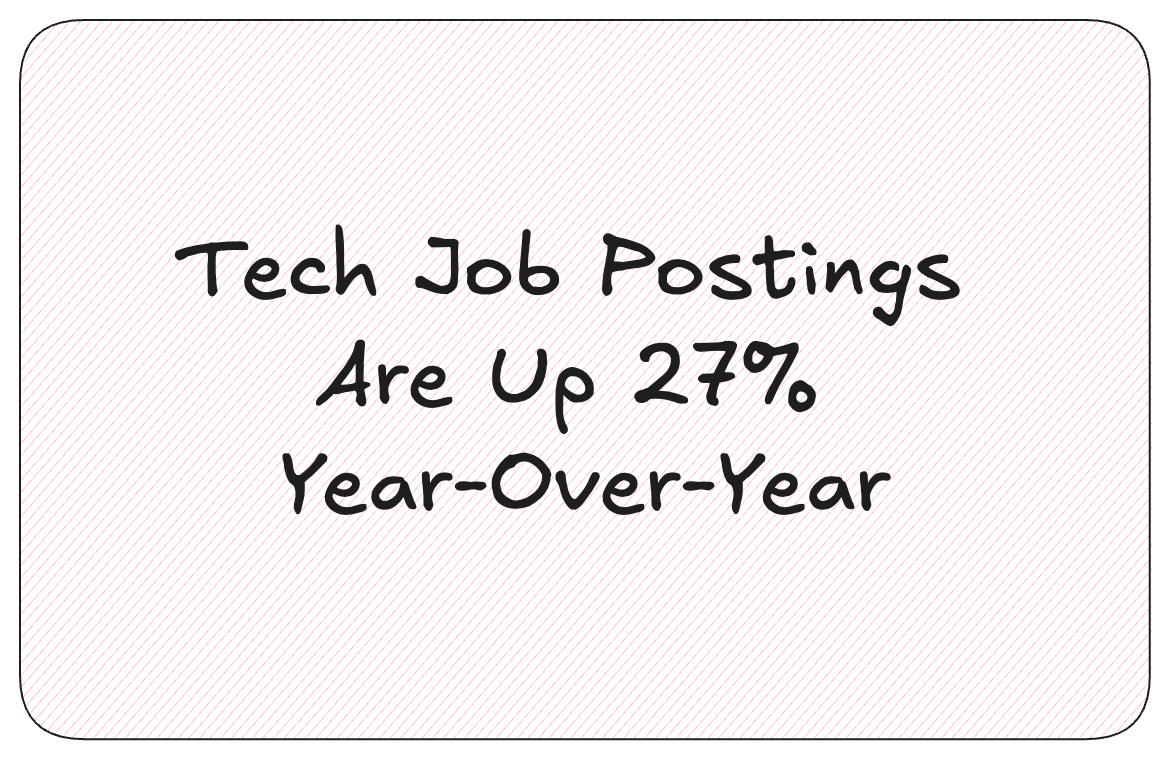
Tech job postings grew 3% month-over-month in June — consistent with the sustained expansion that has held for most of 2026.
Year-over-year, postings are up 27% compared to June 2025.
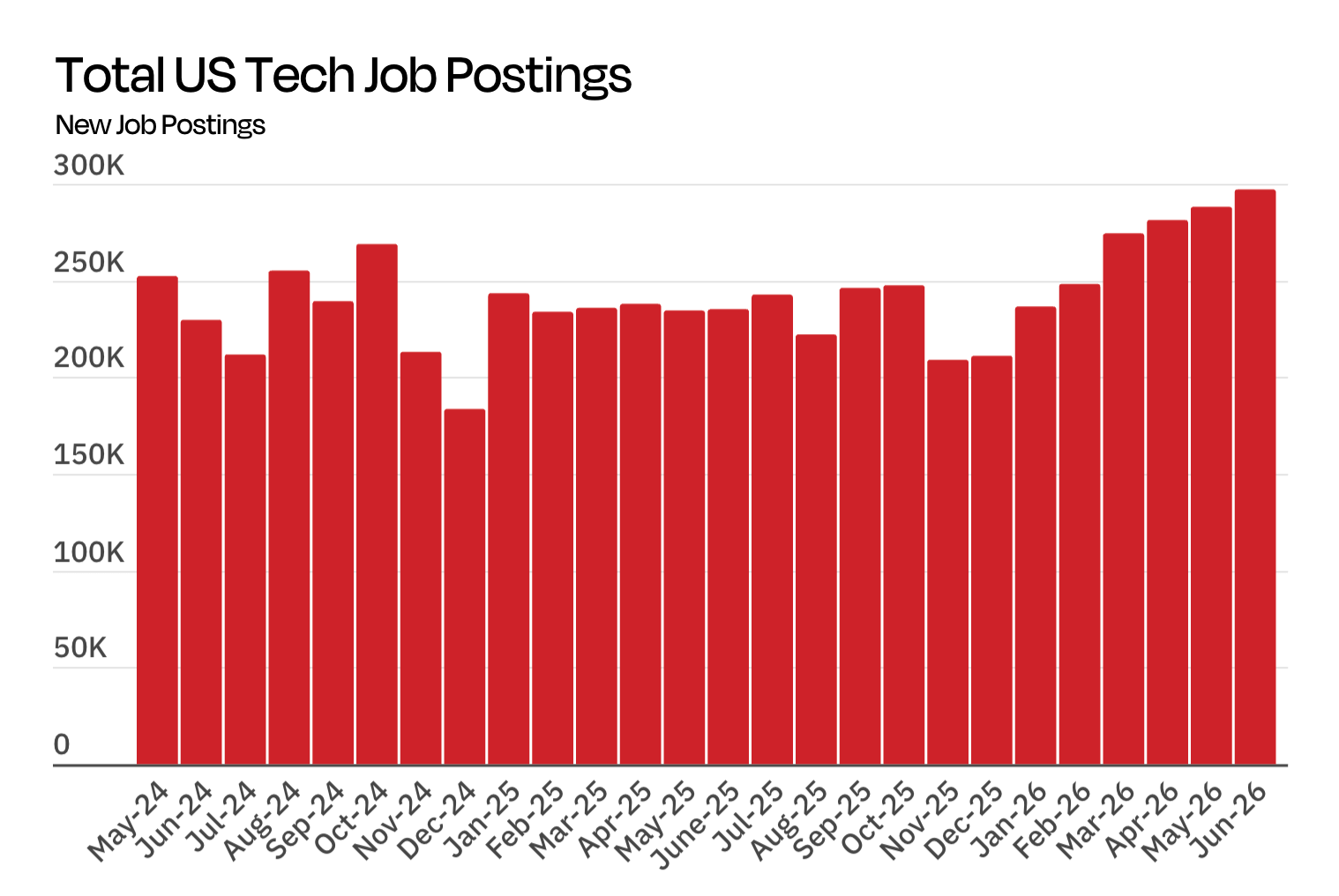
Dice’s framing is deliberate: the market has moved from recovery into a period of steady growth. That’s a meaningful shift in language from where we were twelve months ago.
AI skill requirements reached 75% of US tech job postings in June, up from 73% in May — and up 178% year-over-year from June 2025.
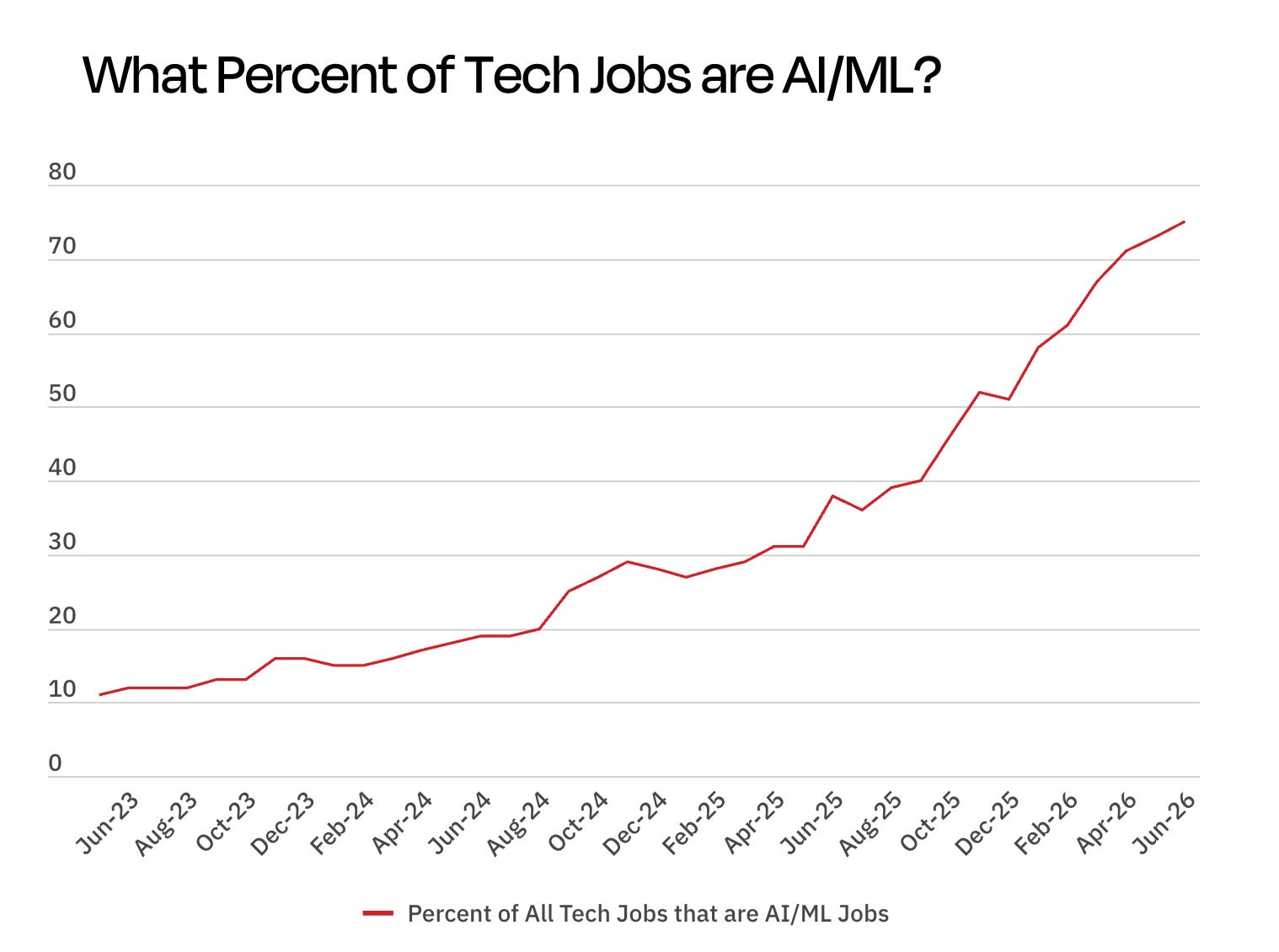
The report’s conclusion: AI fluency now sits at the centre of most tech hiring, not at its margins.
That last point is worth pausing on. Three years ago, listing AI skills on your resume was a differentiator. Today, not listing them is a gap. The bar moved faster than most people adjusted.
Where the Industry Growth Is
This is where the headline number starts to break apart into something more useful.
Manufacturing posted the largest month-over-month industry gain in June, with tech job postings up 35%. Technology came in at +19%, Consulting at +7%, Software at +5%.
Manufacturing is growing faster than Technology. The report’s explanation is straightforward - manufacturers are moving past early AI pilots toward production-scale automation, and they need the technical talent to do it.
Year-over-year, the picture is even more striking. Manufacturing, Consulting, and Healthcare each grew more than 50%, consistent with industries that spent 2025 building out AI-integrated operations rather than experimenting with them.
Think about what that means for your job search. The industries most tech professionals instinctively target pure tech companies and software firms. They are growing but they’re not where the momentum is heaviest right now. Manufacturing, Healthcare, and Consulting are the growth stories of mid-2026, and they’re competing for the same supply of technical talent.
If you’ve been sending all your applications to software companies and wondering why the response rate feels low, this data is part of the explanation.
Where the Skill Growth Is
This is the finding I found most surprising and most directly actionable.
The fastest-growing skills month-over-month in June were Electronic Engineering (69%), API System Integration (58%), LDAP (55%), Digital Forensics (54%), Data Exchange (53%), Enterprise Integration (50%), Threat Detection (48%), NIST Cybersecurity Framework (47%), and SAML (45%).
Two clear threads run through that list.
The first is integration: API System Integration, Data Exchange, and Enterprise Integration are all in the top six. These skills reflect the work of connecting AI systems to enterprise data and workflows — widely cited as the primary bottleneck between AI pilots and production deployment.
The second is identity and governance: LDAP, SAML, NIST CSF, and Threat Detection. This reflects a security posture that treats AI agents as identities needing authentication and monitoring alongside traditional users. As agentic systems start acting autonomously inside enterprise environments, the question of “which agent is doing what, with whose credentials, and how do we audit it?” becomes urgent.
Now look at the year-over-year numbers, and the signal gets louder.
Skills growing 250% or more year-over-year include: Enterprise Integration (638%), Agentic AI (587%), AI Agents (503%), Responsible AI (495%), AI Infrastructure (366%), Vector Database (353%), Event-Driven Programming (310%), RAG (275%), Prompt Engineering (253%), and Observability (251%).
Enterprise Integration is growing at 638% year-over-year. Agentic AI, the most-discussed topic in our industry, is growing at 587%. Enterprise Integration is outpacing Agentic AI itself.
The report’s interpretation is explicit: connecting agentic systems to existing infrastructure is growing faster than the agentic systems themselves. The bottleneck isn’t building agents. It’s getting them to reliably talk to real enterprise systems like CRMs, ERPs, legacy databases, internal APIs.
If you’re deciding which technical skill to double down on right now, this data is pointing clearly in one direction.
The Job Titles Surging Right Now
Job titles posting month-over-month growth above 150% in June cluster into three groups:
Enterprise systems and consulting: Appian Developers, Oracle Cloud Financials Consultants, ServiceNow Managers, Principal Consultants, Technology Consultants.
Core engineering and infrastructure: IT Software Engineers, C++ Software Developers, Configuration Analysts, Support Engineers, Network Infrastructure Engineers.
AI and security: Artificial Intelligence Analysts, Cyber Threat Intelligence Analysts.
What This Means for Your Career Right Now
Three practical takeaways:
1. Widen your industry targeting. If your job search is focused on pure tech companies, you’re competing in a smaller pool than you need to be. Manufacturing, Healthcare, and Consulting are growing at 50%+ year-over-year and are actively looking for the same skills you have. Most of your competitors aren’t applying there. The job market is less efficient in these sectors, which works in your favour.
2. Reframe your integration experience. If you’ve worked on connecting systems like APIs, data pipelines, legacy modernisation, cloud migration, identity management etc, that experience is now directly in demand. It wasn’t always framed as a career strength. Frame it that way now, explicitly, in AI-adjacent language. “API System Integration” and “Enterprise Integration” are the specific terms showing up in job postings.
3. Think seriously about the integration + governance combination. The skills clusters in this data aren’t independent. The companies building production agentic systems need people who understand both integration architecture and identity and access management. Engineers who can speak credibly to both — how to connect an agent to an enterprise system, and how to ensure it’s doing so securely and auditably — are describing a skillset that is genuinely hard to find right now.
The Bottom Line
The 27% year-over-year growth is real. But the more useful number for your career is 638% which is the year-over-year growth in Enterprise Integration. The market is telling you clearly what it needs most right now: not more people who can build AI demos, but people who can connect those AI systems to the real infrastructure enterprises run on.
That gap between what’s been built and what’s been integrated is where the demand is. It’s also, not coincidentally, where most of the interesting problems are.
Enjoyed this article? You might also like these popular posts from Big Tech Careers:
The AI Job Market Has Split in Two. Here’s Which Side You Want to Be On.
How to Transition from a Developer or Architect to AI FDE Roles
The Quiet Signs Your Company Is About to Do Layoffs — And What to Do Right Now
When you’re ready, here’s how I can help:
1:1 long-term career coaching to fast-track your career growth at Big Tech
Behavioral Interview preparation course for MAANG+ companies
Mock interviews for your upcoming interviews
For more details, send an email to info@bigtechcareers.com