

Hey, Prasad here 👋 I’m the voice behind the weekly newsletter “Big Tech Careers.”
In this week’s article, I share the 5 behavioral shifts that solutions architects need in the age of agentic AI.
If you like the article, click the ❤️ icon. That helps me know you enjoy reading my content.
AI can now generate designs and architecture in minutes. It can compare services, draft documentation, and produce infrastructure-as-code faster than any human.
That is not the threat. The threat is that many solutions architects built their entire value around doing those things manually. And now the question is: what is left?
These five behaviors were always the real differentiators that technical work used to obscure.
Let’s get into them.
1. Proactive Engagement
Most solutions architects walk into a customer meeting and start by asking questions. It feels natural. It is also reactive.
The problem is you are rarely the first SA that customer has spoken to. If they have to explain their situation from scratch again, you have already lost ground.
The shift is to show up with a point of view, not a blank page. Before the meeting, spend 45 minutes doing AI-assisted research. Brief your AI tool on the customer, the industry, the regulatory landscape, and the modernization challenges companies like theirs typically face.
A question that helps: what do I already know about this customer that AI can help me build context around?
Then take it further. Ask the technical account manager about the stakeholders and their concerns. Then feed that into your AI tool and generate likely objections and responses before you walk in. You are not just preparing to answer questions. You are preparing to anticipate them. That’s the differentiator.
Showing up prepared builds trust. It also stops the customer from having to repeat themselves.
The question to ask yourself: Before my next customer meeting, can I articulate three things I already know about their situation without them having to tell me?
2. Outcome Oriented Communication
Most SAs are proud of the technical solution they built. So naturally, that is what they lead with. They talk about the orchestrator, the tools, the agent architecture, the token optimization. They jump straight into how they built the system.
The best SAs do the exact opposite.
They show the business outcome first. Show the data, the result, the time saved, the problem solved. They don’t spend time talking about the how until they have articulated the business value.
This matters even more with agentic systems because they are hard to demo. The chat window shows planning, thinking, reasoning. It disappears and comes back. You cannot demo that process in a way that lands with a non-technical executive. Demo the outputs. Show a side-by-side: here is what we got before, and here is what the agentic system produced. Then let that difference for itself.
The technicalities of how it is done are just the medium. The business outcome is what matters to the customer.
The question to ask yourself: If I removed every mention of a specific technology from my presentation, would the business value still be clear?
3. Human Contextualization
AI can get you 65 - 75% of the way to a solid architecture. It can research the industry, generate discovery questions, and produce reference architectures in minutes. Filling in that remaining 25 - 35% is what puts you ahead.
That gap is human context. The messy, political, budgetary reality that no AI tool can access.
AI cannot tell you that the customer’s CTO Dave is extremely cost conscious because the board is pushing for a 20 percent infrastructure cost reduction by end of year. It also cannot tell you that the CISO Priya is risk-averse and will push back hard on anything that touches customer data.
That information comes from the technical account manager, from real conversations, from paying attention. AI gives you the industry baseline. The human context is what makes it real for that specific customer.
The shift is to layer both together. Use the industry landscape AI provides, then combine it with the specifics you know about the dynamics of the people in the room. That combination is what turns a technically correct architecture into one the customer actually trusts and adopts.
The question to ask yourself: Can I name the top concern of every stakeholder who will be in my next meeting, without guessing?
4. Validation
AI can generate an architecture in minutes. But most architectures do not fail because they are technically wrong. They fail because the SA did not anticipate the questions that matter most to the customer.
Before the solution lands on a customer’s desk, run it through three questions.
1) Does it match the actual constraints I am dealing with right now?
2) Have I validated these claims and confirmed that this works?
3) Can I defend this in a room full of skeptics?
If the answer to any of those is no, you are not ready to present.
This is where you need to use AI against itself. Prompt the model to act as a skeptical CTO and generate the ten hardest questions that would challenge the design holistically.
Business risk, technical feasibility, operational complexity, hidden costs. Then prepare answers, with tiered options backed by real numbers.
For example, the customer asks: what happens if there is a regional outage? Do we lose all orders?
Instead of coming in with a vague reassurance, come in with three options.
Option A: accept the risk, estimated downtime 2 - 4 hours, revenue impact around $10,000.
Option B: add multi-region failover at $800 / mo, reduces downtime to minutes but adds operational complexity.
Option C: introduce a queuing layer at $20 / mo, orders are buffered during outages and processed when service recovers, no lost orders.
AI surfaced the options. You framed them in a way that lets the customer make a decision they feel confident about.
Trust, but verify. Every single time.
The question to ask yourself: Before I present, have I stress-tested my own recommendation by prompting AI to challenge it from the customer’s perspective?
5. The Identity Shift
This is the one that most SAs struggle with. And it is the one that makes the other four possible.
For years, your worth as a solutions architect was defined by what you knew. How many services could you memorize? How many certifications did you hold? Could you recite the differences between EBS volume types from memory?
AI filled that moat overnight. Anyone can now ask a model to compare services and get an accurate breakdown in seconds.
If your identity is tied to what you know, you will see AI as a threat. The SAs who resist AI the hardest are almost always the ones whose entire professional identity is built on technical knowledge.
But knowledge was never the real moat. The real moat is synthesis. Taking the technical capabilities, the business requirements, the human constraints, and the risk tolerance and synthesizing all of that into a coherent architecture that works in the real world. Not in a vacuum. In the actual messy environment where budgets are limited and the executives have been burned before.
Use AI aggressively for the knowledge-heavy work. Then reinvest the time you save into deeper customer conversations.
The job is not to be better than AI at what AI does well. It is to be indispensable at what AI cannot do.
The question to ask yourself: When asked what I do, do I start with a laundry list of tools or do I speak in the outcomes I deliver?
The Bottom Line
These five behaviors are not new. Good SAs have always done their homework, led with outcomes, read the room, validated their work, and thought beyond technical knowledge.
What is new is that AI removed the excuse for not doing them. What is left is the human layer - and if you cannot do these five things, there is nothing left to justify your seat at the table.
Every one of these behaviors is learnable. They are not personality traits. They are behaviors, and behaviors can be practiced.
Pick the one where the gap is biggest for you right now. Work on that first.
Want to Build These Shifts Alongside a Community?
BeSA Batch 10 starts 22 August and the entire behavioral track is built around Facilitation skills
Six sessions. Six Saturday mornings. Completely FREE.
Here’s the full behavioral track agenda:
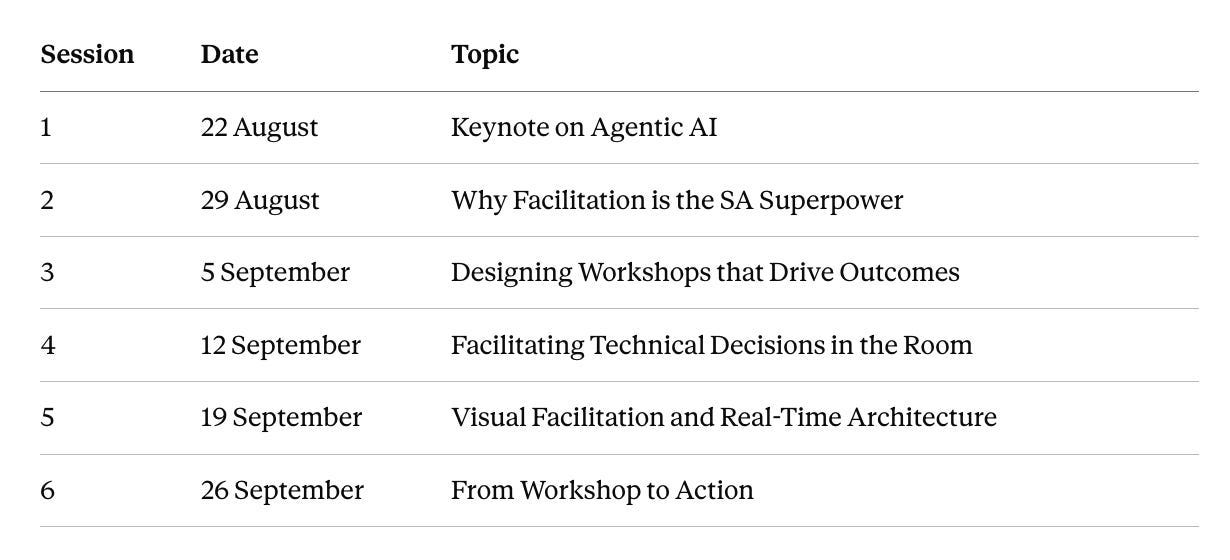
Sessions run live every Saturday and are streamed on the BeSA YouTube channel. The recordings go up after each session if you miss a week.
👉 Register here: https://besa.techexpert.io/program/self-paced-become-a-solutions-architect-agentic-ai-on-aws-3849
Enjoyed this article? You might also like these popular posts from Big Tech Careers:
The AI Job Market Has Split in Two. Here’s Which Side You Want to Be On.
How to Transition from a Developer or Architect to AI FDE Roles
When you’re ready, here’s how I can help:
1:1 long-term career coaching to fast-track your career growth at Big Tech
Behavioral Interview preparation course for MAANG+ companies
Mock interviews for your upcoming interviews
For more details, send an email to info@bigtechcareers.com
This is a fantastic piece and I noted many down for my list of 'differentiators' to remind myself & use as a guiding foundation. Excellent writing and expertise, thank you for sharing!