

Hey, Prasad here 👋 I’m the voice behind the weekly newsletter “Big Tech Careers.”
In this week’s article, I share the 3 behaviors you need to practice to move from senior to staff+ roles. It’s part 2 of 2-part article series.
Also, at the end of the article, I share about Big Tech Careers scholarship
If you like the article, click the ❤️ icon. That helps me know you enjoy reading my content.
In Part 1, we established the fundamentals getting promoted to staff+ requires changing how you behave, not improving what you know. Your job is no longer to be the smartest person in the room. It’s to multiply impact through others.
To re-iterate: the basic useful unit in staff+ work is a behavior that multiplies. Behaviors are practiced (and reinforced by) daily choices.
“Great, great,” you might say “but which behaviors do I practice and how?”
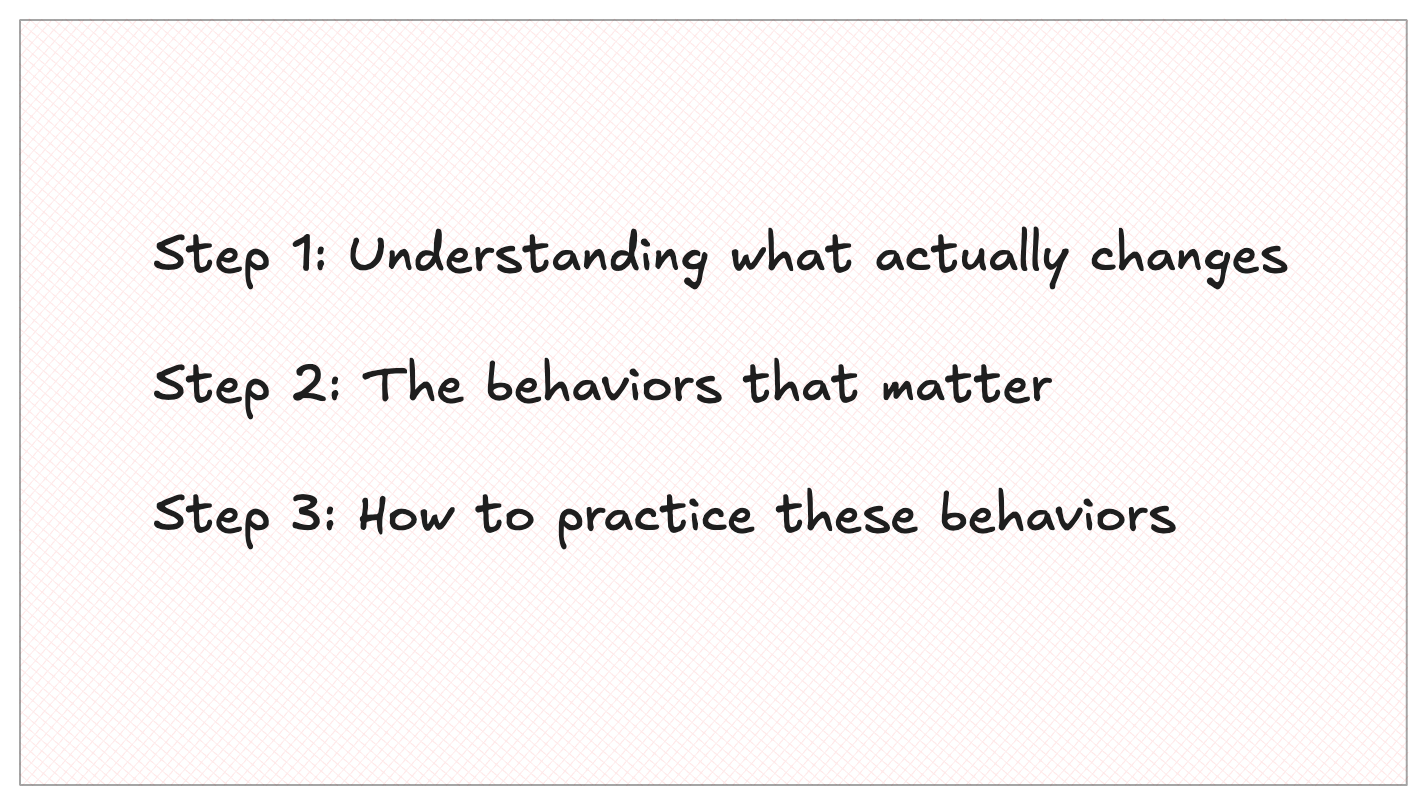
That’s what we will cover in this Part 2 article (Step 2 and Step 3)!
Step 2: The Behaviors That Actually Matter
From the perspective of growing toward staff+, there are really only three kinds of behaviors: input behaviors (how you take in information), processing behaviors (how you think and decide), and output behaviors (also known as how-you-show-up behaviors).
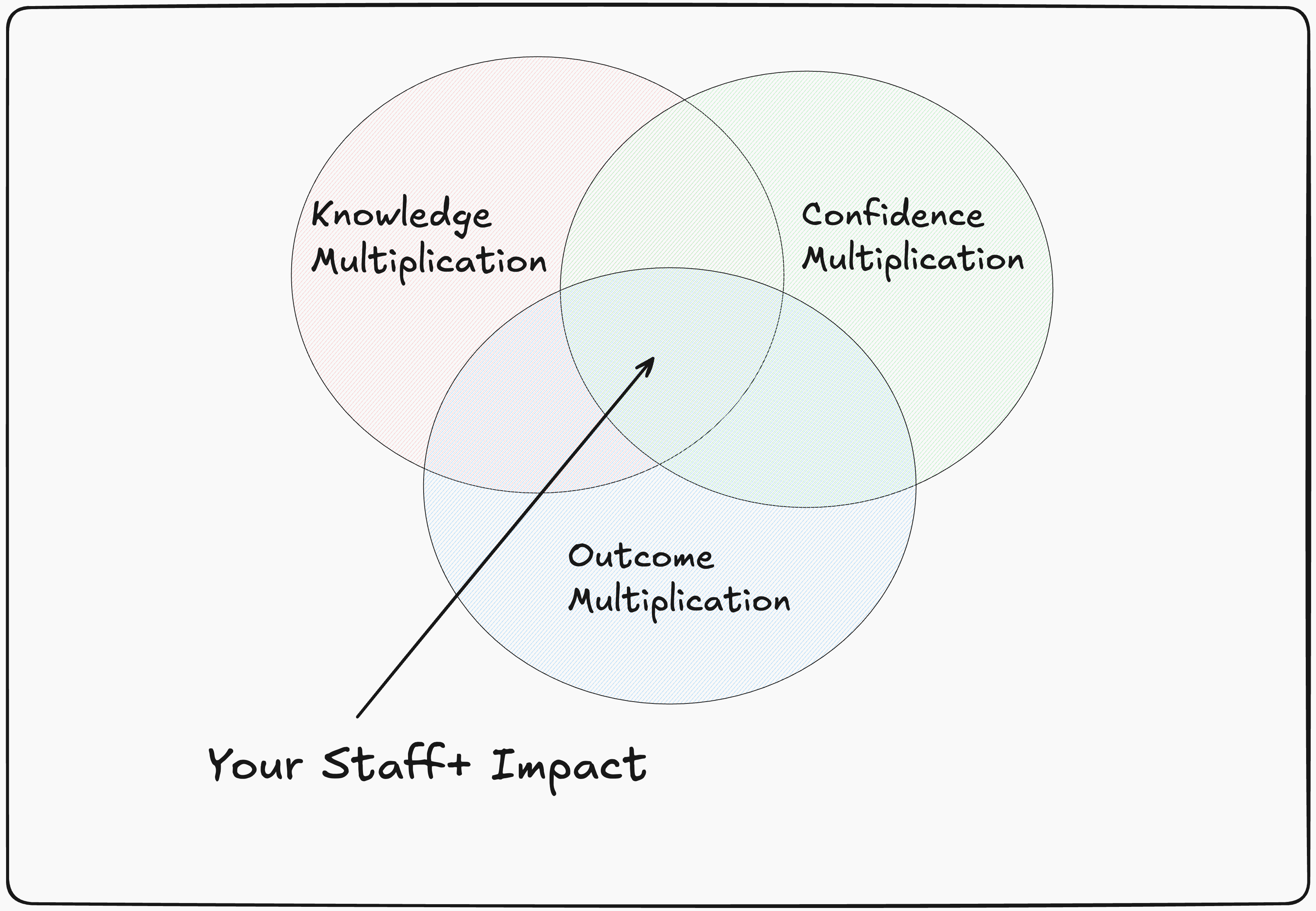
Output behaviors (in fact, almost all staff+ behaviors) really only have three types:
Behaviors where you multiply knowledge. Think teaching, documenting, explaining. When done right, these are called enabling behaviors. Tag them in your brag doc as “knowledge multiplication.”
Behaviors where you multiply confidence. Think unblocking, encouraging, championing. When done right, these are called empowering behaviors. Tag them as “confidence multiplication.”
Behaviors where you multiply outcomes. Think connecting, aligning, deciding. These are often strategic behaviors. Tag them as “outcome multiplication.”
Your impact lives at the intersection of all three.
Let’s talk more about each type of behavior, since they’re the core part of any staff+ practice.
Knowledge multiplication behaviors: Making expertise scalable
For instance, instead of being the person everyone asks about system architecture, you might write the design doc that answers everyone’s questions. Or run the working group that upskills five engineers. Or give the tech talk that changes how people think about the problem.
This is hard because it feels slower. Answering one question in Slack takes 30 seconds. Writing the doc takes 3 hours. But that doc serves 50 people over 6 months.
If someone might consistently ask you this then write it down! Your small investment will save everyone hours of repeated questions.
(Now, what’s to stop you from becoming the person who only writes docs and never codes? Well, that’s mostly an internal balance problem. You could imagine spending, say, 60% of your time on multiplication and 40% on direct contribution. Or using technical work as the research that informs better multiplication.)
Confidence multiplication behaviors: Making others braver
Despite being about confidence, these behaviors contain technical judgment.
Unlike pure cheerleading, which will feel hollow, they’re grounded in genuine belief in someone’s capability.
The essence of good confidence multiplication is helping someone do something they didn’t think they could.
So “you should present this at the architecture review” becomes: “Here’s why your design is solid. Here’s how I’d frame it. Here’s what questions might come up. You’ve got this and I’ll be there if you need backup.”
Some of these actions are strictly speaking unnecessary. You could just present it yourself. But they’re crucial for growth, so why not invest the time and let someone else shine?
Q: Wait! So if knowledge behaviors also involve judgment, and confidence behaviors also involve expertise, what’s the difference?
A: Glad you asked. Here’s what it boils down to:
Is the primary outcome that someone knows something new? Knowledge multiplication.
Is the primary outcome that someone feels capable of something new? Confidence multiplication.
That’s it. You’re welcome.
Outcome multiplication behaviors: Making the org move faster
These are the hardest to describe but easiest to feel. It’s when you:
Connect two teams who should be collaborating but don’t know about each other
Break a deadlock by asking the question that reframes the problem
Say “I think we should do X” and three projects shift direction because they trust your judgment
Write the strategy doc that gives everyone aligned clarity
Outcome multiplication behaviors change what happens, not just what people know or feel.
Here, as in so much staff+ work, you are spending your credibility freely. You are taking risks. You are also doing a macro form of leadership. Rather than waiting for permission, you’re stepping up when nobody asked you to.
Your time is expensive, your credibility is valuable. But hoarding them is not. You want organizational outcomes to improve — both tactically in terms of execution, and in terms of long-term strategy.
Step 3: How to Actually Practice This (Without Waiting for Permission)
Q: Wait! But I’m still senior. Can I practice these behaviors now? Won’t people think I’m overstepping?
A: Friend, this is the whole game. You don’t get promoted to staff+ and then start acting differently. You start acting differently, prove you can operate at that level, and then — maybe six months later, maybe a year later — someone says “oh hey, you’ve been doing staff+ work, let’s make it official.”
The title doesn’t change you. You change, and then the title catches up.
Q: But what if I fail? What if I try to influence and nobody listens? What if I write a doc and it goes nowhere?
A: Then you learn. Here’s a secret — staff+ folks fail at influencing ALL THE TIME. The difference is they keep trying. They iterate. They ask for feedback. They figure out what works in their specific org.
There’s no playbook that works everywhere. You have to experiment.
Start small. Practice one behavior this week.
Monday: Someone comes to you with a question. Instead of answering directly, ask them: “What have you tried? What are you thinking?” Help them think it through. (Knowledge multiplication)
Wednesday: Someone is nervous about their design review. Spend 20 minutes helping them prepare. Tell them what’s strong about their design. Role-play tough questions. (Confidence multiplication)
Friday: You notice two teams solving the same problem differently. Send one email connecting them. (Outcome multiplication)
None of this requires a title. None of this requires permission. All of it requires choosing to show up differently.
The Power of Compounding Behaviors
Here’s the beautiful thing: these behaviors reinforce each other.
When you multiply knowledge, people start asking you better questions.
When you multiply confidence, people start taking bigger swings.
When you multiply outcomes, people start involving you earlier.
Your influence grows. Your impact grows. Your scope grows.
And suddenly, maybe without even realizing it, you’re operating at staff+ level.
The promotion becomes a formality. The recognition of something you’re already doing.
Navigating the actual promotion process in your organization is a separate ball game. Perhaps a topic for another day!
The uncomfortable truth
This work is invisible until you stop doing it.
You won’t get immediate credit. You won’t have a commit to point to. You won’t have a metric that says “multiplied 5 people this week.”
The impact shows up later. When that engineer you mentored ships something great. When that team you connected collaborates successfully. When that doc you wrote prevents three teams from making the same mistake.
This is why most people don’t do it. It’s slow. It’s ambiguous. It’s hard to measure.
But it’s also the only way forward.
The Bottom Line
The senior engineers who become staff+ aren’t the most technical. They’re the most multiplicative.
They’re the ones who realized: the higher you go, the less it’s about what you know, and the more it’s about how you help others know.
Start this week. Choose one behavior. Show up differently. The rest will follow.
Big Tech Careers scholarship
Big Tech Careers Interview Preparation course is worth £299. I understand there might be other people who are genuinely interested in the course but cannot afford the full price and hence I’m announcing the Big Tech Careers scholarship.
If you genuinely can’t afford the course and you would like to access it, please fill out the scholarship request form. I will be selecting:
20 people for a 50% scholarship
5 people for a 75% scholarship
1 person for a 100% scholarship