

Imagine two professionals using the same AI tool for a similar task.
One gets a useful first draft in five minutes, makes a few improvements and moves on. The other spends twenty minutes refining prompts, correcting responses and trying again. Eventually, they end up with something they could probably have produced themselves.
The difference is not the tool. It’s how each person approached the problem before using it.
The first knew what they wanted, who the output was for and what a good result looked like. The second was still figuring these things out while interacting with AI.
This highlights an important reality.
Access to AI doesn’t automatically make someone better at their work. How they think and behave while using it makes the difference.
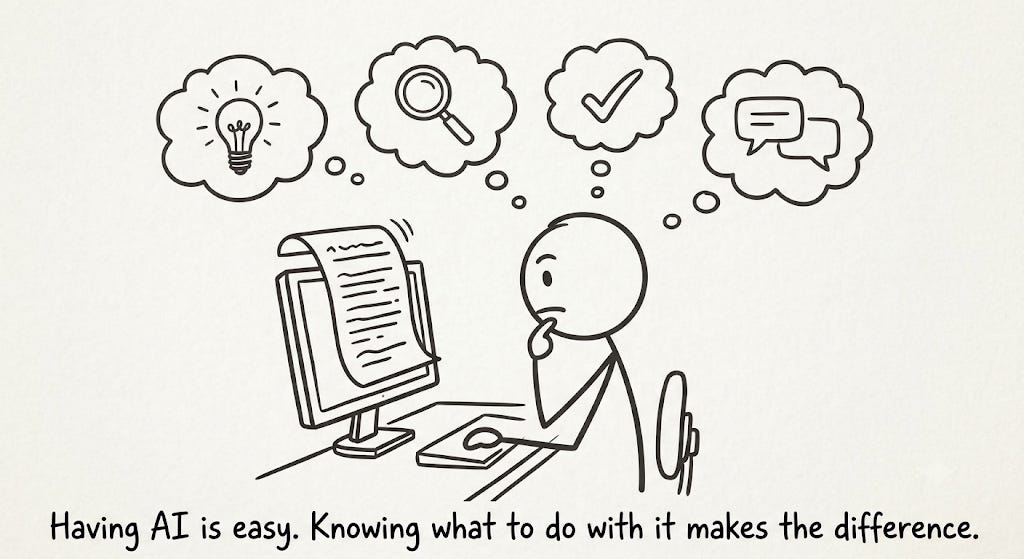
Why knowing the tool isn’t enough
It is relatively easy to develop basic AI skills. Most people will be able to create prompts, include context and improve their results using the tool in just a few weeks. But building expertise takes longer.
Once you’ve got a response from your AI, you will need to consider whether it is accurate, relevant and appropriate. You may need to explain it to a colleague, or give reasoning as to why you would recommend it, or make a decision.
While AI can speed up delivery, it does not absolve you of the responsibility.
The real question you should be asking is not “Can I use AI?” It’s “Can I be trusted with what AI produces?”
There are 4 behavioral skills that can help you answer this question.
1. Clear thinking: Understand the problem before asking AI to solve it
One common mistake is asking AI to solve a problem that hasn’t been properly defined.
Ask the AI to create a presentation on the performance of your team.
Do you want to cover the positives, explain a drop in productivity, find out what issues exist within operations or suggest improvements?
Depending on what you want it to do, it will approach the task in a different way. If you don’t have clarity, the AI will make assumptions which may produce a very polished result, but not actually solve any issues in your business.
Thinking clearly is key. Understand what the goal is, who it is for, any limitations and what a successful outcome looks like.
This is the same skill set that helps professionals create great project briefs, define requirements and ask the right questions in meetings. AI simply exposes unclear thinking much faster.
How to develop it: Before your next three AI-assisted tasks, write down the goal, audience, constraints and definition of done. If you cannot explain these clearly to a capable colleague, you’re probably not ready to delegate the task to AI either.
Sometimes, this exercise will reveal that you don’t need AI at all. That’s also effective adoption.
2. Judgment: Know when to trust and when to question
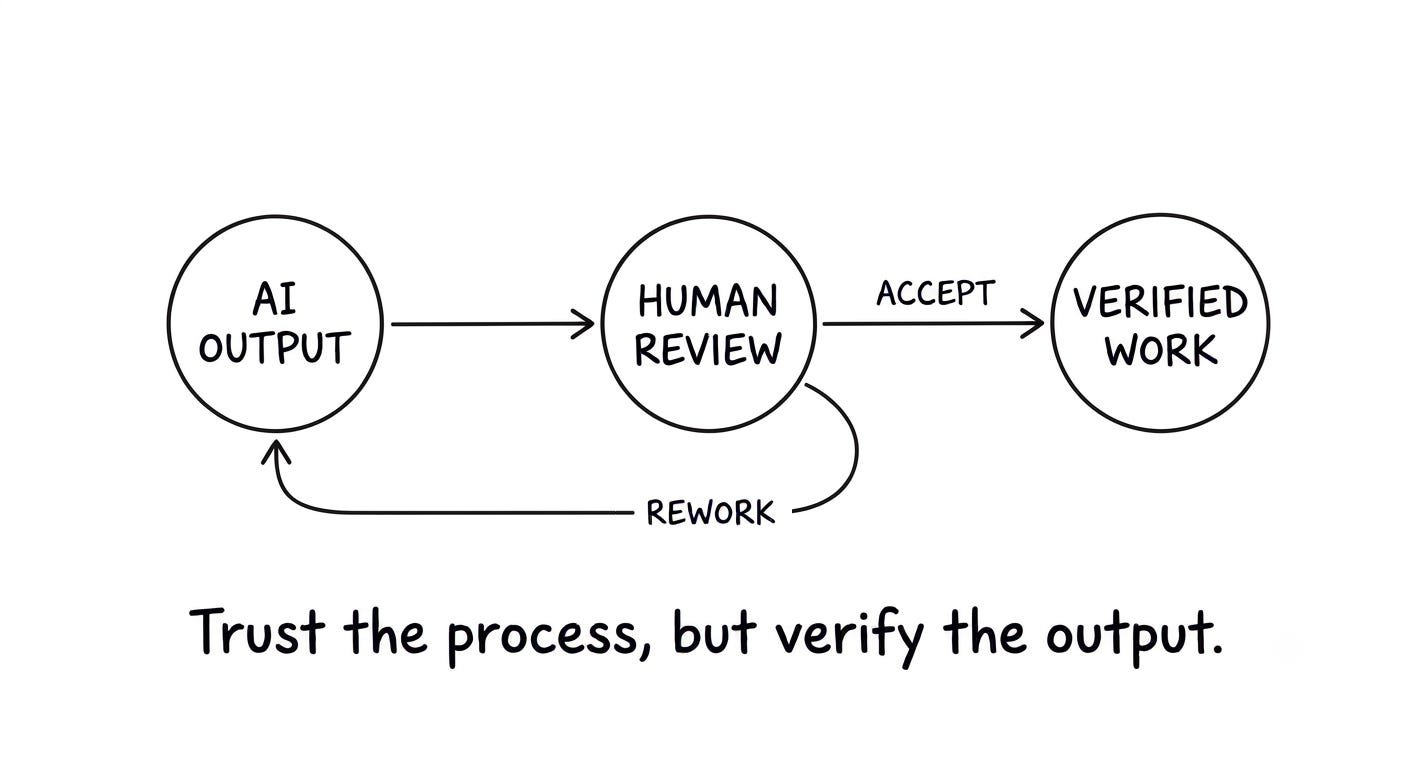
AI can sound equally confident when it’s right, partially right or completely wrong.
Some professionals accept its output because it looks convincing. Others distrust everything and spend so much time checking and rewriting that they lose the productivity benefit.
Both approaches reflect a lack of calibrated judgment.
Good judgment means understanding where verification matters most. An AI-generated meeting agenda may need relatively little checking. Financial figures, customer-facing recommendations, security-related code and legal interpretations deserve considerably more scrutiny.
This is where professional experience becomes valuable. An experienced finance professional can recognize questionable financial assumptions. A software engineer can identify generated code that works but introduces design or security problems.
AI doesn’t make domain expertise less important. It makes applying that expertise more important.
This is also where Human-in-the-Loop (HITL) becomes relevant. It emphasizes keeping human oversight and judgment involved in AI-assisted processes, particularly when decisions have significant consequences. AI can generate, analyze and recommend, but humans still need to review important outputs, challenge assumptions and make informed decisions.
How to develop it: Don’t just correct AI-generated mistakes. Understand why they happened. Was the information outdated? Did the AI make an assumption? Did you provide insufficient context? Or did you overlook something because the answer sounded convincing?
Before relying on an important AI-generated output, practice asking three questions:
What assumptions is this based on?
What could make this answer wrong?
What should I independently verify?
Over time, this reflection helps you recognize patterns and develop better judgment about when to trust AI and when to intervene.
The objective isn’t to question everything. It’s to question the right things.
3. Accountability: Take responsibility for the quality of AI-assisted work
Imagine presenting an AI-assisted business recommendation to your manager. When asked why you recommended a particular course of action, you respond, “That’s what the AI suggested.”
It’s unlikely to be a satisfying answer.
Using AI doesn’t transfer responsibility for the work to the tool. Whether you’re submitting code, preparing an analysis or presenting a recommendation, you remain accountable for the accuracy, quality and suitability of what you deliver.
AI makes producing work easier and faster. But generating something is not the same as understanding it.
Accountability also involves transparency. Explaining that AI helped structure an analysis and that you independently verified the figures demonstrates responsible use. Presenting unchecked output as your own thinking can damage trust when errors emerge.
How to develop it: Before sharing AI-assisted work, conduct a final quality check. Verify important facts, review assumptions and make sure the output meets the original requirements.
For code, understand what the solution does. For analysis, know the sources and assumptions. For recommendations, understand the reasoning, limitations and alternatives.
Ask yourself whether you could put your name to this work and be able to answer questions about how this was done. If not, you still have some work before sharing it.
4. Collaborative learning: Make AI adoption a shared effort
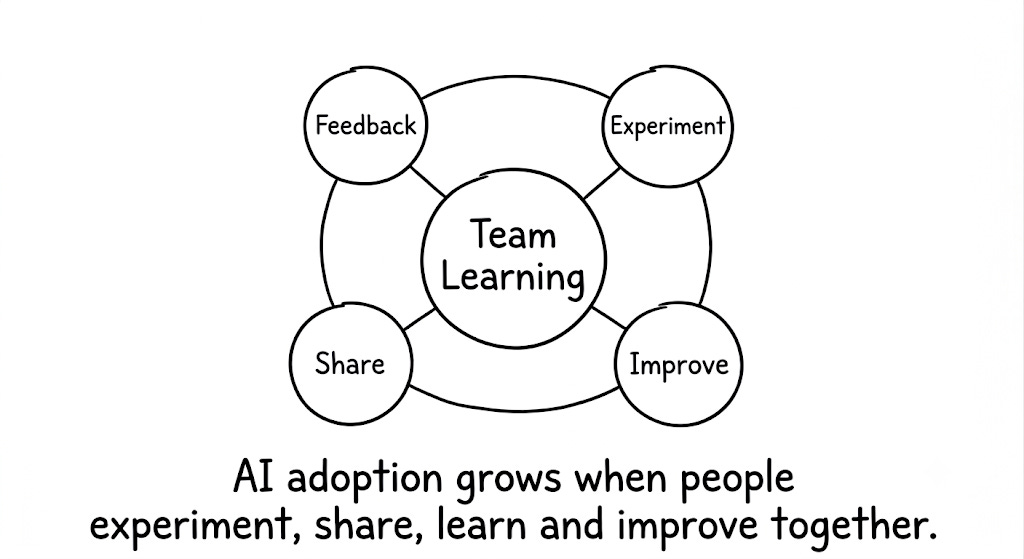
AI adoption is as much a team activity as an individual one.
Imagine someone discovers an AI workflow that saves several hours each week. If they keep it to themselves, the benefit remains individual. But if they share what worked, explain its limitations and encourage colleagues to experiment, the learning can spread across the team.
This requires more than a willingness to try new tools. It requires a willingness to learn from others, share experiences and accept that someone else’s approach may be better than your own.
Collaborative learning doesn’t mean everyone has to enthusiastically adopt every new tool. It means creating an environment where people can experiment, question, share mistakes and learn from one another.
It also means listening when colleagues raise concerns. Someone questioning whether customer information should be entered into an AI tool may be identifying an important privacy risk, not resisting change.
How to develop it: Make AI learning a two-way conversation with your team.
Share one practical observation each week: a workflow that saved time, an AI-generated mistake you caught or a task where you deliberately chose not to use AI.
But don’t stop at sharing your own experiences. Ask colleagues what they have discovered, what hasn’t worked for them and where they have concerns. Invite feedback on your own approach and be willing to change it when someone offers a better solution.
Small, honest exchanges of experience are often more useful than polished demonstrations.
The four skills work together
Consider two professionals with similar experience who are asked to prepare an analysis using AI.
The first accepts the AI-generated findings, uses the suggested recommendations and submits the report. The second clarifies the business question, checks the assumptions behind the analysis, verifies important figures and considers whether the recommendations make sense in the actual business context.
Both have used the same technology. Both may have completed the task faster.
But the second professional has done something more valuable: used AI to support their thinking rather than replace it.
The quality of the outcome depends on all four skills working together.
What this means for your career
As AI becomes part of everyday work, simply knowing which tools to use may become less useful as a way to distinguish yourself professionally. The bigger difference will be how effectively you combine technology with your own expertise.
Think about what organizations value in their people. They need professionals who can identify the right problems, make sound decisions, deliver reliable work and help others improve.
AI can support all these activities, but it cannot automatically develop these capabilities in the people using it.
A professional who uses AI to prepare an analysis, questions its assumptions, verifies the findings and communicates the implications clearly brings more value than someone who simply produces the analysis faster.
This also matters in interviews and career discussions. Instead of simply listing AI tools on your resume, think about situations where you used them responsibly: catching an error before it influenced a decision, questioning an AI-generated recommendation or helping a colleague adopt a useful workflow.
These examples demonstrate how you think, exercise judgment, take responsibility and work with others. Those capabilities matter regardless of which AI tool becomes popular next.
A question worth thinking about
In our previous newsletter, Critical Thinking Skills for Better AI-Powered Decisions, we discussed how critical thinking and decision-making can help us use AI more effectively. In this newsletter, we will take that a step further.
Knowing how to question AI and evaluate its answers is important. But effective adoption also depends on how clearly we define problems, how accountable we are for the work we deliver and how willing we are to learn with others.
Think about the last piece of work you completed using AI.
Did you define the problem clearly? Did you question the output? Could you explain and take responsibility for the result? Did you share anything useful with your colleagues?
Most of us are stronger in some of these areas than others. Recognizing that gap is a better starting point than chasing another tool or learning increasingly elaborate prompting techniques.
The real opportunity isn’t simply to get AI to do more of your work. It’s to become better at the work that still requires you.
Which of these four skills do you think professionals struggle with most: clear thinking, judgment, accountability or collaborative learning?
Share your thoughts in the comments. I read every response, and the discussion could be just as useful as the article itself.
See you next Thursday,
Prasad Rao
Hey, Prasad here. I’m the voice behind the weekly newsletter Big Tech Careers. I share practical strategies for Big Tech interviews, behavioral storytelling, technical careers, and professional growth every Thursday.
New to Big Tech Careers? Subscribe to join a tribe of 37k+ and level up alongside engineers and architects.