

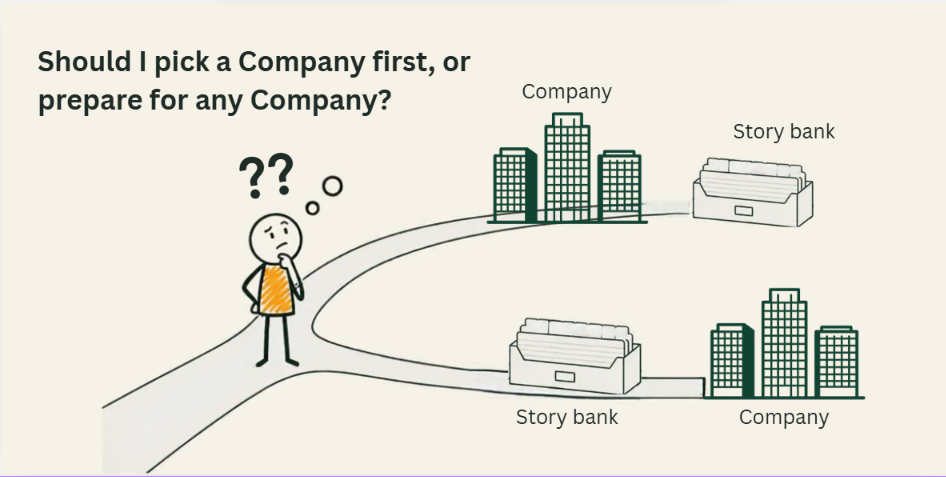
Every candidate that I coach asks a version of the same question early on: Should I prepare for the Big Tech company I’m interviewing with or prepare in a way that’ll apply to any company?
It seems like a binary you have to resolve before you start. It isn’t. I’ve seen candidates who spent three weeks reading Meta’s culture deck before writing a single story and candidates who built a story bank before figuring out what angle to take an interview at any company. The second group walked into interviews more prepared every time. Let me explain why and how they did it.
They prepared based on common themes rather than predicting every question they might get. They built a bank of stories that they could use for different questions. This way, when an interviewer asked them a question that they didn’t have a prepared answer for, they had a real-life example they could use instead of panicking and making something up.
Having a story bank is better preparation than company research. Company research will tell you what an interviewer is looking for, but it won’t give you anything to say. Three weeks spent poring over a culture deck leaves you knowing which qualities an interviewer is looking for but without any prepared experiences to cite. A story bank organized by theme gives you the proof and applies to whichever company you’re interviewing with. If that interview falls through and another company reaches out, nothing is wasted.
Before you start building those stories, though, take a few minutes to figure out where you stand and what you should work on first.
🚀 Start with our Interview Readiness Questionnaire
Based on your responses, you may also see the option to book a free 15-minute 1:1 call with me at the end. See you there!
🚀 Already know where you stand?
Then the cohort may be your next step. Big Tech Interviews: Build Your Story Bank in 4 Weeks starts October 16.
Over four weeks you’ll build your story bank, practice delivering it, and get feedback along the way.
🚀 Have questions before you enroll in the cohort?
Why prepare by theme
There are hundreds of behavioral questions a Big Tech interviewer could ask you.
Preparation for all of them is impossible, in my experience, and leads to memorizing a stack of answers that are inevitably forgotten in the middle of an interview.
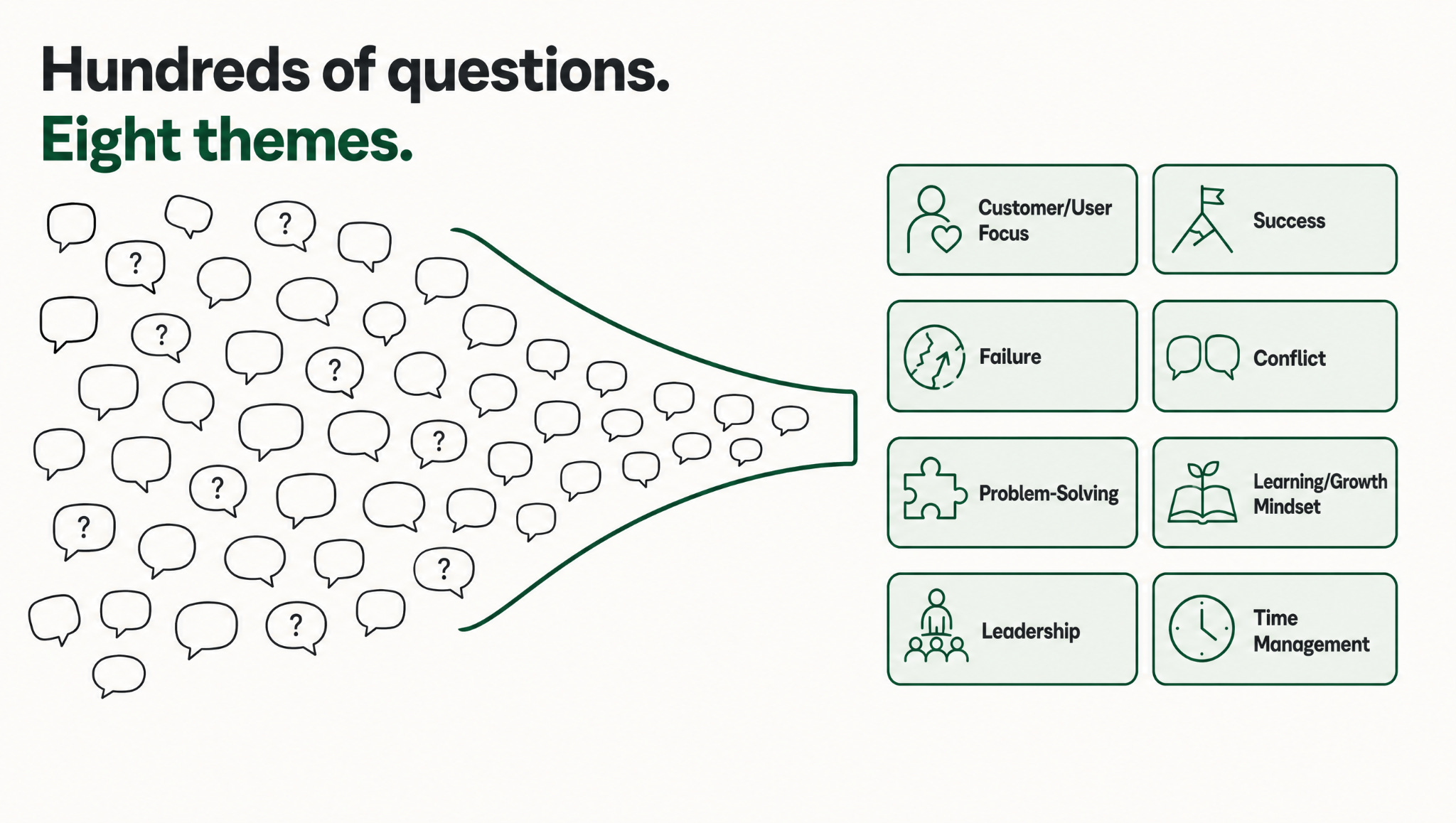
There is another approach, which is based on the fact that many questions in the Big Tech world have a common theme. If you have a solid answer for each theme, you can address any question that falls under it and get the interviewer to accept your response, even if they asked a question you’ve never prepared for. This is why the questionnaire is grouped by themes.
“Tell me about a time you disagreed with a teammate.” “Describe a difficult working relationship.” “How did you handle a colleague who wasn’t pulling their weight?” These three questions may sound different, but they’re getting at a similar skill: how you work through challenging situations with other people. One well-prepared answer to a seemingly random question can potentially serve as a response to all three.
These are the Past Experience / STAR (Situation, Task, Action, Result) stories from the three types of stories you should prepare before a Big Tech interview.
Organizing those stories by theme is what turns them into a useful story bank. It also helps with what happens after your first answer. As I covered in the last article on behavioral consistency, interviewers aren’t just listening to one story in isolation. They’re looking for patterns across your answers. That’s much easier to demonstrate when you have more than one strong story behind each theme.
The 8 behavioral themes and STAR response strategy
If you’ve read the earlier newsletters, these will be familiar. Here they are in one place for quick reference. The focus areas also work as prompts when you map your own experiences in the next step.
How to use the themes in your preparation
Build a story before a call
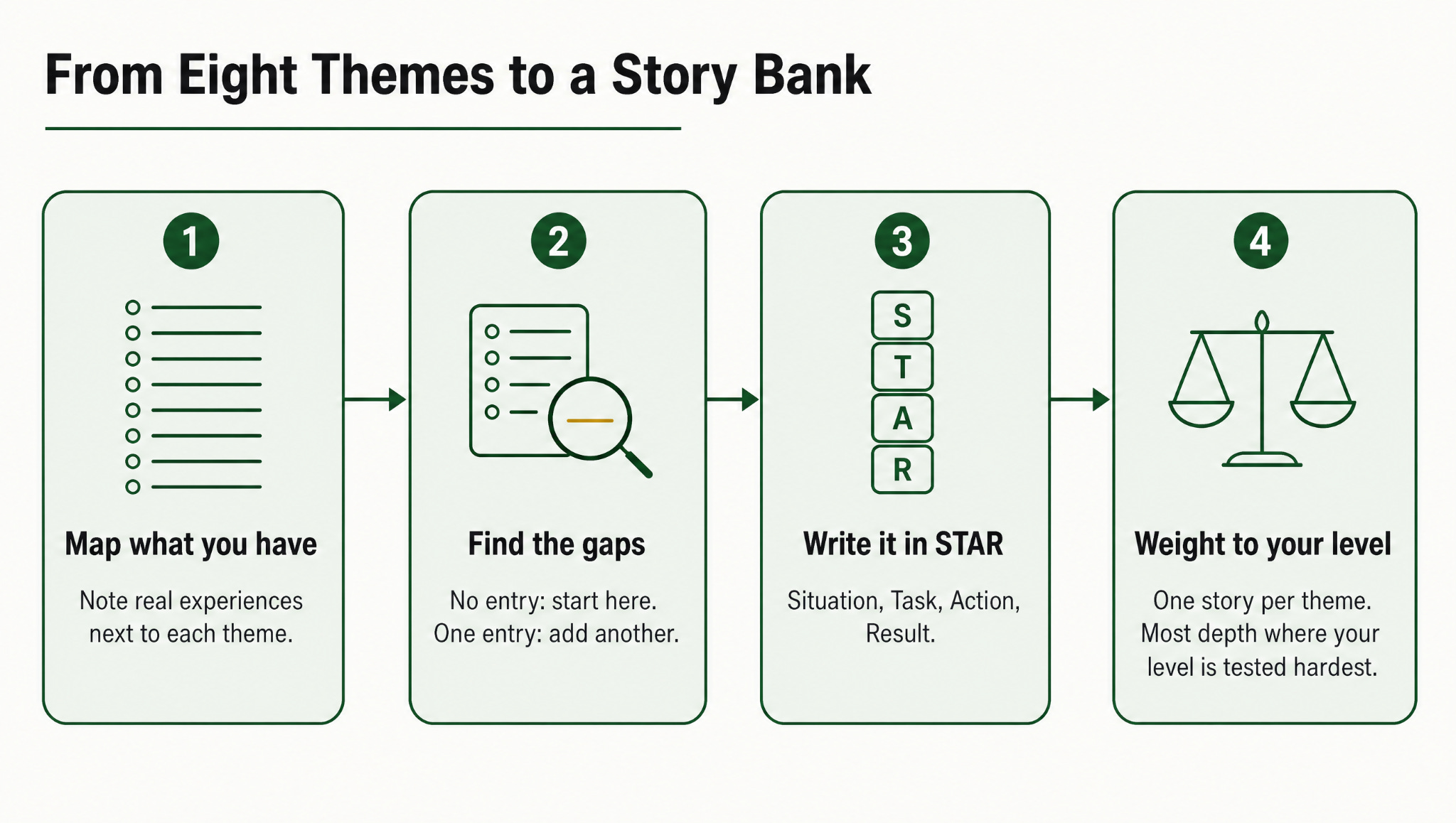
Start by mapping what you already have. Write down the eight themes, and next to them note the experiences you could turn into a story for today. One line per experience at this stage. Want a structure for the exercise? The questionnaire above guides you through for each theme.
The gaps will reveal themselves. An empty theme represents a story you need to prepare (or revisit). A theme with just one line is thin, since a follow-up question can always ask for another example.
Write each of these stories in STAR form: the Situation, the Task you were responsible for, the Action you personally took, and the Result. Most of the detail belongs in the Action. That’s where the interviewer learns how you think, and it’s often what candidates rush through.
Weigh all of that to your career stage, your role, and your level. Some themes will matter more to interviewers than others, and will need to have more stories attached. A staff engineer’s Leadership stories should be substantially different from someone two years into their first role. Keep at least one story for each theme, but put more depth into the ones that will be tested.
When Big Tech calls, calibrate. Don’t start over.
Once an interview with a specific company is confirmed, your story bank is your point of departure. Start with what the company has publicly said about how it thinks about its hiring and priorities. Match up those areas with your eight themes, decide which stories you’ll lead with, and deepen where the company is likely to press.
Say a company’s published values put a premium on the customer. Your Customer/User Focus stories move to the front of the queue, and if you only have one, finding a second becomes your priority in the coming week. The rest of the story bank remains as it is, since you can always be asked about any of the eight themes.
Since every theme already has at least one story behind it, you’re calibrating emphasis rather than starting from scratch. That’s a much calmer place to be in the final days before an interview, and it’s the advantage the second group had when they walked in.
Tell me in the comments: Which theme did you assume you had covered, until you tried to name a real experience for it? And which one feels hardest for your current role?
The best interviews feel more like conversations than interrogations. When you have thoughtful stories ready for each of these themes, you can have that conversation, whatever question opens it and whichever company is asking.
🚀 Start with our Interview Readiness Questionnaire
Based on your responses, you may also see the option to book a free 15-minute 1:1 call with me at the end. See you there!
🚀 Already know where you stand?
Then the cohort may be your next step. Big Tech Interviews: Build Your Story Bank in 4 Weeks starts October 16.
Over four weeks you’ll build your story bank, practice delivering it, and get feedback along the way.
🚀 Have questions before you enroll in the cohort?
Helpful Resources:
See you next Thursday,
Prasad Rao
Hey, Prasad here. I’m the voice behind the weekly newsletter Big Tech Careers. I share practical strategies for Big Tech interviews, behavioral storytelling, technical careers, and professional growth every Thursday.
New to Big Tech Careers?
Subscribe to join a tribe of 37k+ and level up alongside engineers and architects.